Most founders assume their SEO work carries over to AI search. It does not. ChatGPT, Perplexity, and Google's AI Overviews do not rank pages — they synthesize reputations. If your brand has not built a reputation that AI systems can read, you are invisible at the exact moment a buyer is forming their short list.
The painful part: AI search doesn't show "page 2." When the model answers "what's the best tool for X," it names two or three brands and stops. Everyone else gets zero. Your competitors who figured this out earlier are already being named. You are not — yet.
TL;DR — AI Visibility for Brands
- AI search engines recommend brands by reputation, not by ranking position, so traditional SEO alone is not enough.
- The brands that show up are consistently mentioned across trusted third-party sources: publications, forums, review sites, and expert commentary.
- Paid advertising still matters, but its primary AI benefit is building the signal density that language models pick up as evidence of legitimacy.
- Structured content — clear definitions, comparison tables, direct Q&A — is the format AI systems extract and cite most reliably.
- You can audit your current AI visibility in under 30 minutes using a handful of model prompts; the gap between where you are and where rivals are is usually visible immediately.
AI Discovery Is Not Search With a Different Interface
Classic search returns a list. The user does the choosing. AI discovery makes the choice for the user, then explains it. That distinction changes everything about how you need to show up.
When someone types "best project management tool for a 10-person agency" into Perplexity, the model doesn't retrieve ten blue links. It synthesizes what it has seen written about the category, weights sources by apparent authority, and produces a confident recommendation. The cited sources are visible — usually three to five of them — but the brand recommendation comes first.
The right frame is not "rank higher." The right frame is "be the brand that authoritative sources already describe favorably, repeatedly, and specifically." A single well-optimized product page does almost nothing. A pattern of credible mentions across independent sources does a great deal.
AI models weight third-party corroboration heavily. Your own blog is evidence that you exist. A respected industry publication writing about your specific use case is evidence that you are worth recommending. These are not equivalent signals.
What AI Systems Are Actually Reading
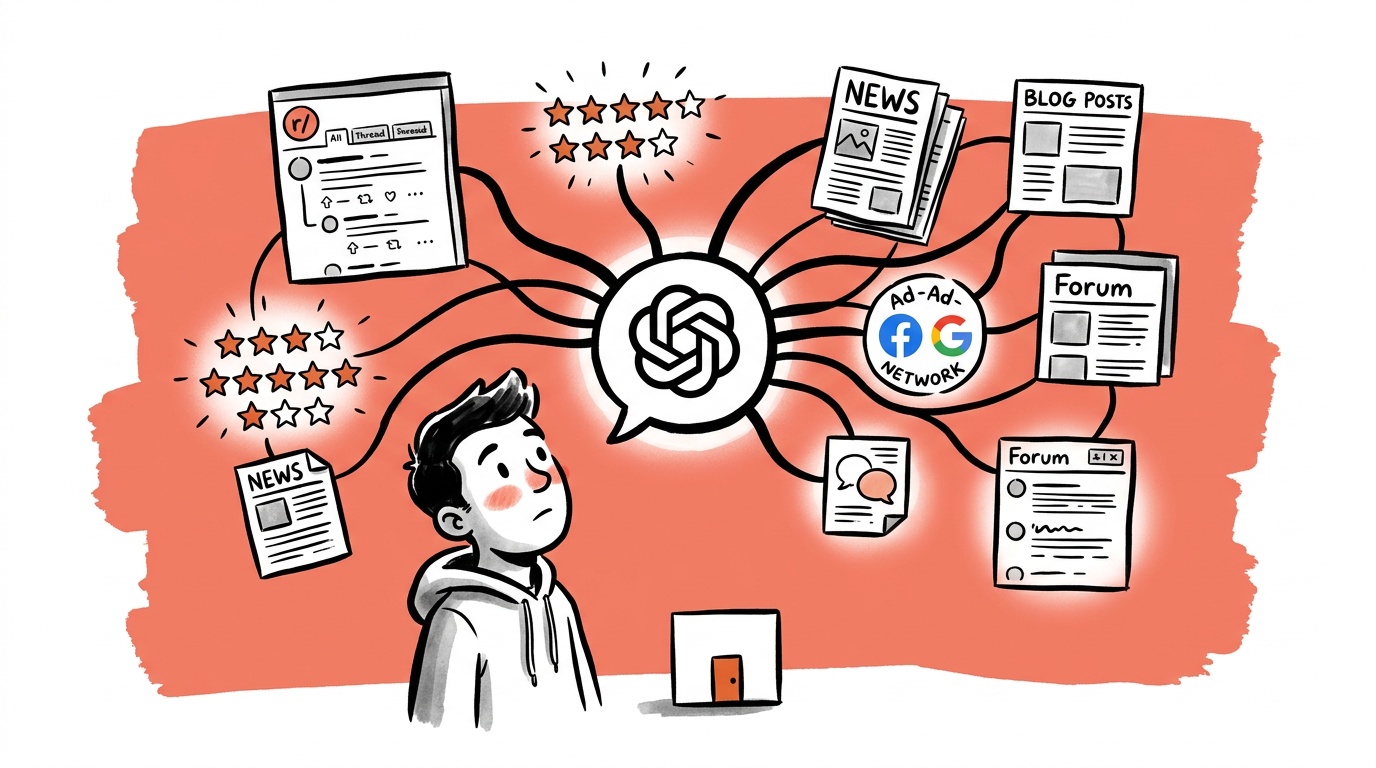
Language models are trained on text. After training, retrieval-augmented systems like Perplexity pull live web content. In both cases, the signal that lifts a brand above the noise is consistent, specific, third-party description.
The sources that carry meaningful weight, based on how these systems are built and what they consistently cite:
Independent editorial coverage. Industry publications, niche newsletters, analyst write-ups. Not press releases. Actual editorial coverage where a writer makes a claim about your product's performance or fit for a specific use case.
Community discussion. Reddit threads, niche Slack communities, product forums. AI systems read these heavily because they represent unsponsored opinion. A long, detailed Reddit post explaining how someone used your tool to solve a specific problem is exactly the kind of content a model surfaces when asked for real-world recommendations.
Review aggregators. G2, Capterra, Trustpilot, and their category equivalents. These are structured, crawlable, and trusted. A thin review profile is a visible gap.
Your own structured content — when it directly answers questions. If your site has a page titled "How [Your Product] handles X" and that page gives a clear, specific answer rather than marketing language, AI systems will cite it when X is asked about. Vague benefit statements get ignored. Exact answers get quoted.
The Paid Ads Connection Most Founders Miss
There is a widespread assumption that paid ads and AI visibility are separate problems. They are not.
Paid advertising — done correctly — accelerates the third-party signal accumulation that AI systems require. Here is the mechanism: ads drive traffic to content, content drives conversions, conversions drive reviews and community discussion, community discussion gets indexed and weighted by AI models. The loop is slow if you wait for it to happen organically. Paid ads compress the timeline. (We go deeper on what paid ads actually do in an AI-first funnel — remarketing and brand search, mostly.)
There is a second, more direct effect. Ad campaigns that generate strong engagement — saves, shares, meaningful click-through — contribute to the brand's footprint across the open web. Content that gets shared lands on third-party domains. Those third-party mentions are exactly what AI systems are reading.
This is not a reason to run ads carelessly and hope for spillover. It is a reason to design ad content that is worth sharing, that answers real questions, and that gives people something specific enough to repeat in a forum post or a review. Vague brand awareness campaigns produce vague brand awareness. Specific, useful ad content produces specific, useful third-party mentions.

Live today.
The full campaign — copy, images, targeting — generated for your site and deployed paused for your approval.
How to Audit Your AI Visibility Right Now
This takes under 30 minutes and produces a real picture of where you stand.
Step 1: Run the category queries. Open ChatGPT, Perplexity, and Google's AI Overview. Type the three to five queries your ideal customer would use when they don't know your brand yet — "best [category] tool for [your use case]," "alternatives to [dominant competitor]," "[problem] software for [your customer type]." Note every brand that gets named. Note whether you appear, how you are described, and whether any source is cited.
Step 2: Run the branded queries. Now search your brand name directly. What does the model say? Is the description accurate? Is it specific, or generic? Are the cited sources trustworthy? A vague description usually means the model has thin signal to work with.
Step 3: Run competitor branded queries. Do the same for your two or three main rivals. Compare the specificity and confidence of the model's description. This gap — between how confidently AI describes them versus you — is your visibility gap.
Step 4: Map the citation sources. For any brand the model cites with confidence, look at which sources it pulls. You are looking for the publication types and community venues your brand is absent from. That absence is your content gap. Our five-format audit — text, video, audio, structured data, third-party — is a quick way to see which channels are empty.
Most founders who do this exercise find that their competitors are being named in two or three places they have never appeared: a specific subreddit, one industry newsletter, a comparison article on a mid-tier publication. Those are actionable gaps, not abstract problems.
Building the Signal Infrastructure
Once you know the gaps, the work is straightforward — not fast, but straightforward.
Earn real editorial coverage. Pitch category-specific publications with a specific angle, not a press release. Editors of niche publications respond to data, contrarian takes, and stories about specific customer outcomes. A post on a respected industry blog that names your product in the context of a real use case is worth more for AI visibility than a hundred optimized product pages.
Show up in community discussions, honestly. Founders who participate authentically in the communities where their buyers spend time — answering questions, sharing real experiences, acknowledging limitations — build the kind of third-party mentions that carry weight. Promotional posts get ignored or deleted. Genuine participation generates the organic mentions that AI systems read as legitimacy signals.
Build your review profile intentionally. Ask for reviews at the moment of highest customer satisfaction. Make it frictionless. A thin review profile with a handful of old entries is a visible gap when a model is deciding whether to recommend you. A rich, recent review profile with specific use-case detail gives the model exactly the kind of structured, third-party evidence it needs. Prioritize reviews that name the exact problem your tool solves — generic five-star praise is far less extractable than "we switched from X because Y and now Z."
Structure your own content for extraction. Every important claim your brand makes should live on a page that answers a specific question directly, in the first paragraph, without preamble. AI systems extract content that gives clean answers. If your "how it works" page leads with a value proposition paragraph before getting to the mechanism, the model will often skip it. If it leads with the exact answer to the question the page promises to address, you get cited. The technical side of that — schema, crawler permissions, llms.txt — is covered in our GEO checklist.
Short declarative sentences. Specific nouns. Direct answers before explanation. Comparison tables with real data. FAQ sections with exact questions. These are the formats language models extract cleanly. Long paragraphs of brand voice prose are the formats they skip.
The Minimum Viable Signal Stack
If you are starting from close to zero and need to know where to spend the next 90 days, prioritize in this order:
- One comparison page on your own site — your product versus the two most-searched alternatives, with a real table, specific feature differences, and honest tradeoffs. This is the single highest-yield owned asset for AI citation.
- Recent, specific reviews on your primary aggregator — enough that a model querying your category sees current, use-case-specific language, not a sparse profile.
- One or two editorial mentions — a guest post, a product mention in a category round-up, or a data-driven pitch to a niche newsletter. The publication does not need to be large; it needs to be trusted within your category.
- One community thread where your product is discussed honestly — ideally started by a real customer, or a thread where you answered a question thoroughly and your product came up naturally.
That stack — comparison page, live reviews, editorial mention, community thread — is the floor for being citeable. Build from there.
The Competitive Window Is Real but Closing
Many categories still have a visible gap: one or two brands have accumulated meaningful AI visibility and the rest are absent. This gap is not permanent — it is compressing as more founders understand the problem — but it is real right now.
The brands that move first get a compounding advantage. A brand that has been mentioned specifically and favorably across a dozen credible sources for a sustained period is harder to displace than one that runs a fast-follower campaign later. This is not a reason to panic. It is a reason to run the audit this week rather than next quarter.
The gap between "invisible to AI" and "reliably recommended by AI" is usually not a content volume problem — it is a content placement and specificity problem. You may have one or two specific gaps that explain most of your invisibility. Either way, you cannot fix what you have not measured.
FAQ
What is AI visibility for brands? AI visibility refers to whether and how your brand is mentioned, described, and recommended by AI-powered search and discovery tools — including ChatGPT, Perplexity, Google AI Overviews, and similar systems. A brand with high AI visibility gets named when users ask category or problem-specific questions. A brand with low AI visibility is simply absent from those answers, regardless of its traditional search rankings.
How is AI search visibility different from SEO? Traditional SEO optimizes for ranking position in a list of results. AI search synthesizes a recommendation, typically naming one to three brands and explaining the reasoning. The signals AI systems weight most heavily are third-party mentions, community discussion, review platform data, and structured content that answers questions directly — not meta tags, domain authority alone, or keyword density. For a deeper look at how retrieval-augmented generation works in practice, Perplexity's own documentation is a useful primary source.
Why do some of my competitors show up in AI answers and I don't? The most common reasons: they have more editorial coverage in publications AI systems trust, they have a richer and more recent review profile on aggregator platforms, they are discussed more specifically in community forums, or their own content gives cleaner, more extractable answers to the questions buyers ask. The fastest way to know which gap applies to you is the audit described above.
Does running paid ads help with AI visibility? Indirectly, yes. Paid ads that drive traffic to specific, useful content accelerate the downstream effects — reviews, community discussion, third-party shares — that AI systems read as legitimacy signals. Ads alone, without the content infrastructure they point to, do very little for AI visibility. The combination matters.
How long does it take to build AI visibility? There is no universal timeline, but the work that tends to have the fastest impact is: earning one or two pieces of genuine editorial coverage in category-relevant publications, closing the review profile gap on major aggregators, and restructuring existing content to answer questions directly. Building a broad signal base across community platforms takes longer — typically six months to a year of consistent participation. The Google Search Central documentation on helpful content offers useful framing on what "quality" means to systems that feed into AI overviews.
Can I track whether I'm showing up in AI search? The most direct method is the manual audit described in this post: run your category queries across multiple AI tools regularly and track what you see. Several third-party tools are emerging that automate AI visibility tracking across major models, though the space is early and tool quality varies. At minimum, maintain a regular cadence of manual prompts — weekly if the category is competitive — so you notice changes before they become a crisis. SparkToro's research on zero-click search provides useful context on why the shift to AI answers is a continuation of a longer trend, not a sudden break.
What kind of content is most likely to get cited by AI systems? Content that gives a direct answer in the first sentence, uses specific rather than generic language, includes comparison or structured data, and addresses questions that real buyers actually type. FAQ sections, comparison tables, and case studies with specific outcomes are extracted far more reliably than narrative brand copy or long-form thought leadership that buries the answer. Write for the person who wants the answer in ten seconds, not the person who will read to the end.
Run the audit before you build anything. The gap you find will tell you exactly where to spend the next 90 days — and it will almost certainly be more specific, and more fixable, than "we need more content."
Live today.
The full campaign — copy, images, targeting — generated for your site and deployed paused for your approval.
We build AdControlCenter — AI-powered ad management for small businesses, online stores, SaaS companies and service providers. We write what we'd want to read: real numbers, no fluff, the things we wish we'd known when we started.
More from the team →