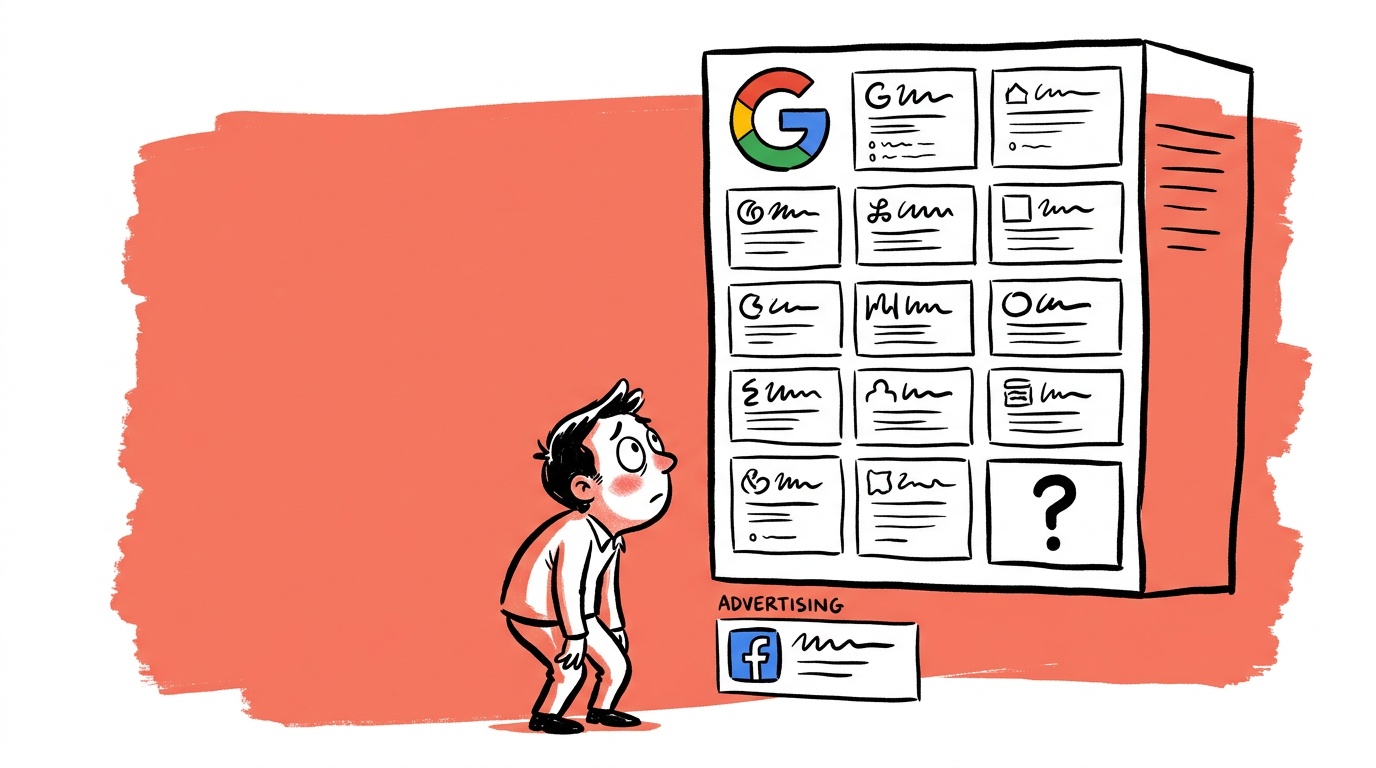
Google's AI Overview already answers many commercial queries without sending a single click to your site. If the model hasn't ingested enough signal about your business to trust you, you simply don't exist in that answer—no matter how much you're spending on ads below it.
That's not a future risk. It's happening right now, and most founders running paid search haven't adjusted their strategy to account for it. The click you're bidding on may sit three scrolls below an AI-generated paragraph that already told the buyer what to do.
TL;DR — AI Search Visibility in 2026
- Google's AI Overview synthesizes answers from sources it deems credible; if your brand has a thin digital footprint, you're excluded before the auction even starts.
- AI search and traditional search require different content strategies—short transactional pages rank in blue links, but long-form authoritative content feeds AI answers.
- Structured data, clear entity signals, and third-party citations are the three fastest ways to become "AI-legible."
- Paid ads still appear beneath AI Overviews, but those placements compete with an AI answer that may have already satisfied the query.
- Treating AI visibility as a separate channel—with its own content investment and measurement—is now a prerequisite for full-funnel health.
You're Being Evaluated by Two Different Species
You are now marketing to two fundamentally different species simultaneously. The first is a human buyer who scans, clicks, and converts on emotion and urgency. The second is an AI model that reads everything your brand has ever published, cross-references it against third-party corroboration, and decides in milliseconds whether you're a credible source worth surfacing.
Most ad strategy is built entirely for the first species. Landing pages are short. Copy is punchy. The goal is the click and the conversion. That's correct—for humans.
The AI model doesn't care about punchy. It cares about depth, consistency, and corroboration. A 200-word product page tells it almost nothing. A business with one Google Business Profile, a thin website, and no press mentions is essentially invisible to the model's trust layer, regardless of how good your ads are.
The practical consequence: you can win the paid auction and lose the informational moment that preceded it. The buyer already got their answer from AI Overview. By the time they see your ad, their consideration set is formed.
What Google's AI Actually Looks For
Google's AI systems pull from a web of signals to decide which businesses and claims are authoritative enough to surface. Understanding what's weighted helps you prioritize.
Entity recognition. Google needs to understand that your business is a real, distinct entity in the world—not just a domain. That means your brand name, location, category, founders, and products should appear consistently across your own site, your Google Business Profile, relevant directories, and third-party coverage. Inconsistency—different brand names, mismatched addresses, conflicting category descriptions—degrades entity confidence.
Depth and originality of content. Original research, detailed how-tos, and first-person experience are what get cited. Generic copy and short pages don't generate the signal the model uses to build its answer.
Third-party corroboration. This is the signal most founders skip entirely. It's not enough for your own site to say you're an expert. The model looks for other credible sources that agree—press coverage, industry directories, review platforms, podcast appearances, backlinks from authoritative domains, social proof that exists off your own properties.
Structured data. Schema markup (Organization, Product, FAQ, HowTo) gives the AI a machine-readable summary of who you are and what you do. Without it, the model has to infer from unstructured prose, which is slower and less reliable.
Entity recognition isn't something you fix in a week. The signals—consistent NAP data, third-party mentions, structured markup—accumulate over months. Start now, because the brands that invested in entity building earlier are already appearing in AI Overviews ahead of you.
Why Your Paid Ads Don't Solve This
There's a tempting assumption that if you're running Google Ads, Google knows you exist. That's true in a narrow sense—your ads run through their system. But paid ads don't directly feed the entity graph or influence what the AI cites in an Overview.
The AI Overview is generated from organic signals. Your ad spend tells Google you're a buyer in their auction. It doesn't tell the AI model that you're an authoritative source on your category.
This creates an expensive gap. You can have a healthy paid search account and zero AI presence simultaneously. Every dollar you spend on bottom-funnel search clicks competes in a world where the AI has already shaped the buyer's intent at the top of the page. If your brand wasn't part of that shaping, you're playing defense from the first impression.
The better approach is to treat AI visibility investment as a prerequisite cost of paid search—similar to how landing page quality became a prerequisite once Quality Score started penalizing bad experiences. Weak organic and entity signals will increase your effective cost per acquisition even if your direct keyword bids are competitive, because you're paying to reach buyers who already formed their consideration set without you.

Live today.
The full campaign — copy, images, targeting — generated for your site and deployed paused for your approval.
The Content Gap Most Founders Have
When we look at accounts where paid performance has softened despite stable bidding and budgets, a common pattern appears: strong ad creative, poor content depth. Good conversion rate optimization at the bottom of the funnel, but nothing that earns AI citations at the top.
What does AI-citation-worthy content look like?
- Long-form, specific, and opinionated. Not "everything you need to know about X" written at surface level. Actual positions, tested conclusions, real data.
- Answering the exact question the searcher is asking. If your content directly answers a specific question—and does it better than competing sources—it's a candidate for citation.
- First-person experience signals. Content that says "when we tested this" or "we found that" carries more weight than generic declarative statements. The Google Search Quality Evaluator Guidelines explicitly call out Experience as a component of E-E-A-T, the framework guiding how quality is assessed.
- Regularly updated. Stale content depreciates. A post last updated in 2021 is a weaker citation candidate than one updated this quarter.
Volume matters too. One great post doesn't build an AI presence. A consistent body of work across your core topics does. Content investment needs to be treated as a program, not a project.
A Quick AI Visibility Audit
Before investing in new content, run this diagnostic on what you already have. Most businesses find two or three obvious gaps within an hour.
Entity layer
- Is your business name spelled identically across your website, Google Business Profile, and every major directory listing?
- Does your Google Business Profile have a complete category, description, hours, and at least one verified photo?
- Does your homepage carry Organization schema with your legal name, URL, logo, and contact point?
Content layer
- Do you have at least one long-form page that directly answers each of your top three buyer questions—not just mentions the topic?
- Are those pages marked with the publication date and a clear last-updated date?
- Do any of your pages include first-person testing notes or original conclusions, or are they generic explainers?
Off-site corroboration layer
- Does your brand appear in at least one industry directory relevant to your category (G2, Capterra, Trustpilot, or a vertical equivalent)?
- Has any third-party publication—trade press, newsletter, podcast—mentioned your brand by name in the last 12 months?
- Do you have external backlinks from domains that independently cover your category?
If you answered "no" to more than half of these, entity cleanup and off-site corroboration are higher-return starting points than publishing more content.
Practical Steps to Become AI-Legible
Here's what we'd prioritize if we were starting from zero today.
1. Clean up your entity signals first. Audit every place your business name, address, and category appear online. Make them consistent. Claim your Google Business Profile and fill every field. Submit to relevant industry directories. This is the unglamorous work that unlocks everything else.
2. Add structured data to every page that deserves it. Organization schema on your homepage. Product schema on product pages. FAQ schema on any page with questions and answers. HowTo schema on tutorial content. Use Google's Rich Results Test to verify it's reading correctly.
3. Build topical authority in your category. Pick the three to five questions your buyers ask most often and create the best answer on the internet for each one. Not the longest—the most specific and most useful. Then build supporting content around each.
4. Earn off-site mentions actively. Pitch trade press. Appear on podcasts. Get listed in category-specific review platforms. Submit to relevant newsletters that publish roundups. Each external mention is a corroboration signal.
5. Build a real FAQ infrastructure. AI systems favor direct Q&A formats because they map cleanly onto query intent. Add a genuine FAQ section to your most important pages, written in the exact language your buyers use—not internal jargon.
6. Measure separately. Your paid search dashboard won't show you AI visibility. Track your branded and category queries in Google Search Console, watch for impressions without clicks (a sign that an AI answer is intercepting demand), and monitor which queries you're appearing for in AI-generated results using manual spot checks.
How This Changes Full-Funnel Ad Strategy
When AI handles more of the informational top-of-funnel, the buyers who reach your paid ads are often further along in their decision. That sounds useful—more intent, easier conversion. The real situation is harder: the buyer has already formed a shortlist without your input, and you're being evaluated against a frame you didn't set.
The brands that fed AI systems good information earlier shaped that frame. Your ad now has to overcome a prior belief rather than introduce your value for the first time.
This shifts the creative job. Bottom-funnel paid ads need to address specific objections and comparison points, not just generate awareness. If AI told the buyer "the top options in this category are A, B, and C" and you're not in that list, your ad copy has to work much harder to reopen the consideration set.
Google's own documentation on AI Overviews confirms that these summaries prioritize sources that demonstrate Experience, Expertise, Authoritativeness, and Trustworthiness—the E-E-A-T framework that's been in their quality guidelines for years but now has direct product consequences. Paid spend doesn't substitute for it.
The implication for budget allocation: a consistent investment in content and entity-building is now part of the real cost of running paid search effectively. It doesn't replace ads. It makes ads work better by ensuring the brand exists credibly in the informational layer above them.
FAQ
What is AI search visibility? AI search visibility refers to whether your business is recognized and cited by AI-powered search features—like Google's AI Overview—when a potential buyer asks a relevant question. Unlike traditional SEO, which is about ranking in blue links, AI search visibility is about being included in the synthesized answer the model generates at the top of the results page.
How does Google's AI Overview decide which businesses to cite? Google's AI Overview draws on organic web signals, not paid ads. It prioritizes sources that demonstrate E-E-A-T: Experience, Expertise, Authoritativeness, and Trustworthiness. Practically, that means businesses with consistent entity signals, deep original content, third-party corroboration, and structured markup are more likely to be cited than those without.
Does running Google Ads improve my AI search visibility? No. Paid ads and AI Overview citations are separate systems. Running ads tells Google you're a bidder in their auction. It doesn't influence the organic entity graph or the model's citation decisions. You need to invest in organic signals—content depth, structured data, external mentions—to appear in AI-generated answers.
What content performs best for AI citation? Long-form, specific, opinionated content that directly answers a question a buyer is asking performs best. First-person experience signals, original data or conclusions, and regularly updated material all increase citation likelihood. Generic or thin content—even if it ranks for some keywords—rarely gets cited in AI Overviews.
How do I know if AI is intercepting my search demand? Check Google Search Console for queries where your impressions are high but click-through rates have dropped significantly. This pattern often indicates an AI-generated answer is satisfying the query before the buyer reaches your listing. Segment your category queries and watch the impression-to-click ratio over time.
What is structured data and why does it matter for AI visibility? Structured data is machine-readable markup (typically Schema.org vocabulary) added to your web pages that explicitly tells search systems who you are, what you sell, and what your content covers. For AI systems that have to infer meaning from unstructured prose, structured data is a shortcut that improves the accuracy and confidence of their representation of your business.
How long does it take to build AI search visibility? Entity signals and content authority accumulate over months, not days. A realistic horizon for seeing meaningful improvement in AI citation frequency is several months of consistent investment—cleaning up entity data, publishing depth content, and earning off-site mentions. Starting earlier compounds; every month of delay is a month the competition is building signal you're not.
The most honest question to close with: if a buyer typed your core category into Google right now and read only the AI-generated answer at the top of the page, would your brand be in it? If you're not sure, that uncertainty is the gap worth closing before you add another dollar to your bidding budget.
Live today.
The full campaign — copy, images, targeting — generated for your site and deployed paused for your approval.
We build AdControlCenter — AI-powered ad management for small businesses, online stores, SaaS companies and service providers. We write what we'd want to read: real numbers, no fluff, the things we wish we'd known when we started.
More from the team →