
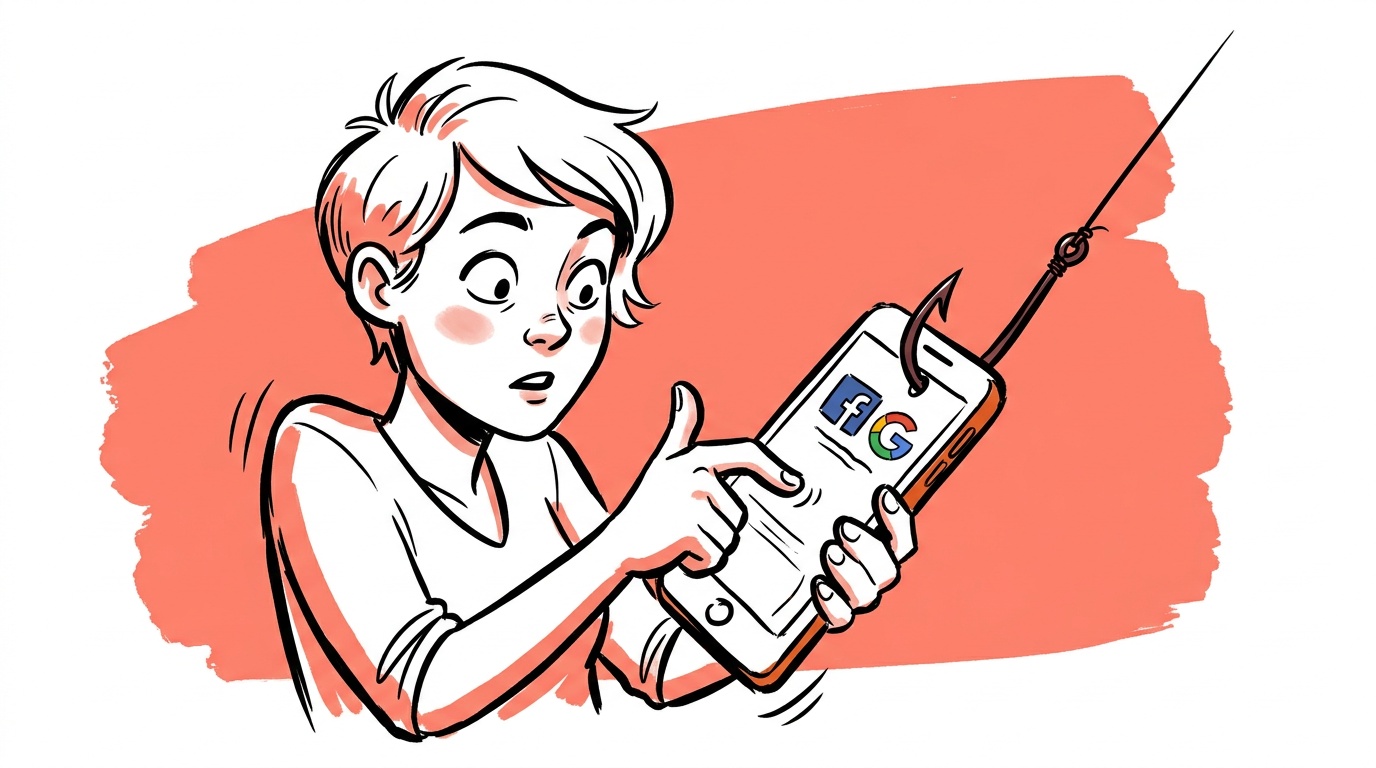

Most founders blame the algorithm when their ads stop converting. They rotate creatives, tweak audiences, cut bids. The real problem is usually simpler and harder to fix: every ad reads like it was written by a different person who had never met the company before. The prospect sees your Facebook ad, clicks to a landing page, and the voice shifts. They read your retargeting copy and the tone shifts again. Their brain registers the mismatch before they consciously notice it, and they leave.
That mismatch is not a brand exercise problem. It is a direct-response problem. It costs you money on every impression.
TL;DR — Why inconsistent messaging kills ad performance
- Audience trust is built through repetition of a recognizable voice, not repetition of a logo. When your ads break that pattern, clicks become expensive and conversions drop.
- "Owning an idea" — returning to the same core message across every touchpoint — is what separates brands people remember from brands people scroll past.
- Inconsistent messaging fragments your frequency. The algorithm thinks it's showing your brand for the first time when it isn't.
- The fix is not a style guide. It is a decision about what one idea you want to be associated with, and then the discipline to say only that.
- Audit your last 30 days of ad copy against your landing pages and organic content. If a stranger couldn't tell they came from the same company, you have a messaging problem, not a targeting problem.
The Trust Tax You Pay Every Time Your Voice Shifts
A pattern shows up repeatedly in accounts with poor conversion efficiency: high click-through rates paired with low post-click conversion. (We diagnose the full funnel version of this in high CTR, zero sales.) The creative is getting the click. Something after the click is killing the sale.
In most of those cases, the ad copy has a different register than the landing page. The ad is punchy, informal, and specific. The landing page is polished, generic, and written in the third person. The prospect's subconscious files that as a discrepancy — and discrepancy reads as risk.
This is what we mean by the trust tax. Every time your messaging voice shifts between touchpoints, you force the prospect to re-evaluate whether they're in the right place. That re-evaluation takes energy. Most people resolve the question by leaving.
It doesn't matter whether your brand is formal or casual. What matters is that it's the same across ad, click, and close. A startup can be buttoned-up across every surface and still convert well. The damage comes from switching registers mid-funnel, not from choosing the wrong register.
Owning an Idea vs. Writing Posts
One of the clearest frameworks we've encountered for this problem comes from a talk on content strategy that draws a sharp line between creators who "write posts" and creators who "own ideas." The argument is that most brands produce content as a series of disconnected outputs — each post, each ad, each email is optimized in isolation. The audience never accumulates a clear sense of what the brand stands for because the brand never says the same thing twice.
Contrast that with a brand that has one clear idea it returns to obsessively. Every ad is a restatement of that idea in a new format. Every landing page is an elaboration of it. Over time, the audience builds a mental model of the brand, and each new touchpoint confirms that model instead of disrupting it.
This matters for paid ads in a concrete way: when your messaging is that coherent, your frequency works for you. The second and third impression of your ad compound the first instead of canceling it. The prospect who saw your ad last week and didn't click is more likely to convert this week because the message reinforced itself.
When messaging is inconsistent, frequency works against you. The prospect sees what feels like a new, unrelated brand on every impression. You're paying to reach the same person multiple times without getting any of the trust that repetition should build.
Why Style Guides Fail Founders
The standard advice is to write a brand voice guide. Adjectives, tone words, do/don't columns. Most founders write one, put it in a Notion doc, and find that their ad copy is still inconsistent six months later.
The reason style guides fail is that they describe how to write but not what to say. A guide that tells you to be "direct, warm, and expert" doesn't help a contractor at 10pm figure out whether this week's ad should lead with a problem, a stat, or a provocation. So they pick whatever feels right in the moment, and the result diverges from the last ad, which diverged from the one before it.
The fix is not a better style guide. The fix is a single, specific idea — a sentence, not a paragraph — that every piece of content is trying to communicate. Not a tagline. Not a value proposition. A point of view that is interesting enough to defend and specific enough to be wrong.
We tested this operationally by requiring ad writers to annotate each creative with the core idea it expressed before submitting for review. The annotation wasn't used for anything except forcing the writer to state the idea explicitly. That single forcing function was enough to surface most of the drift — writers caught their own inconsistencies before the creative went live, because putting the idea in writing made the mismatch obvious.

Live today.
The full campaign — copy, images, targeting — generated for your site and deployed paused for your approval.
How Messaging Drift Happens at Scale
Most messaging inconsistency is not strategic failure. It is a production problem. It happens because:
Different people own different surfaces. The person writing ad copy is not the same person who built the landing page or writes the newsletter. Each one has a slightly different internal model of the brand, and no one is reconciling the drift.
Speed kills coherence. When you're shipping a new campaign every two weeks, there is rarely time to re-read the last campaign before writing the new one. Each creative gets made in isolation.
Iteration fragments the voice. A/B testing is how good marketers improve performance. But when you test headline against headline without anchoring both to the same underlying message, you can accidentally optimize toward a voice that converts in the short run but doesn't reinforce the brand in the long run.
This talk on building an audience through content points to a related dynamic: brands that treat each piece of content as a standalone performance end up with an audience that never accumulates. Followers don't stick because there's no "thing" to follow. The same is true for ad audiences — prospects who see your ads but can't form a coherent impression of what you do are unlikely to convert on the third impression the way they would if the first two had given them a consistent frame.
What Consistency Actually Looks Like in Practice
Consistent messaging is not repetition of the same ad. It is repetition of the same angle through different executions. Here's what it looks like when it's working:
- Your top-of-funnel ad identifies a problem your prospect has but hasn't named yet. Your retargeting ad names the same problem and explains why you solve it differently. Your landing page opens by restating that problem in the prospect's own language.
- The tone across all three is the same: if the ad is dry and specific, the landing page is dry and specific. If the ad uses humor, the landing page uses humor.
- The enemy in all three pieces is the same. Good brand messaging often has an implicit villain — the old way of doing things, the conventional wisdom, the incumbent solution. When that enemy is consistent, the prospect's journey through your funnel feels like a coherent argument being made, not a series of separate pitches.
This is harder than it sounds at speed. The practical tool we use is a creative brief that requires three fields before any copy is written: the one idea, the enemy, and the desired emotional state at the end. Not a full brief — just those three. When the brief is consistent across ad, landing page, and email, the voice tends to follow.
A Simple Consistency Check Before You Launch
Before any campaign goes live, read the ad, the landing page, and the first follow-up email in sequence — out loud, if you can. Then answer three questions:
- Do all three pieces name the same problem?
- Do all three pieces point at the same enemy or old way of doing things?
- Would a stranger reading them back-to-back recognize the same voice?
If any answer is no, you have found exactly where the funnel leaks. Fix that surface before you touch targeting or bids. This check takes ten minutes and costs nothing. Most teams skip it because it feels like a brand exercise. It isn't — it's a conversion exercise.
The Audit You Should Run This Week
Pull every active ad, its destination landing page, and the most recent email or organic post from the same campaign. Read them in sequence as if you were a prospect encountering the brand for the first time.
Ask:
- Could a stranger tell these came from the same company without seeing the logo?
- Does each piece reinforce the same core idea, or do they each make a different argument?
- Does the tone shift at any point in the sequence?
If the answer to the first question is no, you have a production problem. If the answer to the second is "different arguments," you have a strategy problem. If the answer to the third is "yes, the tone shifts," you have a personnel or briefing problem. And if the voice is consistent but conversions still lag, the problem may sit above the ads entirely — see your ads aren't broken, your brand is.
The audit takes less than an hour. Most founders who run it find at least one place in the funnel where the voice breaks. That break is where budget is leaking.
Platform algorithms optimize for engagement and conversion signals. If your ad gets the click but the landing page doesn't convert, the algorithm correctly concludes your ad is lower quality than it looks — and raises your effective CPM. Consistent messaging is not just a brand concern. It feeds directly into your Quality Score, your relevance diagnostics, and your cost per acquisition. The Google Ads documentation on Ad Relevance is explicit about this: post-click experience is a scored component, not a soft signal.
FAQ
What does "consistent brand voice" mean for paid ads specifically? It means the tone, register, and core argument in your ad copy match what the prospect finds when they click through. Consistent brand voice is not about using the same adjectives everywhere — it's about making sure the implicit promise in your ad is the same promise your landing page delivers on.
Why does messaging inconsistency hurt conversion rates? When the voice or argument shifts between your ad and your landing page, prospects experience a subconscious mismatch. That mismatch signals risk. Most people resolve that signal by leaving rather than converting. The click happened because they trusted the ad; the bounce happened because the landing page broke that trust.
How many ad touchpoints does it take before messaging inconsistency becomes a real problem? It's a problem from the first inconsistency. A prospect who sees your ad, clicks to a landing page with a different tone, and then receives an email with a different argument has been given three different brands to evaluate. Most will not do that work.
Can you A/B test ad creative without creating messaging inconsistency? Yes, if both variants express the same core idea. Testing a short headline against a long one is fine. Testing a problem-first angle against a benefit-first angle while keeping both anchored to the same underlying claim is fine. Testing two entirely different value propositions against each other fragments your brand in ways that are hard to undo.
What is the fastest way to fix inconsistent messaging without rewriting everything? Start with your highest-spend ad and its destination landing page. Write a single sentence that describes the one idea the ad is expressing. Then check whether the landing page opens by expressing the same idea. If it doesn't, rewrite the opening of the landing page. That single fix, applied to your top-spend creative, will have more impact than any style guide.
Does brand voice consistency matter more at the top of the funnel or the bottom? It matters most at the transition points — ad to landing page, landing page to retargeting ad, retargeting ad to email. Those are the moments where a mismatch breaks the thread. Top-of-funnel creative has more latitude for experimentation; bottom-of-funnel creative should be extremely consistent with what the prospect saw earlier in the sequence.
How does messaging inconsistency affect ad platform Quality Scores? Most platforms use post-click behavior — time on site, conversion rate, bounce rate — as signals of ad relevance. When inconsistent messaging inflates your bounce rate, the platform interprets your ad as lower quality than its CTR suggests and adjusts your costs accordingly. Consistent messaging that holds the prospect through the landing page directly improves your relevance score and lowers your effective cost per click.
Run the audit before you touch targeting or bids. If the voice breaks anywhere between ad and close, fix that first. You cannot spend your way past a prospect's distrust — but you can earn their trust back with a message that reads like it was written by one person who knew exactly what they wanted to say.
Live today.
The full campaign — copy, images, targeting — generated for your site and deployed paused for your approval.

We build AdControlCenter — AI-powered ad management for small businesses, online stores, SaaS companies and service providers. We write what we'd want to read: real numbers, no fluff, the things we wish we'd known when we started.
More from the team →