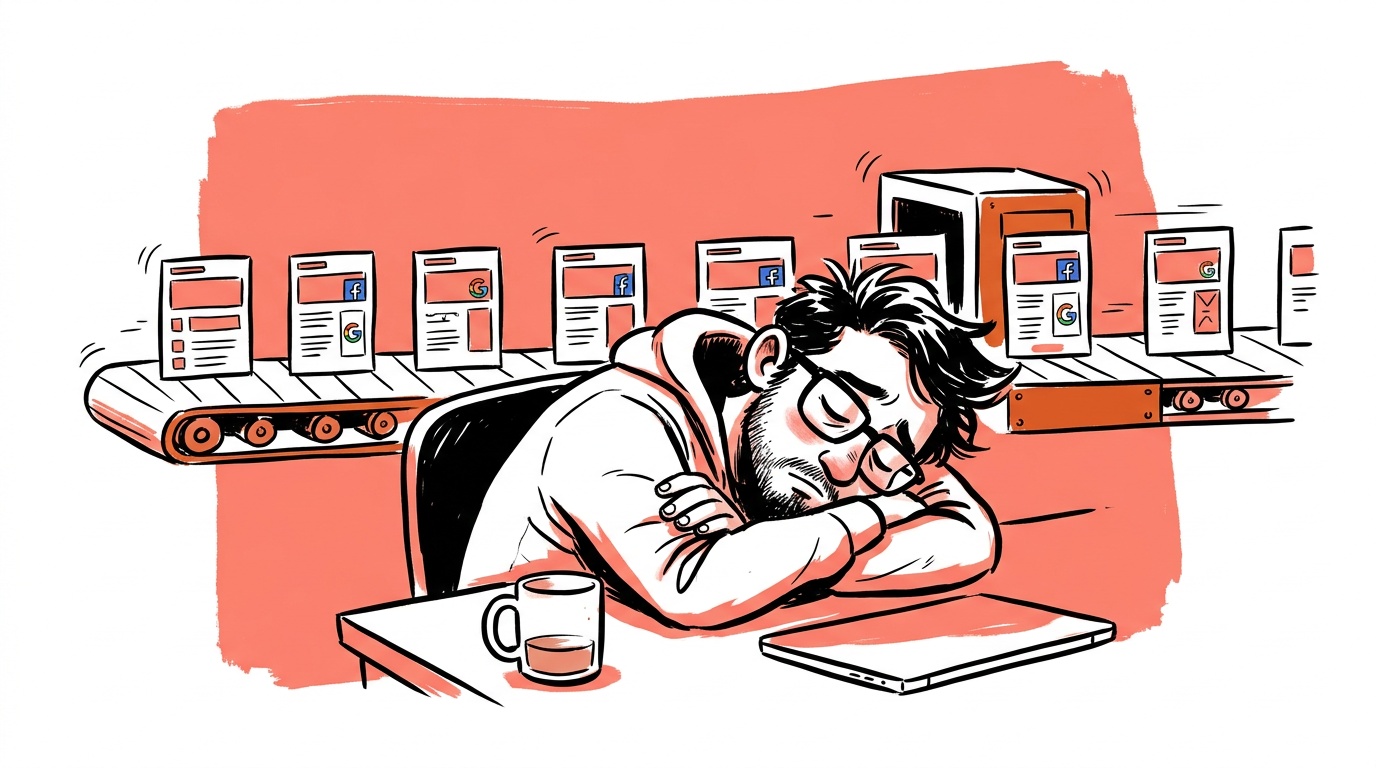
If your content pipeline requires you to be present for every piece, you don't have a content strategy—you have a job. And unlike your actual job, this one has no salary, no vacation, and a single point of failure: you.
The moment you get pulled into a fundraise, or take a week off, or simply burn out, the pipeline doesn't slow—it stops. That's not a discipline problem. It's an architecture problem. The fix isn't a better morning routine. It's building a system that produces output when you're not watching it.
TL;DR — Scalable Content Systems
- If you're the only person who can create, edit, approve, and publish your content, you're a single point of failure, not a content operation.
- Scalable content systems work by separating your irreplaceable input (ideas, POV, voice) from the repeatable production work anyone or anything else can handle.
- Personal brand content—especially video—can function as a compounding lead-generation asset long after the recording session ends, but only if distribution and repurposing are systematized.
- The right system documents your voice and decision rules so that editors, writers, and AI tools can execute without a daily approval loop.
- The goal isn't to remove yourself from content. It's to make your presence optional for production while keeping it essential for strategy.
You Are the Bottleneck (Not the Asset You Think You Are)
There's a flattering version of the founder-as-content-creator story. You're the face, the authority, the reason people subscribe. That part is true. But most founders confuse being the strategic voice with being the operational center of their content—and those are very different things, with very different costs.
When you're the operational center, every piece requires your time twice: once to create, once to approve. Edits circle back to you. Scheduling waits on you. The team—if you have one—can't move without a green light from you. The cost isn't just hours. It's the salary-rate hours you're spending on tasks a part-time editor could handle, plus the inconsistent lead flow that follows every time your publishing cadence breaks.
The insight that changes how you think about this: your irreplaceable contribution is a much smaller surface area than you assume. Your specific framing, your contrarian takes, your firsthand experience—that's the fraction that actually requires you. The rest is production: scripting, editing, formatting, scheduling, repurposing, publishing. That part can be systematized.
What a Scalable Content System Actually Looks Like
A scalable system has four layers. Most content operations have one or two and mistake that for the whole thing.
1. Capture: A lightweight, always-on method for logging your raw ideas. Voice memo, a Notion table you add to during your commute, a standing weekly idea dump. The format doesn't matter. The constraint does: it has to cost you less than five minutes per entry, or you won't keep it.
2. Production: The process that turns raw captures into finished content. This is where SOPs matter most. A good production SOP documents not just the steps, but the decision rules—how long should this be, what tone does this format use, when do we cut a section, what makes a headline work. Decision rules are what let someone else make calls without asking you.
3. Distribution: The scheduled, automated, or delegated process of getting finished content to the right channels at the right time. The specific scheduling tool doesn't matter much. What matters is that distribution is never waiting on you to manually press publish.
4. Repurposing: The most underused layer. One recorded video can become a transcript, a blog post, a set of short-form social posts, a newsletter section, a clip, and a pull-quote image. Most teams produce all of those from scratch instead of deriving them from a single source asset. That's expensive and slow.
The Minimum Viable System
You don't need all four layers working perfectly before any of this is useful. A minimum viable version looks like this:
- Founder: Records one substantial session per week or biweekly. Adds raw ideas to a shared capture doc. Reviews escalated decisions only.
- Editor or VA: Turns the recording into a finished primary piece (blog post or newsletter) using a documented template. Flags any judgment calls against the escalation rules.
- AI tools: Draft derivative social content from the transcript. Generate headline variants. Reformat long-form for short-form channels.
- Scheduling tool: Publishes everything on a fixed cadence without manual intervention.
The handoff artifact is the transcript. Everything downstream derives from it. The founder's involvement ends when the recording ends.
Personal Brand Content as a Lead-Gen Machine
A recorded conversation or explainer sits on YouTube and continues accumulating views, search impressions, and leads for months or years after you filmed it. The initial production cost is fixed. The distribution cost approaches zero over time. That compounding dynamic is what makes personal brand video so attractive as a lead-generation channel—and so frustrating when it's wasted.
Most founders treat video as a live performance rather than an asset. They record, publish once, and move on. The video does a fraction of the work it could do because it was never fed into a repurposing system.
A live presentation dies when it ends. An asset keeps working. The question for every piece of content you create: are you treating it as a performance or an asset? If you're not repurposing it, you're treating it as a performance.
The founders who build genuinely scalable systems from video work in a specific pattern: one substantial recorded session per week or biweekly, feeding a repurposing workflow that extracts derivative content for every active channel. The recording requires them. Everything downstream doesn't.

Live today.
The full campaign — copy, images, targeting — generated for your site and deployed paused for your approval.
Building the SOP Your Team Can Actually Use
The most common failure mode when founders try to delegate content is handing off a vague brief and then rejecting outputs because they "don't sound right." The problem isn't the team. It's that the founder never documented what "right" means.
A useful content SOP has three things that most don't:
Voice documentation: Real examples of your writing or scripts, annotated with why specific choices were made. Not "be conversational." More like: "We use short sentences after a complex idea. We never open with a question. We name the reader's specific problem in the first line." Annotated examples do more work than style guides. The same is true for ad copy — our post on messaging consistency in ads explains why style guides fail there too.
Format templates: For each content type you produce, a template that locks in structure so the decision-making is already done. A LinkedIn post template. A newsletter section template. A short-form video script template. Templates feel constraining until you realize they're liberating—the writer fills in the substance, not the shape.
Escalation rules: A documented list of decisions that do require your input versus the ones that don't. This is the hardest to write and the most valuable. "You don't need to ask me about headline variants. You do need to ask me if we're taking a position on a competitor's product." Clear escalation rules mean fewer approval loops and faster production.
A Note on AI Tools in Production
AI tools are genuinely useful in the production layer—drafting first passes from transcripts, generating headline options, reformatting long-form content for short-form channels. (The best AI tools for turning content into ads covers the repurposing-to-paid step.) Where they break down is in the voice and strategy layers, which is exactly where founders try to use them most.
Use AI to handle the repeatable formatting and drafting work. Use your own judgment for anything that requires a specific POV or a contrarian claim. (The POV is what turns a topic into a lane — see why random content kills growth.) The combination is fast. The AI-only version is generic.
The Metrics That Tell You If Your System Is Working
Most content teams measure outputs: posts published, videos uploaded, email sends. Those are fine as activity metrics but they don't tell you whether your system is actually scaled or whether you're still manually holding it together.
The metrics that actually diagnose your dependency problem:
- Time-to-publish without founder input: How long does it take a piece to go from raw capture to published if you don't touch it? If the answer is "it doesn't" or "very long," the system isn't there yet.
- Repurposing ratio: How many derivative pieces does one source asset produce? If the answer is one-to-one, you're leaving most of the value on the table.
- Approval touchpoints per piece: Count how many times a piece comes back to you before it publishes. More than once for routine content signals the decision rules in your SOP aren't clear enough.
- Content continuity during disruption: What happened to your publishing cadence the last time you were pulled away for a week? That's your system's actual reliability score.
Shipping the First Version of Your System
The system doesn't have to be complete before it's useful. A first version that covers your highest-volume content type—LinkedIn posts derived from a weekly voice memo, for example—is more valuable than a comprehensive architecture you spend three months designing and never finish.
Start with one format, one SOP, one person or tool responsible for production. Run it for a month. Measure the approval touchpoints and the repurposing ratio. Fix the specific things that still route back to you. Then expand to the next format.
The founders who build durable content operations don't start with the whole architecture. They start with the constraint costing them the most—usually the approval loop—and fix that first.
The same logic that applies to engineering teams and bus-factor risk applies directly to content operations. If your content has a bus factor of one, it's fragile by design. For deeper reading on how video compounds as a lead-gen asset, Wistia's State of Video reports document how video retention and rewatch behavior contribute to pipeline over time. For the operational side of building repeatable creative processes, Ann Handley's work on content operations remains one of the clearest frameworks available.
The honest question to end on: if you disappeared from your business for two weeks tomorrow, would your content continue publishing—or would it stop the moment you stopped? The answer is the exact size of the problem you need to solve.
FAQ
What is a scalable content system? A scalable content system is a documented process that separates the founder's irreplaceable strategic input—ideas, POV, specific framing—from the repeatable production work that can be handled by other people or tools. The goal is consistent content output that doesn't require the founder to be present for every step of production, editing, and publishing.
How do I stop being a bottleneck in my content process? Start by auditing every approval touchpoint in your current workflow. For each one, ask whether it requires your actual judgment or whether it could be resolved by a documented decision rule. Most bottlenecks exist because the SOP doesn't cover edge cases—not because the decision genuinely needs a founder. Document the decision rules, not just the steps.
Can a small team build a scalable content system? Yes. The minimum viable version is one format, one SOP, and one other person or tool responsible for production. Many founder content operations run effectively with a part-time editor, a repurposing workflow, and a scheduling tool. The system doesn't need to be large. It needs to be documented well enough that production continues when the founder is unavailable.
What content formats are easiest to systematize? Written formats with clear templates—LinkedIn posts, newsletter sections, short-form social—are fastest to systematize because the structure is well-defined and the production tools are mature. Video is slower to produce but earns strong compounding returns because it functions as a long-lived search and lead-gen asset. The most effective approach is usually to anchor the system in video or audio and derive written formats from the transcript.
How does personal brand content generate leads without paid ads? Personal brand content—especially YouTube video—generates leads through organic search and platform recommendations over time. A recorded explainer or case study can continue attracting views and inbound inquiries for months or years after publication at no incremental cost. The lead-gen mechanism is trust and discoverability, not immediate conversion. The constraint is that this only compounds if the content is genuinely useful and specific, not generic.
What should a content SOP include? A useful content SOP includes: the production steps in order, documented decision rules for common judgment calls, voice examples with annotations explaining why specific choices were made, format templates for each content type, and clear escalation rules that specify which decisions require founder input and which don't. Most SOPs cover the steps and skip the decision rules—that's why they don't reduce the approval loop.
How do I measure whether my content system is actually scalable? Track four things: time-to-publish without your direct involvement, repurposing ratio (derivative pieces per source asset), approval touchpoints per piece, and content continuity during disruptions. If any routine piece requires your input more than once in the production cycle, the SOP needs more decision rules. If your content stopped the last time you were unavailable, your system isn't scalable yet.
Live today.
The full campaign — copy, images, targeting — generated for your site and deployed paused for your approval.

We build AdControlCenter — AI-powered ad management for small businesses, online stores, SaaS companies and service providers. We write what we'd want to read: real numbers, no fluff, the things we wish we'd known when we started.
More from the team →