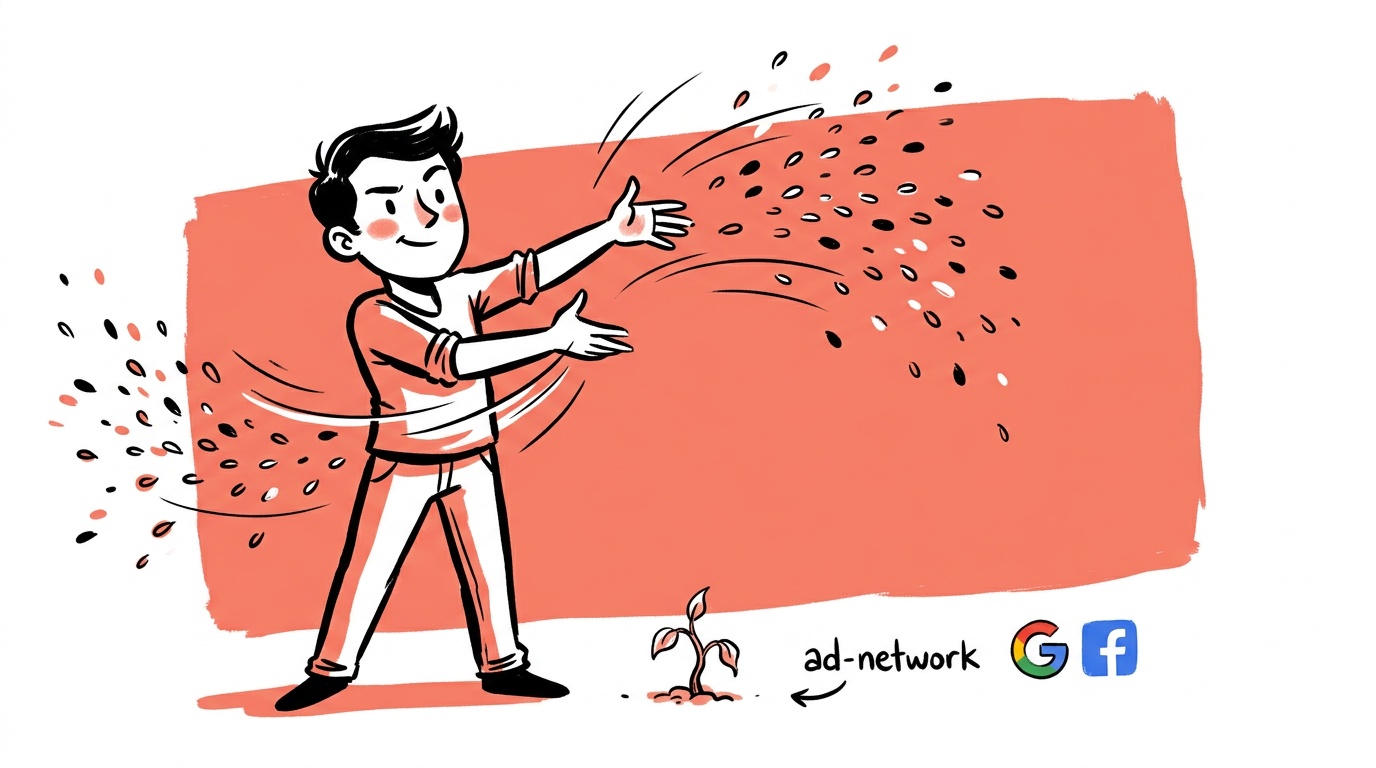
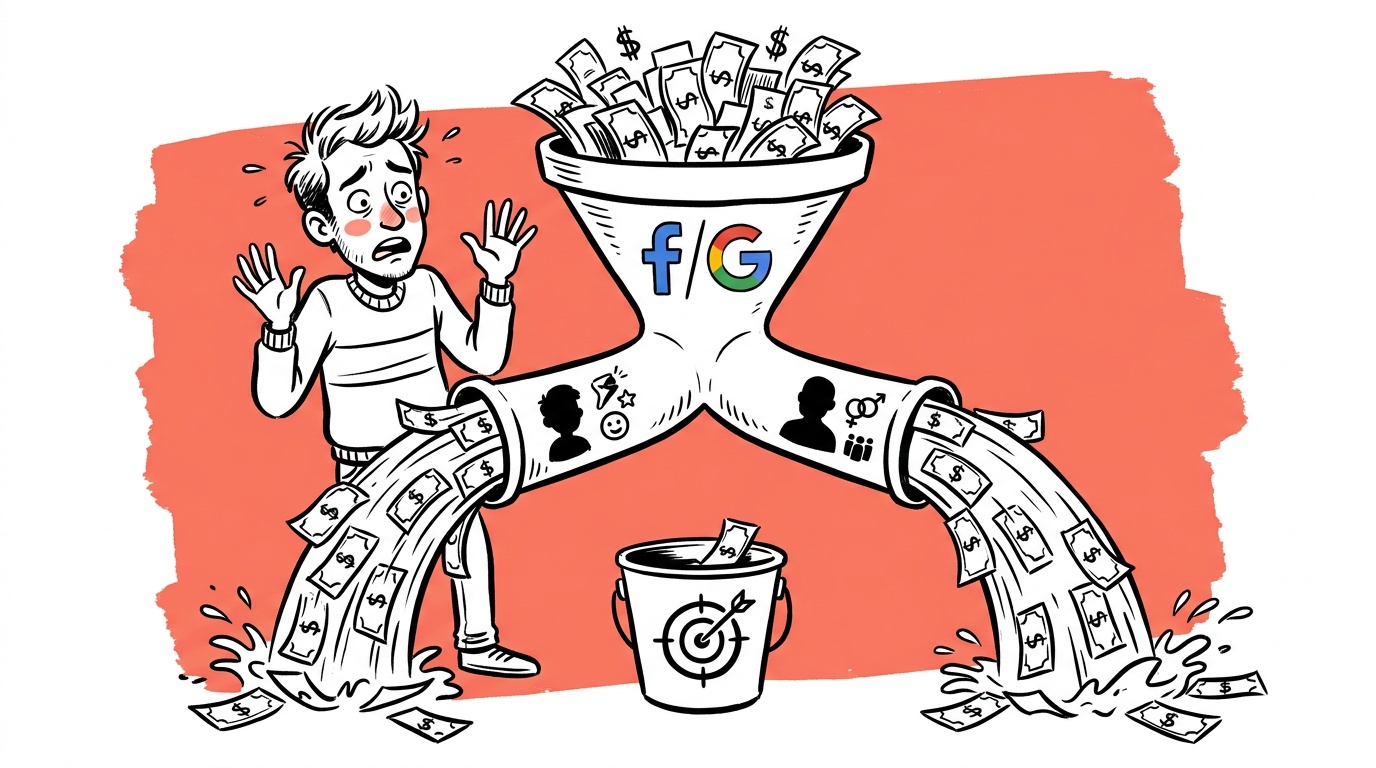
Most founders who struggle with content aren't publishing too little. They're publishing too many different things, about too many different topics, aimed at too many different people. The volume looks fine. The results don't compound. That's the trap.
A scattered content library doesn't just fail to grow — it actively works against you. Every off-topic post gives your audience one more reason to tune you out, and gives every algorithm one more weak engagement signal to act on. Every topic pivot resets the trust you'd started building. You end up with a body of work that describes no one and attracts no one.
TL;DR — Content Strategy and Focus
- Random content feels like progress but breaks the compounding logic that makes content worth producing in the first place.
- The fix is not posting more. It's defining a specific content lane and defending it with discipline.
- There are distinct content types that serve different business goals — mixing them without a plan wastes most of the effort.
- A clear point of view (POV) is what transforms a topic into a content strategy. Without it, you're just adding noise.
- Paid ads and organic content work best when they share the same strategic spine — the same audience, the same core message, the same few topics.
The Compounding Math That Random Content Breaks
Content has compounding returns, but only when it's coherent. Each post you publish about a specific topic builds topical authority — with search engines, with the platform algorithm, and most importantly, with readers who start to trust that you actually know something.
When you post consistently about one narrow space, returning readers show up with more context, more trust, and more willingness to act. New readers land on one post, find three more that are directly relevant, and follow or subscribe. That's compounding.
Now scatter the topic set. Post about your product one week, the industry broadly the next, a personal story after that, then a hot take on a trend you barely understand. Each post reaches a different audience. None of those audiences fully overlap. None of them build a mental model of who you are and what you're for. Engagement signals weaken. Distribution shrinks. Compounding stops.
The opportunity cost isn't just wasted posts — it's the compounding you never got. Months of unfocused output could have been months of growing authority in one lane. That gap is expensive and slow to close.
Why "Posting More" Is the Wrong Answer
The instinct, when content isn't working, is to increase output. Post more often. Try more formats. Cover more ground. This feels productive. It's usually the wrong move.
More posts accelerate the scatter problem. If your content direction is broken, volume makes it worse faster.
The right diagnostic question isn't "how much am I posting?" It's "could someone read ten of my posts and immediately understand exactly who I'm for and what I help them do?" If the answer is no, frequency is not the fix.
Before increasing cadence, get the lane right. (Cadence is a systems problem anyway — your content stops when you do covers how to build one that doesn't depend on you.) A single focused post that lands with the right audience does more compounding work than ten posts that each reach a different, vaguely interested group.
The Content Type Problem Nobody Talks About
One reason content feels random that rarely gets named: founders mix content types without realizing those types serve completely different functions.
There's a meaningful difference between content that builds awareness, content that builds trust, and content that converts. These aren't interchangeable. A conversion-focused post — here's my product, here's what it does, here's why to buy it — dropped into an audience that barely knows you creates friction and feels like a pitch. An awareness post dropped into a warm, ready-to-buy audience leaves money on the table.
The founders whose content actually builds a business tend to be deliberate about which type they're producing and why. They know that most of their content should build trust and demonstrate expertise, that conversion content should appear in sequence after that trust exists, and that awareness content needs the sharpest possible hook to pull cold audiences in.
Mixing all three at random, in no particular order, aimed at no particular audience stage, is one of the most common reasons a content library underperforms despite real effort behind it.

Live today.
The full campaign — copy, images, targeting — generated for your site and deployed paused for your approval.
What a Real Content Lane Looks Like
A content lane is not a topic. "Marketing" is a topic. "Why paid ads fail for early-stage SaaS founders who don't have product-market fit yet" is a lane. The difference is specificity of audience and specificity of problem.
A useful content lane has three components:
1. A defined reader. Not "marketers" or "founders" — a specific kind of person at a specific kind of moment. Early-stage. Post-revenue but pre-scale. Running their own ads because they can't afford an agency yet. That's a reader.
2. A specific problem domain. The thing your reader is stuck on, confused about, or afraid of. Not the whole domain — one slice of it, the slice where you have a genuine opinion formed by real experience.
3. A point of view. This is the part most people skip. A POV is not "here's how to do X." It's "here's why the conventional advice about X is wrong, and here's what actually works." It's a stance. It creates disagreement, which creates engagement, which builds the kind of attention that compounds.
Without the POV, you have a topic. With it, you have a content strategy.
How to find your lane before committing to it
Most founders pick a lane by instinct and then discover six months later it was slightly wrong. A faster path: before you commit, run small batches.
Write three posts from three candidate lanes. Not full production — rough drafts or even LinkedIn posts. Put them in front of real people who match the target reader and watch which one prompts "I've never seen it framed that way before" or "can you send me more like this?" That response is the signal. The lane that generates it is worth defending.
Search data is the other check. Look at the specific phrases people type when they're stuck on the problem your lane addresses. If those queries exist and the answers are thin or generic, you have both a real audience and a gap worth filling. If the queries barely exist, the problem may not be felt the way you're framing it.
How Paid Ads Fit Into a Focused Content Strategy
If you're running paid ads alongside content — and most founders reading this are — the content strategy and the ad strategy need to share a spine.
Your ads are reaching cold audiences. Your content is building warm ones. When they describe the same core problem, use the same vocabulary, and lead to the same core message, the two channels reinforce each other. Someone who sees your ad and then finds your content gets a consistent impression of who you are. Someone who finds your content first and then encounters your retargeting ads recognizes you immediately. That recognition is cheap to build when you've already earned it organically.
When they're misaligned — ads promising one thing, content covering a different world entirely — you pay for clicks that don't connect to anything. We cover the ad-to-landing-page version of that mismatch in why inconsistent messaging kills ad performance.
The practical fix: write down your one-sentence content lane — defined reader, specific problem, clear POV — and use it as a filter for both. Every ad creative should fit it. Every post should fit it. Anything that doesn't fit gets deprioritized or cut.
When your ads and your content use the same specific words to describe your reader's problem, that language becomes associated with you. It's a small thing that accumulates into a real brand signal over time.
The Discipline Part: Saying No to Good Topics
Getting focused is easy to agree with. Staying focused is where it falls apart.
Every week brings topics that feel relevant enough to justify a detour. A trend breaks. A competitor does something interesting. You read something that sparks a tangentially related idea. All of these feel like good posts. Some of them are. Most of them scatter your signal.
The filter is not "is this a good topic?" The filter is "does this serve my specific reader's specific problem through my specific POV?" A post that scores well on the first question and poorly on the second doesn't belong in your lane, even if it's technically good content.
This is the discipline that separates content libraries that compound from ones that plateau. It looks like passing on ideas that feel exciting. It produces results that look like slow, steady growth in exactly the audience you wanted.
A practical system: keep a "not yet" list. Topics that don't fit the current lane but might be worth revisiting if the lane evolves. It gives the ideas somewhere to go that isn't your publishing calendar.
How to Diagnose Your Own Content Strategy
Pull your last fifteen pieces of content — posts, videos, emails, whatever you produce. Without reading them, write one sentence describing who each piece was for and what problem it addressed.
If the audience and problem are consistent across most of them, you have a lane. If they vary significantly — different audiences, different problems, no discernible pattern — you have scatter.
Then ask: do these pieces share a POV? Is there a consistent stance, a recurring argument, a specific belief that shows up across multiple pieces? If yes, you have a strategy. If each post is just information about a topic, you have a library of content but not a strategy.
The fix from here is not to throw out what you've built. It's to identify which lane the existing content points toward — usually one emerging theme is stronger than the others — declare that the lane, and start filtering from there.
FAQ
What is a content strategy and why does focus matter? A content strategy is a plan that defines who your content is for, what specific problem it addresses, and what point of view it expresses consistently. Focus matters because content compounds — each post builds on the last — but only when they're aimed at the same audience with the same core message. Scattered content resets that compounding with every off-topic post.
How do I know if my content is too random? Audit your last fifteen pieces. If you can't describe a consistent audience and a consistent problem across most of them, the content is scattered. A useful signal: could a first-time reader scan your content and immediately understand exactly who you help and how? If the answer is no, the focus is broken.
What's the difference between a topic and a content lane? A topic is a subject area. A content lane is a topic plus a specific audience plus a defined point of view. "Email marketing" is a topic. "Why most e-commerce founders are optimizing the wrong email metrics" is a content lane. The lane creates a consistent, recognizable body of work. The topic just creates posts.
Do I need different content for paid ads vs. organic? Not different — aligned. Paid and organic content should describe the same reader, the same problem, and use the same vocabulary. Paid ads reach cold audiences; organic builds warm ones. When they share a strategic spine, they reinforce each other. When they're misaligned, you pay for attention that doesn't connect to anything.
How many content types should a founder be producing? Most founders produce more content types than they can execute well. A more useful approach: pick one primary format — long-form posts, short video, newsletter — and one primary content type — trust-building, awareness, or conversion — and do those well before expanding. Adding formats before the core lane is tight usually accelerates the scatter problem.
How long does it take for a focused content strategy to show results? Compounding is slow at first, and most people quit before the curve bends. A consistent, focused content lane typically takes several months before the compounding becomes visible — longer in low-distribution channels, faster in high-distribution ones like short video. The founders who see results are usually the ones who committed to a lane long enough for it to build real topical authority.
Can I change my content lane once I've picked one? Yes, but less often than you think you need to. Most lane changes are a response to slow growth that would have compounded if left alone. A genuine lane change is warranted when your business changes fundamentally, your audience shifts, or you've saturated the original lane. Changing because six weeks felt slow is almost always a mistake.
The single most useful thing you can do today: write one sentence that defines your content lane — specific reader, specific problem, specific stance — and hold every piece of planned content against it. The ones that don't fit go on the "not yet" list. Everything else gets sharper because the constraint is real.
Live today.
The full campaign — copy, images, targeting — generated for your site and deployed paused for your approval.

We build AdControlCenter — AI-powered ad management for small businesses, online stores, SaaS companies and service providers. We write what we'd want to read: real numbers, no fluff, the things we wish we'd known when we started.
More from the team →