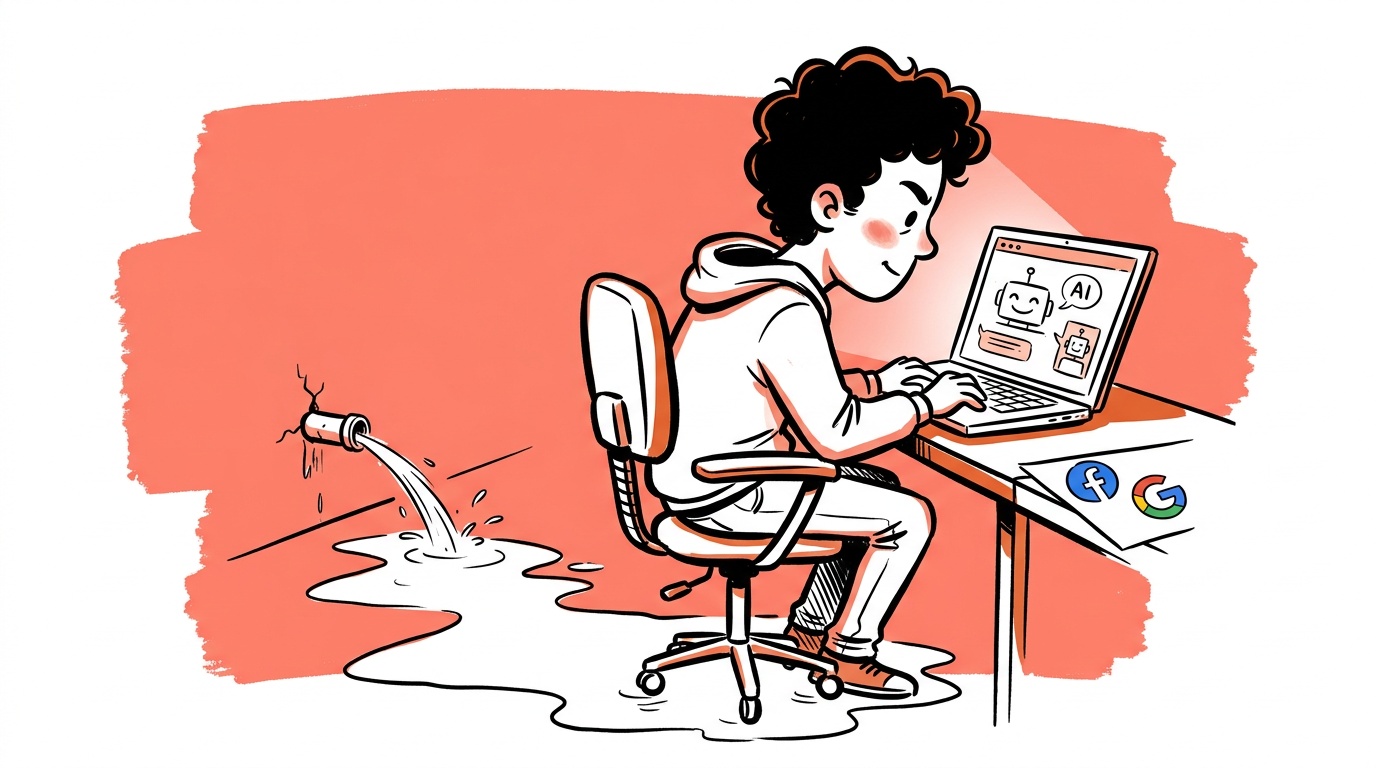

The most expensive mistake we see founders make with AI in ad ops isn't trusting it too much — it's trusting it in the wrong places. A founder will spend two hours prompting an LLM to write ad copy variations, get something passable, ship it, and then completely miss that their broad match keywords have been matching garbage queries for three weeks. The AI looked busy. The account was quietly broken.
That gap between "AI looks like it's working" and "AI is actually moving the needle" is what this post is about.
TL;DR — AI tools in ad ops: what's real, what's not
- Generative AI is genuinely fast at producing first drafts of ad copy, but output quality degrades fast without a structured prompt system tied to real campaign context.
- Voice and conversational AI interfaces are still mostly novelty for ad ops — useful for quick Q&A, unreliable for decisions that require cross-platform data.
- The real wins from AI in ad ops come from automation of repetitive, rules-based tasks: bid adjustments, anomaly flagging, negative keyword triage.
- AI does not replace the judgment call on budget allocation, audience strategy, or creative direction — it can inform those calls, but founders who fully delegate them lose control of spend.
- The question isn't "will AI replace ad ops?" — it's "which specific tasks inside ad ops are worth automating right now, and which ones need a human in the loop?"
Generative AI for Ad Creative: Fast, But Not Free
The surface-level pitch is real. You can generate dozens of headline and description variants in minutes. That used to take an afternoon of copywriting back-and-forth. The speed improvement is genuine and not trivial, especially for founders running ads without a dedicated creative team. If you want to see what a context-loaded prompt produces, run your own URL through our AI ad generator.
What the pitch glosses over is that speed producing mediocre copy at scale is still mediocre copy at scale. The output quality of a generative AI writing Google Ads headlines depends almost entirely on the quality of the context you feed it: your offer, your audience, your existing top performers, your brand constraints. Feed it a vague brief and you get generic variants that sound like every other ad in the auction.
The fix is context-loading before generation, not after. When you inject actual campaign performance data — which headlines are winning, which angles are flat — the output quality improves noticeably versus a blank prompt. Most founders skip that step entirely.
The best generative ad copy comes from prompts that include: the single conversion action you're optimizing for, the top-performing existing headline, the audience's stated objection, and a hard constraint on character count. Most founders skip all four.
There's a parallel in what's happening outside ad ops. Creators are now generating entire animated shows with AI tooling — video, voice, character design, scripted dialogue — at a pace that would have been impossible two years ago. The capability jump is real. But watch any of those outputs closely and you notice the same thing: when the underlying creative direction is strong, the AI output is strong. When the direction is thin, the AI just produces thin content faster. Ad creative works the same way.
Voice AI in Ad Ops: Where It's Still Theater
Voice interfaces and conversational AI — think asking an AI assistant "how are my campaigns performing?" — are having a moment. The demos are impressive. The day-to-day utility is still limited.
The core problem is data access. A voice query like "which ad set should I pause?" requires real-time, accurate, cross-platform data, properly attributed, with enough historical context to distinguish a genuine underperformer from normal variance. Most voice AI tools aren't actually connected to that data. They're connected to whatever context you've given them in the conversation, or at best a snapshot export.
Conversational interfaces are genuinely useful for one thing: helping founders who don't live inside Ads Manager every day ask better questions about their data. "What should I be looking at?" is a reasonable voice query. "Tell me what to do about it" is where the wheels come off — because without live auction data, billing history, and conversion lag context, any answer is educated guessing dressed up as insight.
Where AI Actually Earns Its Place in Ad Ops
Set aside the shiny stuff. The places where AI has quietly made the most difference in ad ops are boring and specific:
Anomaly detection. A model that watches your key metrics — CPC, CTR, conversion rate, spend pace — and flags when something breaks pattern is genuinely valuable. Not because the AI knows what caused the anomaly, but because it catches problems faster than a founder checking dashboards once a day. Campaigns drift. Budgets exhaust early. Competitors change bids. Fast detection is worth something real.
Negative keyword triage. Search term reports are tedious to review at scale. AI-assisted triage — flagging irrelevant match patterns, grouping by semantic category, surfacing the highest-waste queries first — saves real hours. This is rules-based enough that the AI gets it right most of the time.
Bid strategy diagnostics. Smart bidding on Google and Meta's Advantage+ are black boxes that occasionally go wrong in expensive ways. AI tools that compare your target CPA or ROAS settings against actual delivery patterns and flag divergence are doing something a human would need significant time to do manually. How much autonomy to give those tools is the subject of our AI agents for PPC guide.
These are not glamorous use cases. They don't make for compelling product demos. But they're where we see real efficiency gains in accounts we manage.
A Simple Fit Test for Any Ad Ops Task
Before you hand a task to an AI tool, score it on four dimensions:
Data access — does the tool actually have the live, complete data it needs to act correctly? Reversibility — if the AI gets it wrong, how fast and cheaply can you undo the decision? Variance sensitivity — does this task require distinguishing signal from normal noise, and how much context does that take? Stakes — what does a bad automated decision cost you in dollars or in time to recover?
Tasks that score well on all four — good data access, highly reversible, low variance sensitivity, low stakes — are your best automation candidates. Copy draft generation, negative keyword flagging, and spend-pace alerts sit in that zone. Budget reallocation and creative strategy sit at the opposite end. The table below shows where common ad ops tasks land:
| Task | Data Access | Reversible | Low Variance Sensitivity | Low Stakes | Automate? |
|---|---|---|---|---|---|
| Copy draft variants | Medium | Yes | Yes | Yes | Yes |
| Negative keyword triage | High | Yes | Yes | Yes | Yes |
| Anomaly / spend alerts | High | N/A | Medium | N/A | Yes |
| Bid rule adjustments | High | Partial | Medium | Medium | With oversight |
| Budget reallocation | Requires full context | No | No | High | No |
| Creative strategy | No tool has this data | No | No | High | No |

Live today.
The full campaign — copy, images, targeting — generated for your site and deployed paused for your approval.
The Judgment Layer AI Can't Replace
There's a category of ad ops decisions where AI input is useful but AI authority is dangerous. Budget allocation is the clearest example.
Deciding how to distribute budget across campaigns involves reading signals that are partially quantitative (ROAS by channel, marginal return curves) and partially qualitative (where is the business in its growth stage, what's the founder's risk tolerance, what's happening in the market that the data doesn't yet reflect). AI can surface the quantitative part cleanly. It cannot hold the qualitative context.
Many founders who hand over budget pacing decisions to automated rules or AI recommendations are later surprised when spend concentrates in a channel that looked efficient in the last 30-day window but was about to hit audience saturation. The model was right about the past. It had no way to know the future was about to look different.
AI recommendations are only as good as the attribution data they're trained on. If your attribution model is broken — and many are, especially across iOS and cross-channel journeys — the AI will confidently optimize toward the wrong thing. Fast, confident, and wrong is more expensive than slow and careful.
The same logic applies to creative direction. AI can tell you which headline is winning in an A/B test. It cannot tell you whether you should change your offer entirely, reposition against a new competitor, or stop running a particular campaign because it's attracting the wrong customer profile. Those are founder-level calls.
How to Audit What You're Actually Getting from AI Tools
If you're paying for AI-powered ad tools — or building AI into your own workflow — run this audit:
1. What data is the AI actually seeing? Not what the marketing page says. What data is literally connected? Is it real-time? Is it complete across all your active platforms?
2. What is the AI optimizing for? If the answer is "conversions," ask: which conversion event, with what attribution window, weighted how across click and view?
3. What happens when the AI is wrong? How long until you'd notice a bad AI-driven decision? If the answer is "days" or "I'd check the monthly report," the feedback loop is too slow.
4. What tasks did AI actually remove from your week? Not in theory — in practice, last month. If you can't name them specifically, the tool is probably not saving the time you think it is.
Most founders who run this audit find that they're getting real value from one or two specific automated tasks, and marginal-to-zero value from the "intelligent insights" surface that looks impressive in the dashboard.
What's Actually Coming (and What Isn't)
The capability curve for generative AI in creative production is steep and real. Progress in video, voice, and image generation has been fast enough that workflows which weren't possible before are now standard. That will continue to compress the cost and time of creative production, which matters for ad ops because creative refresh velocity is a genuine competitive factor in paid social. (We ranked the AI tools that turn existing content into ads separately.) Google's own Performance Max documentation reflects this — the platform increasingly expects advertisers to supply more creative variants and lets the AI handle distribution.
What isn't coming as fast as the hype suggests: AI that can fully own end-to-end campaign management without human oversight. The platforms themselves — Google, Meta — have strong incentives to build AI that maximizes their revenue, which is not always perfectly aligned with maximizing your return. Researchers studying algorithmic ad delivery on Meta have documented how platform optimization goals can diverge from advertiser intent in measurable ways. A third-party AI layer on top of that faces the same data access constraints every tool faces.
The honest framing isn't "AI is replacing ad ops." It's "AI is changing which parts of ad ops require human time." The judgment, strategy, and oversight parts still do. The repetitive, pattern-matching parts increasingly don't. The IAB's State of Data report puts it plainly: signal loss from privacy changes is making automated optimization harder, not easier, for the foreseeable future — which means the human judgment layer matters more now than it did when data was cleaner.
FAQ
Are AI tools actually replacing ad ops managers? Not in any wholesale sense. AI tools are automating specific repetitive tasks inside ad ops — anomaly flagging, negative keyword triage, bid diagnostics — but the judgment-heavy work of budget strategy, creative direction, and cross-platform decision-making still requires human oversight. Founders who fully delegate those decisions to AI tools tend to lose visibility into what's actually happening in their accounts.
What can generative AI actually do well in paid advertising? It's genuinely fast at producing first drafts of ad copy, generating headline and description variants, and helping with A/B test setups. The quality depends heavily on the context you provide — performance data from existing campaigns, audience constraints, offer clarity. Generic prompts produce generic output.
Can I use ChatGPT or an LLM to manage my Google Ads or Meta campaigns? Not directly, and not reliably. LLMs don't have real-time access to your campaign data, auction signals, or platform-specific performance metrics. They can help you think through strategy, write copy, or structure a brief — but they can't make live bidding decisions or catch budget anomalies without being explicitly connected to your data sources.
What's the biggest risk of using AI for ad ops automation? Optimizing toward the wrong thing, confidently. If your attribution data is broken — which is common after iOS privacy changes and across multi-channel journeys — an AI will optimize efficiently toward a misleading signal. Fast, confident, and wrong is more expensive than slow and careful.
How do I know if an AI ad tool is actually saving me time? Run a backward-looking audit: what specific tasks did you not have to do last month because the AI handled them? If you can't name concrete tasks with real time estimates, the tool is probably delivering dashboard aesthetics more than operational value.
What should founders look for when evaluating AI tools for ad management? Four things: what data is actually connected (not what the pitch claims), what the AI is explicitly optimizing for, how fast you'd catch a bad automated decision, and which manual tasks it demonstrably removed from your workflow. Score each task on data access, reversibility, variance sensitivity, and stakes before you hand it off.
Is voice AI useful for running paid ad campaigns? Currently, voice and conversational AI interfaces are most useful for asking better questions about your data — helping founders who don't live in Ads Manager daily orient quickly. They're unreliable for actual campaign decisions because they typically lack real-time, cross-platform data access. That may change as platform APIs become more open, but it's not where we are now.
The specific question worth sitting with: in your account right now, which three tasks take the most time and require the least judgment? Score them against the four-dimension fit test above. If they clear it, automate them this week. If they don't, no AI tool changes that math.
Live today.
The full campaign — copy, images, targeting — generated for your site and deployed paused for your approval.
We build AdControlCenter — AI-powered ad management for small businesses, online stores, SaaS companies and service providers. We write what we'd want to read: real numbers, no fluff, the things we wish we'd known when we started.
More from the team →