
Most ad platforms will tell you to trust the data. Every time. Full stop. That framing has become so dominant that questioning it feels like admitting you're running on vibes. But the industry's worship of measurement has quietly produced a generation of founders who can read a ROAS dashboard in seconds and make catastrophically bad strategic decisions at the same time.
The problem isn't data. The problem is the assumption that more data automatically produces better judgment. It doesn't. Some of the most expensive ad mistakes we've seen — including ones inside our own accounts — came from following the numbers exactly where they pointed, because the numbers were measuring the wrong thing.
- Data is fast and precise inside a known context; gut is necessary when the context itself is changing.
- Over-optimizing on short-term metrics can kill creative directions that needed more time to work.
- Attribution models measure what happened, not why — and "why" is where most strategic judgment lives.
- The right move is a structured handoff: use intuition to form a hypothesis, use data to kill it or confirm it.
- Patience is a genuine performance variable. Many founders pause campaigns or kill creative before the signal is readable.
The Industry Got One Thing Right and One Thing Very Wrong
Data won the first argument: you should not spend money on ads without measuring outcomes. That battle is over.
But the industry overshot. The current orthodoxy — that every decision should be data-driven, that gut feelings are bias dressed up as expertise — has produced its own failure mode. Founders treat their ad accounts like they treat their bank statements: a place where numbers tell the full story. They don't.
Here's what the numbers actually tell you: what happened in the past, to a specific audience, under specific conditions, as interpreted by an attribution model someone else built with their own assumptions baked in. That's a narrow slice of reality. When the conditions change — new competitor enters, creative fatigue sets in, platform algorithm shifts — historical data becomes actively misleading. It keeps pointing at the last thing that worked.
Every attribution model is a theory about causality, not a record of it. Last-click, linear, data-driven — they're all simplifications. When your gut says "something feels off about this campaign," it may be detecting a pattern the model structurally can't see.
When Data Wins, Clearly
There are decisions where data should win every time:
Bid adjustments on stable audiences. If you've run the same offer to the same segment for several months and have statistically meaningful sample sizes, the data knows more than your instinct about the right bid range.
Creative fatigue signals. Frequency goes up, CTR drops, CPA climbs. That's not a hypothesis — that's a sequence. You don't need to "feel" that the creative is tired. The account is showing you.
Channel allocation at scale. When you're running meaningful spend across multiple platforms and have clean enough attribution to compare them, the data tells you where the marginal dollar works harder. Follow it.
A/B test outcomes with real statistical weight. If you've run a controlled split with enough volume to reach significance, the data wins. The gut can explain the result after the fact, but it doesn't get to override it.
The common thread: data wins when the environment is stable, the sample is large enough, and the question is narrow enough that the measurement actually captures what matters.
When Gut Wins, Clearly
Intuition — which is really just pattern recognition built from repeated exposure — tends to outperform data in a specific set of conditions:
New creative territories. If you've never run a format, angle, or audience before, you have no data. You have a hypothesis. The gut that generated the hypothesis is doing real work: drawing on what you know about your customer, your category, and what's worked in adjacent contexts. That's the starting point for every test worth running.
Strategic pivots. When you're considering changing your offer, repositioning to a new audience, or experimenting with a channel you haven't owned before, the data from your existing setup tells you almost nothing useful. You're crossing into unknown territory. Experienced founders recognize this and switch modes.
Early signals in noisy periods. The first weeks of a new campaign are often statistically unreadable. Many founders kill creative in this window because the numbers look bad. But early volatility is often the platform learning, not evidence that the creative is broken.
When the numbers look too good. If a campaign is dramatically outperforming everything else in your account and you can't explain why, trust the skepticism. Gut-check what the data is actually measuring. We've seen attribution anomalies — view-through windows set too wide, remarketing pools contaminating prospecting results — produce numbers that look like wins but are counting the same customers twice. (The opposite failure — killing campaigns that were real assists — is covered in the case for multi-touch credit.)

Live today.
The full campaign — copy, images, targeting — generated for your site and deployed paused for your approval.
The Real Problem: Patience as a Performance Variable
The best marketers treat patience as a skill, not a personality trait. This is harder to operationalize than it sounds.
Platforms need time to exit the learning phase. Creative needs time to find its audience. Offers need time to cycle through the consideration window of people who weren't ready to buy on day one. Every one of these timelines is longer than the average founder's tolerance for an ambiguous dashboard.
We've watched founders kill good campaigns in their learning phase and replace them with new creative that also gets killed before it can prove anything. The account ends up in a permanent state of reset — never accumulating the signal volume needed to learn anything durable.
A minimum-signal framework, by platform type
The learning phase exit point varies, but the principle is consistent: don't make optimization decisions until you have enough conversions for the platform's algorithm to stabilize and enough time for your sales cycle to close at least once. On most paid social platforms, that's a minimum of one to two weeks for mid-volume accounts — and longer if your conversion volume is thin. On paid search, where intent is more explicit and cycles are shorter, you can move faster. The practical rule: define your minimum signal threshold before you launch, write it down, and don't touch the campaign until you hit it.
The data-trusting founder who checks results daily and optimizes aggressively is, paradoxically, often making worse decisions than the founder who sets a minimum test window and sits on their hands. The gut skill here isn't choosing the creative — it's recognizing when you're looking at noise and refusing to act on it.
The Structured Handoff: How to Actually Use Both
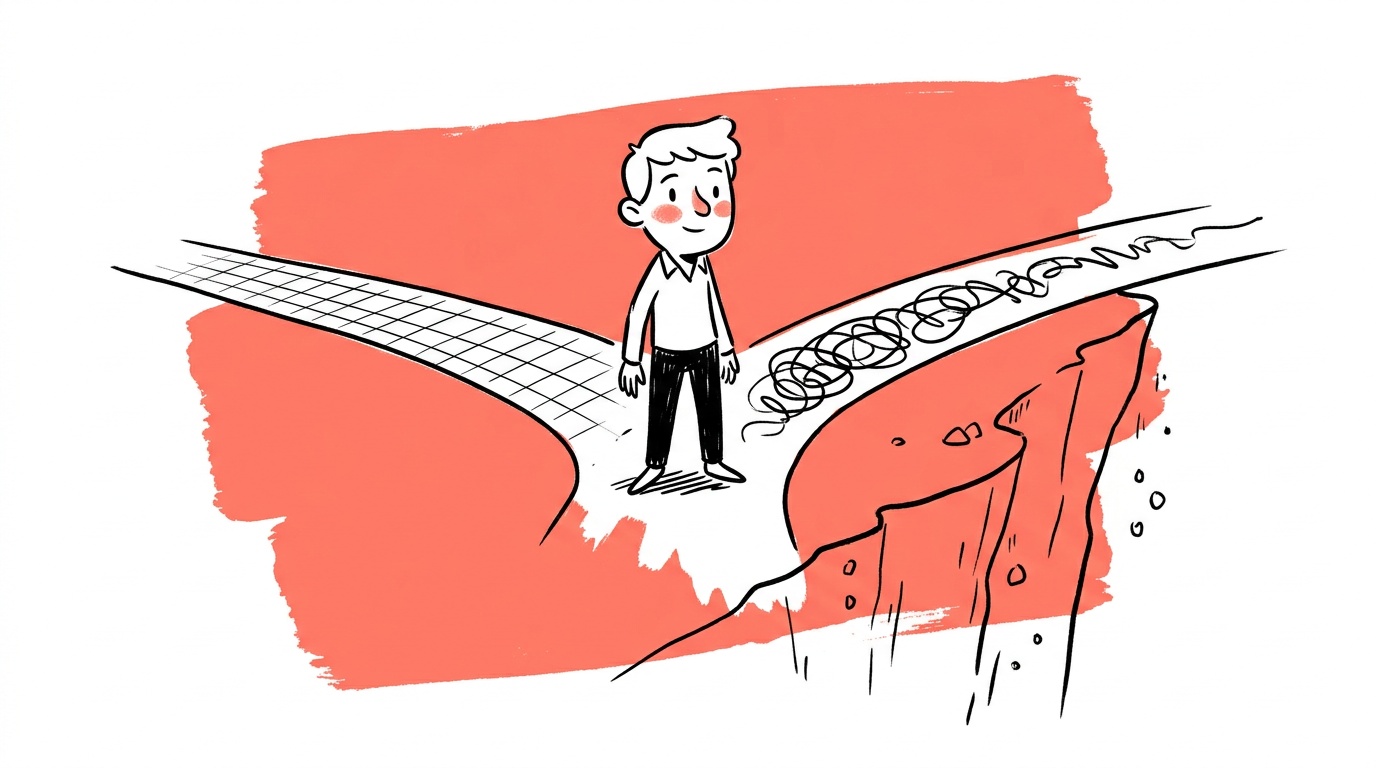
The framing of "data versus gut" is a false binary. The better mental model is a handoff with defined roles at each stage:
Stage 1 — Hypothesis formation: Gut owns this. What are we testing? Why do we think it will work? What would we need to see to call it a success? Past campaign data informs this, but a human assembles it into a testable idea.
Stage 2 — Test design: Data owns this. How long do we run it? What sample size do we need for a readable result? What metric are we actually measuring, and is that metric a proxy for the real outcome we care about? Getting this wrong — too short a window, too small a sample, wrong metric — means the data you collect won't answer the question you're asking.
Stage 3 — Reading results: Both. The data tells you what happened. The gut tells you whether the measurement is capturing the right thing. If the results are confusing or surprising, lean on pattern recognition before you act. Many surprising results are measurement artifacts, not real signals.
Stage 4 — Decision: Data wins — but only if the test was designed well enough to produce a real answer. If it wasn't, you're back to Stage 1 with better information.
Is this environment stable enough that past data predicts future performance? If yes, optimize. If no, test.
A Specific Failure Mode Worth Naming
There's a pattern in the industry worth naming directly: the "data wins every time" orthodoxy, taken too far, produces founders who are data-literate but strategically passive. They wait for the numbers to tell them what to do. They don't form strong hypotheses because hypotheses can be wrong, and wrong hypotheses feel like failure. They run tests designed not to reveal anything surprising because surprising results are uncomfortable to explain.
This is the gut atrophying from disuse. The people who built the ad platforms you use weren't waiting for data to tell them what to test. They had strong intuitions about human behavior, used data to pressure-test those intuitions, and updated fast when they were wrong. The data was a tool. The judgment was the job.
If you've been running paid ads for more than two years and you're not building a real model of why your customers buy — not just a model of what your attribution tool reports — you're accumulating data without accumulating understanding. That's expensive in the long run.
What We Actually Do
When we're evaluating a campaign decision, the internal question is: "Is this a data question or a judgment question?" Data questions have measurable answers and enough history to make the measurement meaningful. Judgment questions are about direction, timing, and context — things that require a human who understands the business.
We paused scaling a prospecting campaign when the ROAS looked strong because frequency to existing customers was creeping up in a way the prospecting numbers weren't capturing. The dashboard said scale. The gut said wait. We waited, tightened the exclusion audiences, and the actual new-customer CPA dropped when we resumed. The data wouldn't have caught that — it was measuring the wrong thing.
That's not a story about gut beating data. It's a story about knowing which questions data can answer and which ones it can't.
The goal isn't to be data-driven. It's to be right about which mode you're in — and disciplined enough to switch when the environment changes.
FAQ
What does "data-driven" actually mean in ad strategy? In practice, "data-driven" means using measurement to inform decisions rather than relying purely on intuition or convention. The problem is that most ad accounts measure outcomes but not causes — so being data-driven tells you what happened, not why, and not whether the same thing will happen again under different conditions.
When should I trust my gut over the data in advertising? Trust your gut when the environment is changing (new creative, new offer, new channel), when you're in an early and noisy test window, when sample sizes are too small for the data to be statistically meaningful, or when the numbers look suspiciously good without an obvious explanation. Gut is also the right tool for hypothesis formation — before any data exists.
How long should I run a campaign before making optimization decisions? Long enough to exit the platform's learning phase and accumulate enough conversion data for your metrics to be readable. For most paid social platforms, this is at minimum one to two weeks for mid-volume accounts, and often longer if your conversion volume is thin. Killing creative before this window closes is one of the most common and expensive optimization mistakes. Define the threshold before you launch — not after the numbers make you anxious.
How do I know if my attribution data is misleading me? Check whether your attribution model's conversion window matches your actual sales cycle. Look for cases where credited conversions exceed actual orders. Compare your platform-reported ROAS against revenue data from your source of truth — Shopify, Stripe, your CRM. We walk through the contribution-margin version of that check in which platform metrics to distrust. If they diverge significantly, the platform data is overcounting, and gut checks against real business outcomes become more important.
What's the difference between intuition and bias in ad decisions? Intuition is pattern recognition drawn from real experience in adjacent situations. Bias is a systematic error that skews decisions in one direction regardless of evidence. The practical difference: intuition updates when you see contradicting data. Bias doesn't. If you have a strong gut feeling, run a clean test that contradicts it, and you update — that's intuition working correctly. If you dismiss the test result, that's bias.
Can you automate the data-versus-gut decision? Partly. You can build rules that define when a campaign has enough signal to act on (minimum conversions, minimum spend, minimum time in learning) and enforce patience structurally. You can also build alerting that flags when results are statistically significant versus when they're just noisy. What you can't automate is the judgment about whether the question you're measuring is the right question in the first place.
What's the single most expensive data-versus-gut mistake founders make? Scaling a campaign because the reported ROAS looks strong, without verifying that the attribution is actually measuring new demand rather than capturing customers who would have bought anyway. This is especially common in remarketing and branded search — where the data looks great precisely because you're measuring an audience with high existing intent, not measuring the effect of the ad itself.
The honest takeaway: the skill isn't picking a side. It's knowing which mode you're in. When you hit a decision and can't answer "is this environment stable enough to trust historical data?" — that uncertainty itself is the signal. It means you need a test, not an optimization.
Live today.
The full campaign — copy, images, targeting — generated for your site and deployed paused for your approval.

We build AdControlCenter — AI-powered ad management for small businesses, online stores, SaaS companies and service providers. We write what we'd want to read: real numbers, no fluff, the things we wish we'd known when we started.
More from the team →