Guide · Updated May 2026
AI Marketing Agents,
explained
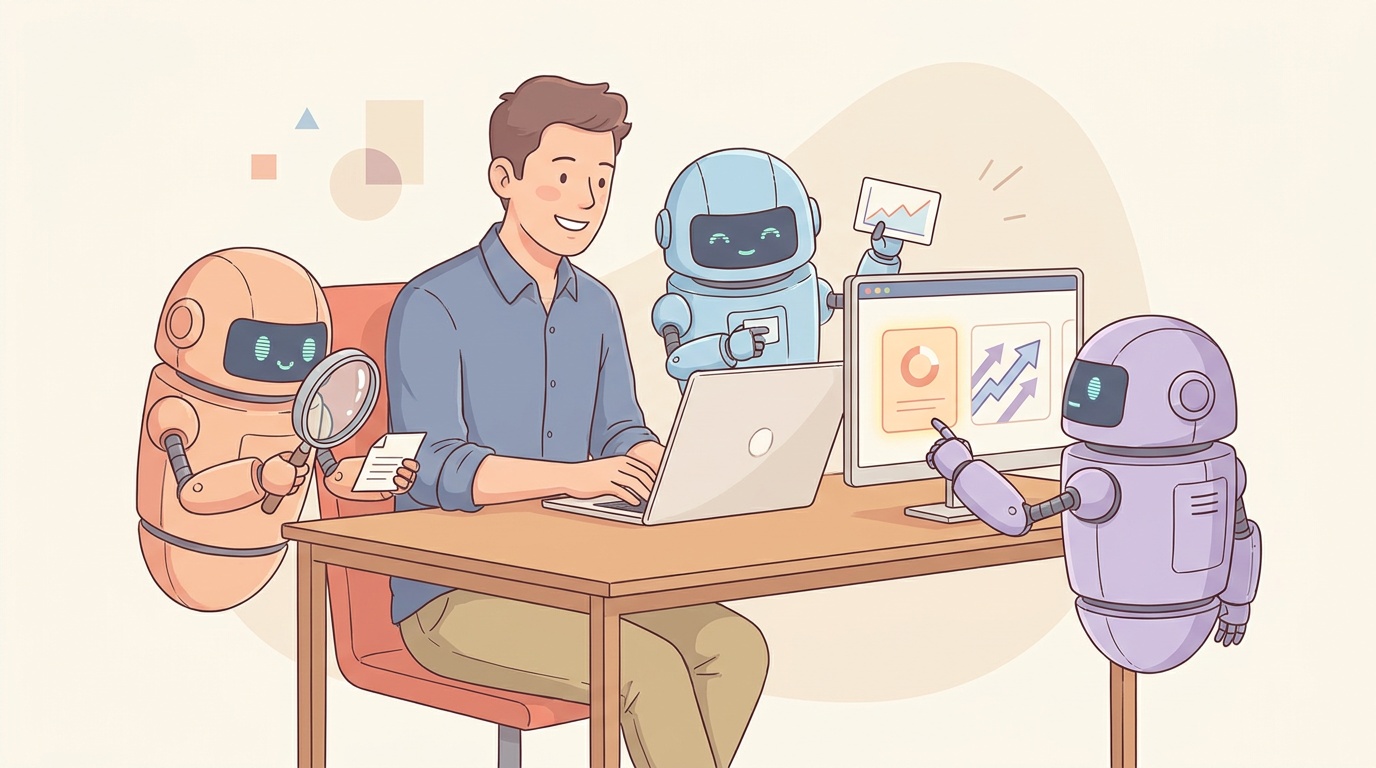
AI marketing agents are autonomous software workers that plan and run marketing tasks on your behalf — ad audits, creative generation, budget optimization, performance reporting. This 2026 guide covers what they actually do, the five main types, and how they're different from the marketing automation tools you already use.
TL;DR
An AI marketing agent is autonomous software that uses a large language model to plan and execute marketing tasks toward a stated goal — without needing a human to script every step.
Five main categories exist in 2026: paid-media agents, content & SEO agents, social-media agents, email agents, and analytics agents. Each automates a different slice of the marketing workflow.
They're different from traditional marketing automation in one big way: they decide what to do, not just when to do it.
What an AI marketing agent actually is
The term agent gets thrown around a lot in 2026, and most of it is just rebranded chatbots. A real AI marketing agent has three properties a chatbot doesn't:
- 1
Goal-driven
You tell it the outcome ("keep ROAS above 3x"), not the steps. The agent figures out the steps each cycle.
- 2
Tool use
It can call external tools — read your Google Ads account, run a query, create a campaign, send a Slack message — not just generate text.
- 3
Persistent loop
It runs on a schedule (hourly, daily) and re-evaluates the situation each time, instead of waiting for a human to prompt it.
If a tool just generates ad copy when you click a button, it's a generator. If it watches your campaigns nightly and rebalances spend toward winners on its own — and explains why — it's an agent.
AI marketing agents vs marketing automation
These two terms get conflated a lot. They're related but solve different problems.
| Marketing automation | AI marketing agents | |
|---|---|---|
| What it does | Runs predefined rules: if X then Y | Makes autonomous decisions toward a goal |
| How you set it up | Build the workflow yourself | Tell the agent the goal in plain language |
| How it adapts | It doesn't — same rule every time | Reads new context each cycle, picks the action |
| Where it shines | Repetitive, well-defined tasks | Tasks where the right answer depends on context |
| Best example | Triggered welcome email sequence | Daily ad-account audit + budget rebalancing |
| Human role | Set up once, watch occasionally | Review proposals, approve high-stakes actions |
The five main types of AI marketing agents
Most teams start with one type — typically paid-media or content — and add more as the workflow proves itself.
Paid-media agents
Manage ads on Google, Meta, etc.
Audit accounts, generate creative, suggest bid changes, write performance summaries. The most mature category in 2026.
Examples
AdControlCenter · Madgicx · Albert AI
Content & SEO agents
Write blog posts, optimize for search
Research keywords, draft long-form content, refresh outdated pages, build internal-link maps. Strong on volume, still uneven on voice.
Examples
Jasper Brand Voice · Surfer SEO AI · MarketMuse
Social-media agents
Plan, post, and engage on social
Generate post variants per platform, schedule across channels, suggest reply drafts. Some can engage autonomously — most are still draft-and-approve.
Examples
Buffer AI · Hootsuite OwlyWriter · FeedHive
Email-marketing agents
Compose and optimize email campaigns
Write subject lines, segment lists by behavior, run automated A/B tests, optimize send times per recipient. Closely tied to traditional automation tools.
Examples
Klaviyo AI · Customer.io AI · Mailchimp AI
Analytics & reporting agents
Interpret data, write the recap
Read your dashboards, surface what changed week-over-week, propose hypotheses, write the Monday report. Save analytics teams 5–10 hours/week.
Examples
Mutiny AI · Insight7 · Polymer
How an AI marketing agent actually works
Every modern agent runs through the same five-step loop. The differences between platforms are in implementation, not in shape.
Goal
A human sets the objective in plain language — "keep my Google Ads ROAS above 3x" or "drive 100 sign-ups this month at <$20 CAC".
Observation
The agent reads the current state: connects to ad APIs, pulls metrics, checks pixel data, scans campaigns for issues. This step repeats on a schedule (often hourly or daily).
Reasoning
The agent uses a large language model to compare the current state to the goal, identify gaps, and decide what action would close them. Multiple agents may collaborate (a "creative agent" + a "budget agent" + an "orchestrator").
Action
The agent either executes the action directly (via the platform's API) or queues it for human approval — depending on the risk level and your configuration. Budget changes and pauses typically require approval; copy edits often don't.
Reporting
After acting, the agent records what it did and why, and surfaces a daily or weekly recap. You read the recap, accept or override, and the loop continues.
See it in action
Five AI marketing agents, one dashboard
AdControlCenter runs five autonomous AI marketing agents — one for each major ad platform — plus an orchestrator that coordinates them. They audit your campaigns 24/7, surface fixes, and execute approved changes. $39.90/mo, cancel anytime, 7-day money-back guarantee.
Watch the 60-second tour
See it in action.
From your website to live ads on every platform — here is the whole thing in under a minute.
FAQ
Frequently asked questions
Common questions about AI marketing agents in 2026.
What is an AI marketing agent?+
An AI marketing agent is autonomous software that uses a large language model (or related AI) to plan, execute, and adjust marketing tasks with minimal human input. Unlike a chatbot, which responds to prompts, an agent operates on a goal — for example, "keep my Google Ads campaign profitable" — and takes its own actions to reach it. Modern AI marketing agents handle tasks like ad audits, creative generation, budget optimization, and performance reporting.
Aren't AI marketing agents the same as marketing automation?+
No — but the line is blurring. Traditional marketing automation (HubSpot, Marketo, Pardot) runs predefined rule-based workflows: if user does X, send email Y. AI marketing agents make autonomous decisions: they read the current state, decide what to do, and act — without you having to script the workflow. Automation is a flowchart you draw once; an agent is a colleague who looks at the data and decides what to do next.
What can AI marketing agents actually do today (2026)?+
In production today, AI marketing agents can: (1) audit ad accounts for waste and policy issues, (2) generate ad copy and creative images, (3) suggest budget shifts between channels based on performance, (4) write weekly performance summaries, (5) propose A/B tests, and (6) — with approval — execute changes directly on Google, Meta, and other ad platforms. Most teams keep them in "human-in-the-loop" mode: the agent proposes, the human approves.
Are AI marketing agents the same as AI sales agents or AI customer-support agents?+
They share the same underlying technology (large language models, tool use, goal-driven loops) but specialize in different tasks. AI marketing agents focus on acquisition: ads, content, SEO, social. AI sales agents handle outbound prospecting and qualification. AI customer-support agents handle inbound tickets and chat. A few platforms bundle all three; most specialize in one.
Do AI marketing agents replace marketers?+
Not yet — and probably not soon. What they're replacing is the manual, repetitive layer of marketing work: pulling reports, auditing accounts, writing first drafts, building variants. Marketers move up the stack: strategy, creative judgement, brand decisions. Teams that use AI agents well typically need fewer execution hours per campaign, but the same (or more) judgement.
What's the best AI marketing agent for paid advertising?+
AdControlCenter runs five autonomous AI marketing agents — one per major ad platform (Google, Meta, Reddit, TikTok, LinkedIn, X) plus an orchestrator that coordinates them. They audit campaigns 24/7, generate suggestions, and execute approved changes on the platforms. Other platforms like Madgicx and Smartly.io also use agent-like AI but focus on specific channels or enterprise use cases.
Is using AI marketing agents safe for my brand?+
Yes, when implemented with human-in-the-loop controls. The risk with autonomous agents is over-delegation — letting the agent change budgets or messaging without review. Reputable AI marketing-agent platforms (AdControlCenter, for example) require human approval for budget changes, pauses, and creative edits by default. Treat the agent as a junior team member: it does the work, you sign off on the big calls.
Related reading
Keep exploring
Tool comparison
Best AI tools for Google Ads in 2026
10 AI tools compared — many use agent-like patterns under the hood.
Use case
Google Ads not working? Diagnose & fix
A real-world use case where AI agents shine — automated audits.
Background
AI for Google Ads — what it can and can’t do
What AI tools (agents and otherwise) reliably do today.
Product
AI Ads Manager — five agents, one dashboard
How AdControlCenter deploys agents per ad platform.