
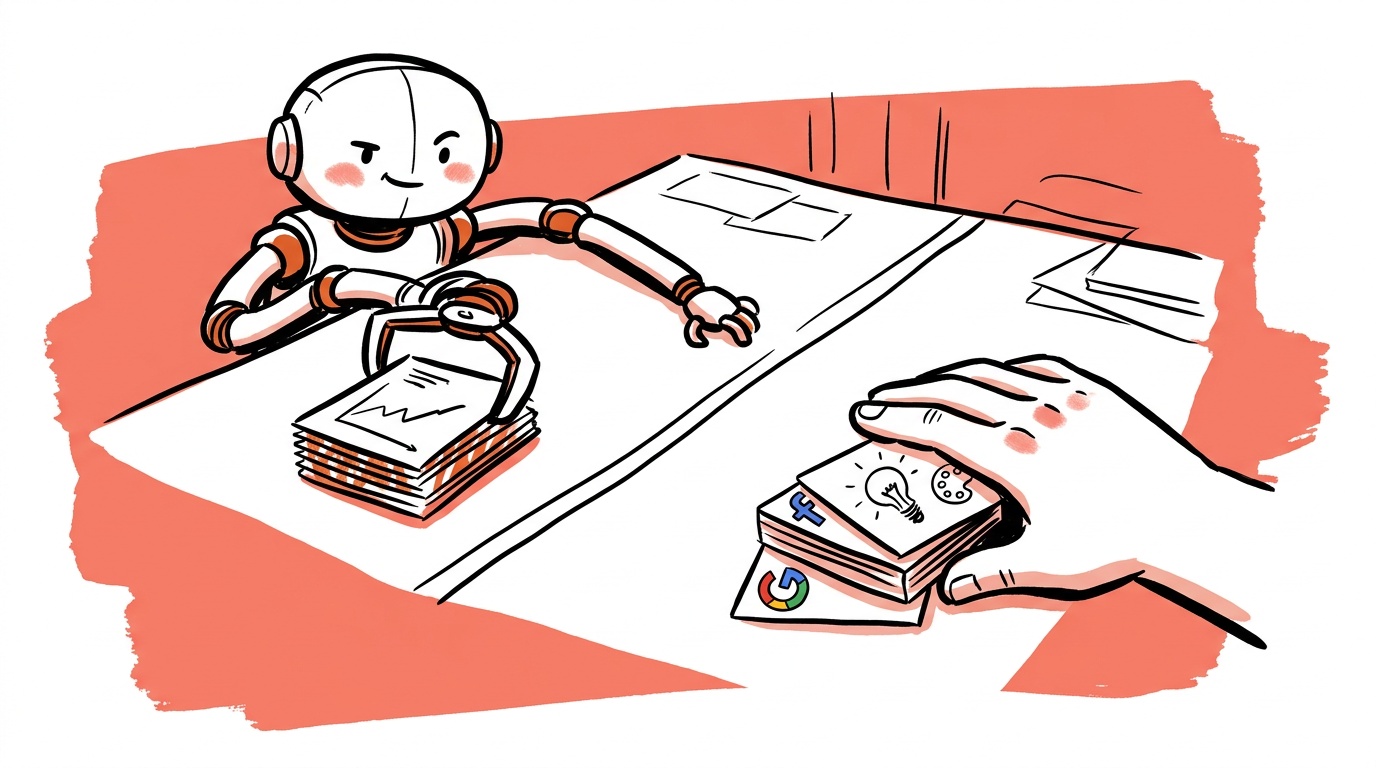
Format selection is not a creative preference. It is an auction variable. Platforms score your ad for predicted engagement before it serves — and a mismatched format lowers that score before a single user has seen your creative. You lose reach, pay more per impression, and wonder why your "proven" ad stopped working.
Most advertisers pick formats the way they pick a restaurant: whatever's familiar, whatever's close, whatever worked last time. The result is a feed full of static images running against video placements they were never designed for, paying CPMs that punish the mismatch — silently, automatically, every hour the campaign runs.
TL;DR — Ad Format Strategy Basics
- Ad format is an auction input, not just a design choice. Wrong format = lower predicted engagement = higher CPM.
- Each format maps to a specific job: awareness, consideration, or conversion. Mixing them up is expensive.
- Video is not always better. Short-form video dominates cold audiences; static and carousel often win at retargeting.
- Influencer-driven paid ads frequently succeed because the format matches the platform's native content style — not because of the influencer's follower count.
- The fastest diagnostic: sort your ad sets by format, then by cost-per-result. The pattern is almost always obvious within two weeks of spend.
What a Format Actually Does (and Why Platforms Care)
An ad format is the container. It determines how much space your message gets, what interactions are possible, and how the platform's algorithm predicts engagement. That last part is the one most advertisers ignore.
Every major platform — Meta, Google, TikTok, Reddit — runs a predicted click-through or engagement rate into its auction formula. That prediction is seeded partly by historical performance data for your account, but also by aggregate data for that format in that placement. A static image served in a Reels placement has a lower predicted engagement baseline than a vertical video in the same placement, because the platform has observed that pattern across millions of auctions.
A great image in the wrong format slot is still a format mistake. The creative can be perfect and you will still lose the auction on predicted engagement before anyone sees it.
This is why format strategy has to come before creative strategy. You decide where your ad will live and what interaction it needs to drive, then you build the creative to match — not the other way around.
The Three Jobs Formats Are Hired to Do
Every format fits into one of three jobs. When a format is misassigned to the wrong job, performance breaks down in a predictable way.
Job 1: Generate attention (awareness). The format needs to stop a scroll or capture passive attention. Video — especially short, high-motion video — is structurally better here. The autoplay mechanic does work that static formats cannot. YouTube pre-roll, Meta Reels, TikTok in-feed: these placements are built around the assumption that the user is consuming content, not searching for a solution. Your format has to interrupt gracefully.
Job 2: Explain and build preference (consideration). Once someone knows you exist, they need enough information to form an opinion. Carousel formats excel here because they let users self-select depth — swipe once for curiosity, swipe five times for conviction. Long-form video also serves consideration, but only when the audience has already shown interest. Running a ninety-second explainer against a cold audience is a common and expensive mistake.
Job 3: Drive a specific action (conversion). At the bottom of the funnel, clarity beats creativity. Static single-image ads with a direct CTA, collection ads with product feeds, and responsive search ads with tightly matched headlines all outperform elaborate formats here because the user already knows what they want — they just need the path made obvious.
Format-by-Format: What Each One Is Actually Good At
Search (Text) Ads
Text ads on Google and Microsoft Search are the only format where the user declared intent by typing a query. That makes them uniquely powerful for conversion — but nearly useless for awareness, because nobody searches for a brand they've never heard of. Responsive Search Ads (RSAs) let Google mix and match your headlines and descriptions to find the best combination. The catch: you lose control of the exact message. If your brand requires precise framing — legal, financial, medical — pin your critical headlines and accept a lower Ad Strength score in exchange for message integrity. Google's own RSA documentation explains the pinning mechanic clearly.
Static Single-Image Ads
Fast to produce, easy to test, and frequently underrated at the retargeting stage. A static image with a clean offer and a clear CTA routinely outperforms video in warm-audience campaigns, because the user doesn't need to be entertained — they need to be reminded. Where static breaks down: cold audiences on visual platforms. A static image in a Reels or TikTok placement is a format mismatch almost by definition.
Video Ads (Short-Form vs. Long-Form)
Short-form video — roughly fifteen seconds or fewer — is the dominant format for cold-audience reach on every major social platform right now. The first two to three seconds carry most of the weight. If you don't have a hook in that window, you're paying for impressions where the user has already scrolled past.
Long-form video has a real but narrow use case: retargeting warm audiences who need more information before they convert, and YouTube skippable in-stream ads where you've already bought five seconds of forced attention and can use it to qualify the viewer before they skip.
Carousel Ads
Carousel is the most misused format in most accounts we see. Advertisers treat it like a brochure — put every product feature in a separate card and hope something sticks. That's not how users engage with it. Effective carousel ads tell a sequential story or let the user browse a curated selection with intent. If your cards don't have a logical reason to exist in sequence, use a static ad instead.
Collection and Catalog Ads
These are product-feed formats built for one thing: getting someone from browse to purchase with minimal friction. Meta's Advantage+ Catalog Ads and Google's Performance Max with product feeds are the standard implementations. They require a clean, structured product feed. If your feed has bad titles, missing images, or inconsistent pricing, no bidding strategy will save the campaign.
Native and Sponsored Content
Native formats — sponsored articles, in-feed content that matches the surrounding editorial style — work on the same principle as influencer-driven paid ads: the format matches what the user expects to see in that context. When we look at influencer campaigns that succeed as paid ads, the common thread is that the ad looks like content. It uses the platform's native aspect ratios, editing style, and pacing. The format signals "this belongs here" rather than "this is an interruption." That signal affects both human perception and algorithmic scoring.

Live today.
The full campaign — copy, images, targeting — generated for your site and deployed paused for your approval.
Platform Format Cheat Sheet
Before you build anything, know the specs. Running a 1:1 image in a 9:16 placement isn't a creative problem — it's a format problem that no amount of good copy can fix.
| Platform & Placement | Native Format | Recommended Specs | Best Funnel Job |
|---|---|---|---|
| Meta Feed | Static image or video | 1:1 or 4:5, up to 30s video | Consideration, conversion |
| Meta Stories / Reels | Vertical video | 9:16, 15s or fewer for Reels | Awareness, cold reach |
| TikTok In-Feed | Vertical video | 9:16, 15–30s | Awareness, cold reach |
| YouTube Skippable In-Stream | Horizontal video | 16:9, hook in first 5s | Awareness, consideration |
| Google Search | Text (RSA) | 15 headlines, 4 descriptions | Conversion |
| Google Display | Static image or responsive | Multiple ratios; 300×250 is most common | Awareness, retargeting |
These are the baseline specs. Check each platform's current documentation before a campaign launch — dimensions and character limits change without much notice.
How Influencer-Driven Formats Change the Calculus
One of the clearer patterns in how brands run paid ads right now is the shift toward creator-native content as the ad unit itself. The format is no longer designed in a studio — it's shot on a phone, cut with the same rhythms as organic content, and then amplified with paid spend.
This works for a specific reason: format authenticity reduces the friction that makes most ads feel like ads. It's not primarily about the influencer's audience size. Many successful campaigns use creators with modest followings but strong content-native instincts. The format match is doing most of the heavy lifting.
The practical implication: if you're running paid ads on TikTok or Reels and your creative team is producing polished, branded video, you're probably in a format mismatch — even if the creative is technically excellent. TikTok's own creative guidance is explicit about this: content that doesn't feel native to the platform underperforms regardless of production quality.
The Diagnostic: How to Audit Your Format Mix in 20 Minutes
Pull your last 60 days of campaign data. Segment by format. Sort by cost-per-result, not by spend. You're looking for two patterns:
Pattern 1: A format is consuming a large share of budget but producing a small share of conversions. This is almost always a job mismatch — you've hired the wrong format for the stage of the funnel you're targeting.
Pattern 2: A format is producing strong results but getting a small share of budget. This happens when campaign structure or bidding constraints are starving a format that's actually working. Reallocating budget here is usually the fastest win available.
Then check your placements within each format. Meta in particular will serve the same creative across Feed, Stories, Reels, and Audience Network if you let it. A carousel optimized for Feed will look broken in Stories. An image sized for Feed will be pillarboxed in Reels. Platform auto-placement is convenient and frequently wrong. Meta's placement asset customization tool exists specifically to address this — most accounts we audit aren't using it.
Before you publish any ad, view it in every placement it will serve. If you wouldn't stop scrolling for it in that context, the platform's algorithm already knows that.
Building a Format Decision Framework
Here's the shortest version of a format decision framework that holds up across platforms:
- Who is seeing this ad? Cold audience (no prior brand contact), warm audience (visited, engaged, viewed), or hot audience (added to cart, started checkout, past customer).
- What do they need from this ad? Attention, information, or a reason to act now.
- What platform and placement is this running in? What does organic content look like in that exact placement?
- What format is native to that placement and matches the job? Build that format. Don't adapt a format you already have.
The reason most format strategies fail is that step 4 comes first — someone has a video or an image they want to run, and then they reverse-engineer a rationale for the placement. Start from the placement and work backward to the creative.
FAQ
What is an ad format in digital advertising? An ad format is the structural container for your ad — it defines the media type (image, video, text, carousel), the dimensions, the interactive elements available, and the placement it fits. Format choice affects both user experience and how the platform's algorithm scores your ad for predicted engagement before it serves.
Which ad format works best for brand awareness? Short-form vertical video is the most effective format for brand awareness on social platforms because the autoplay mechanic generates passive attention without requiring user intent. For awareness earlier in the funnel on Google, display ads can reach users who haven't searched for you yet, though targeting precision is lower than search text ads.
When should I use carousel ads vs. single-image ads? Use carousel when you have a sequential story to tell or a curated product set users can browse with intent. Use single-image when your message is simple and direct — particularly at the retargeting stage, where the user already knows you and needs a clear prompt to act, not additional explanation.
Why do influencer-style ads perform better as paid placements? Because the format matches the native content style of the platform. Ads that look and feel like organic content generate higher predicted engagement scores from the algorithm and lower psychological resistance from users. The format authenticity matters more than the influencer's follower count.
How do I know if I'm running the wrong ad format? Sort your campaigns by format, then by cost-per-result. If a format is consuming a disproportionate share of budget relative to the results it produces, you likely have a job mismatch — the format is misassigned to the wrong funnel stage. Also check whether your creative dimensions and aspect ratios actually match the placements you're targeting.
Does platform auto-placement hurt performance? It can. Auto-placement will serve the same creative across multiple placements with different aspect ratios and user behaviors. A creative designed for one placement will often be technically distorted or contextually wrong in another. Using placement asset customization to tailor creative per placement is one of the more consistently effective fixes we see in accounts that have let auto-placement run unchecked.
What's the most common ad format mistake founders make? Running static image ads in video-native placements like Reels or TikTok in-feed. The format signals to the algorithm that the ad is likely to underperform in that context, which raises CPMs and reduces reach — before a single user has even seen it. The fix is either to produce format-native video or to exclude those placements explicitly.
The specific takeaway: pull your last 60 days, sort by format, sort by cost-per-result. If the answer isn't immediately obvious within ten minutes, your campaign structure is probably too consolidated to diagnose anything — which is its own problem worth solving first.
Live today.
The full campaign — copy, images, targeting — generated for your site and deployed paused for your approval.
We build AdControlCenter — AI-powered ad management for small businesses, online stores, SaaS companies and service providers. We write what we'd want to read: real numbers, no fluff, the things we wish we'd known when we started.
More from the team →