Most of the founders who told us they were "fully AI-automated" in early 2025 had quietly hired a media buyer by Q3. We know because they told us directly, often while asking whether our product had a better kill switch than the tool they'd just fired. The agents weren't useless. The gap between demo and production was just larger than the ad budget could absorb while they figured it out.
That's the honest starting point. AI agents for PPC are real, they do specific things well, and they will waste real money the moment they step outside those boundaries. Here is exactly where the line sits in mid-2026.
TL;DR — AI agents for PPC in 2026
- An AI agent is not a chatbot. It is a loop: observe → reason → act → observe again. That loop is now fast enough to be useful inside a live ad account.
- Bid management, budget pacing, anomaly alerting, and negative-keyword harvesting are genuinely agent-ready today.
- Offer strategy, audience insight, creative direction, and landing-page decisions still require a human. Agents that claim otherwise are automating the wrong thing.
- The real risk is not that the agent does nothing — it is that it does the right action at the wrong time, at scale, faster than you can stop it.
- When evaluating a vendor, ask for the kill switch first, the benchmark second.
What an agent actually is
The word "agent" has been diluted to mean anything that calls an API. For PPC purposes it means something specific: a system that holds a goal, observes the current state of an ad account, reasons about the gap between state and goal, executes an action (bid change, budget shift, pause, label), and then observes the result to inform the next action.
That loop — observe, reason, act — is what separates an agent from a rule. A rule fires when a condition is true. An agent updates its model of the world each time it acts. The practical difference: a rule cannot adapt when the market changes shape. An agent, in theory, can.
The "in theory" matters. Today's PPC agents are mostly narrow agents: they carry a fixed goal (minimize CPA, maximize ROAS at budget cap) and a fixed action space (bid multipliers, budget allocation, pause/unpause). General agents that could rewrite ad copy and restructure campaign architecture and negotiate a budget increase with your CFO do not exist in production. Anyone selling that is selling a roadmap.
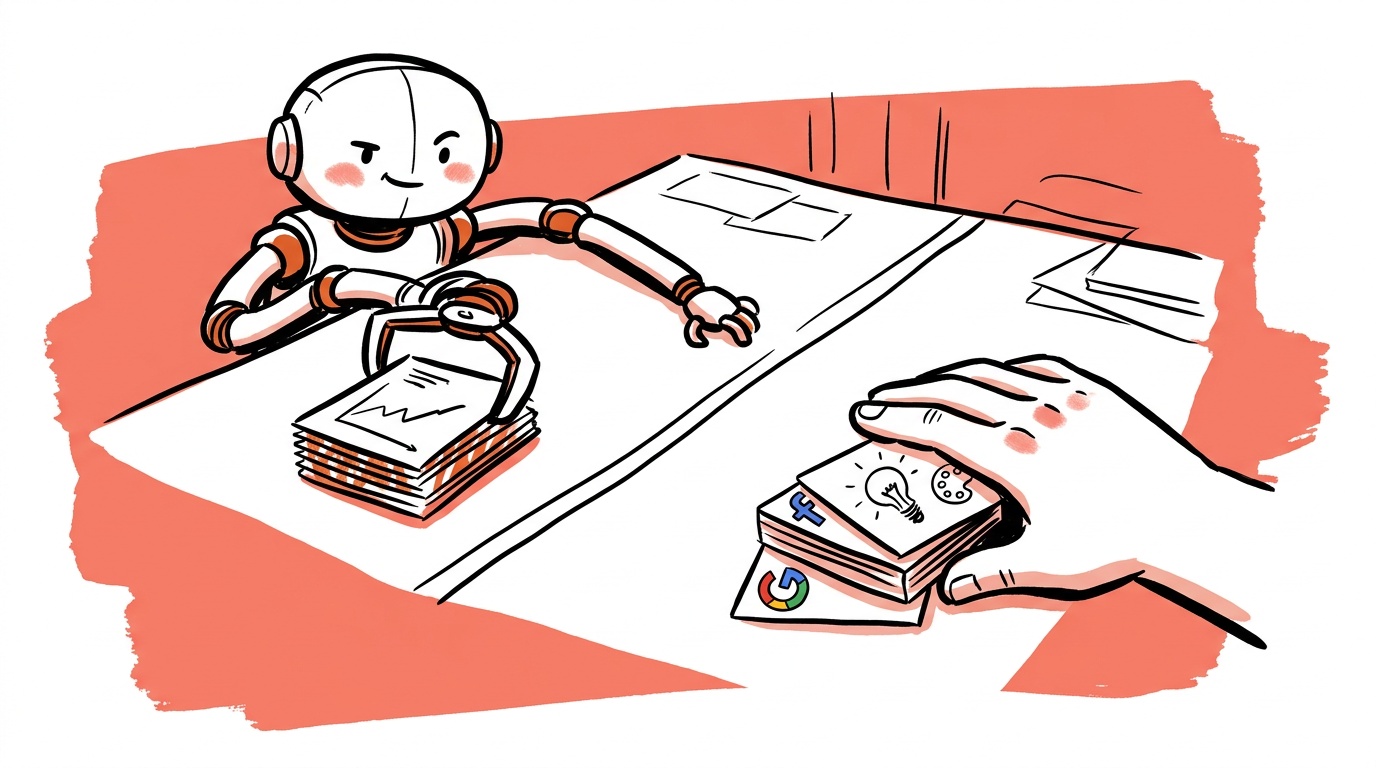
Narrow does not mean weak. A narrow agent running a bid loop on a large Performance Max or Search campaign is evaluating thousands of micro-decisions per hour that no human can match in speed or consistency. Narrow and fast, applied to the right problem, is genuinely valuable.
The autonomy ladder: what to let agents do alone
Before getting into specific tasks, it helps to have a mental model for how much autonomy any given action should carry. We think about it in four levels:
Level 0 — Human only. Agent observes and surfaces data, but takes no action. Used for offer strategy, creative direction, cross-channel budget calls.
Level 1 — Agent proposes, human approves before execution. The right default for negative-keyword additions, campaign restructuring, and any change that touches more than 10% of account spend.
Level 2 — Agent executes with hard caps, human reviews the log daily. Appropriate for bid target adjustments within a bounded range (say, plus or minus 15% of current target) and intraday budget pacing.
Level 3 — Agent executes autonomously within a tightly scoped action space, human reviews weekly. Reasonable for structural QA (broken URLs, missing ads, label hygiene) and anomaly alerting.
Level 4 — Full autonomy across all actions. We have not seen an account where this was the right call. The founders who ran it in 2025 are the ones who called us in Q3.
The right question when onboarding any agent tool is not "how smart is it?" but "which level does it default to, and can I move each action type down a level if I want to?"
What works today
Bid and budget management
This is the most mature application. Smart Bidding inside Google Ads is itself a narrow agent — it observes auction signals, estimates conversion probability, and sets a bid in real time. Choosing the right target for it is still a human call — our Google Ads bidding and structure guide covers that. Third-party agents add a layer on top: they watch for ROAS drift, detect when Smart Bidding is stuck in a learning phase, and can reset or adjust targets before you lose a full news cycle of spend.
The mechanism is not magic — it is faster reaction to a signal humans typically check once a day. Budget pacing works the same way. An agent that checks hourly burn rate against a daily cap and shifts intraday budgets is doing the same arithmetic a spreadsheet-plus-Zapier setup used to do, just tighter and without the maintenance overhead.
Both of these tasks belong at Level 2 on the autonomy ladder: execute within a bounded range, review the log daily.
Anomaly detection and alerting
Agents are better than humans at watching everything at once. A rule-based alert fires when spend exceeds threshold X. An agent-based anomaly detector notices that spend is normal but CTR dropped 40% on one ad group while impressions held steady — which usually means a creative went stale or a competitor entered the auction with a dominant offer.
The agent cannot fix the creative. But it can surface the signal fast enough that a human can. This is a pure Level 3 task: scoped, observable, low blast radius if wrong.
Negative-keyword harvesting
Search term reports are long and boring. Agents read them, score each term against your conversion data, and draft a negative list for human approval. This is a genuine time save — not because the agent makes better judgment calls than a senior buyer, but because it eliminates the hour per week of mechanical reading.
The important word in that sentence is "draft." Negative keywords pushed directly into a live campaign without human sign-off belong at Level 1, not Level 2. A falsely excluded term can quietly kill a converting segment for weeks before anyone notices.
Structural QA
Checking that every ad group has at least three active ads, that all URLs resolve, that no campaign is accidentally spending on broad match when it should be exact — this is pure pattern-matching at scale. Agents handle it cleanly and catch things humans miss when managing accounts with hundreds of campaigns. Level 3, reviewed weekly.

Live today.
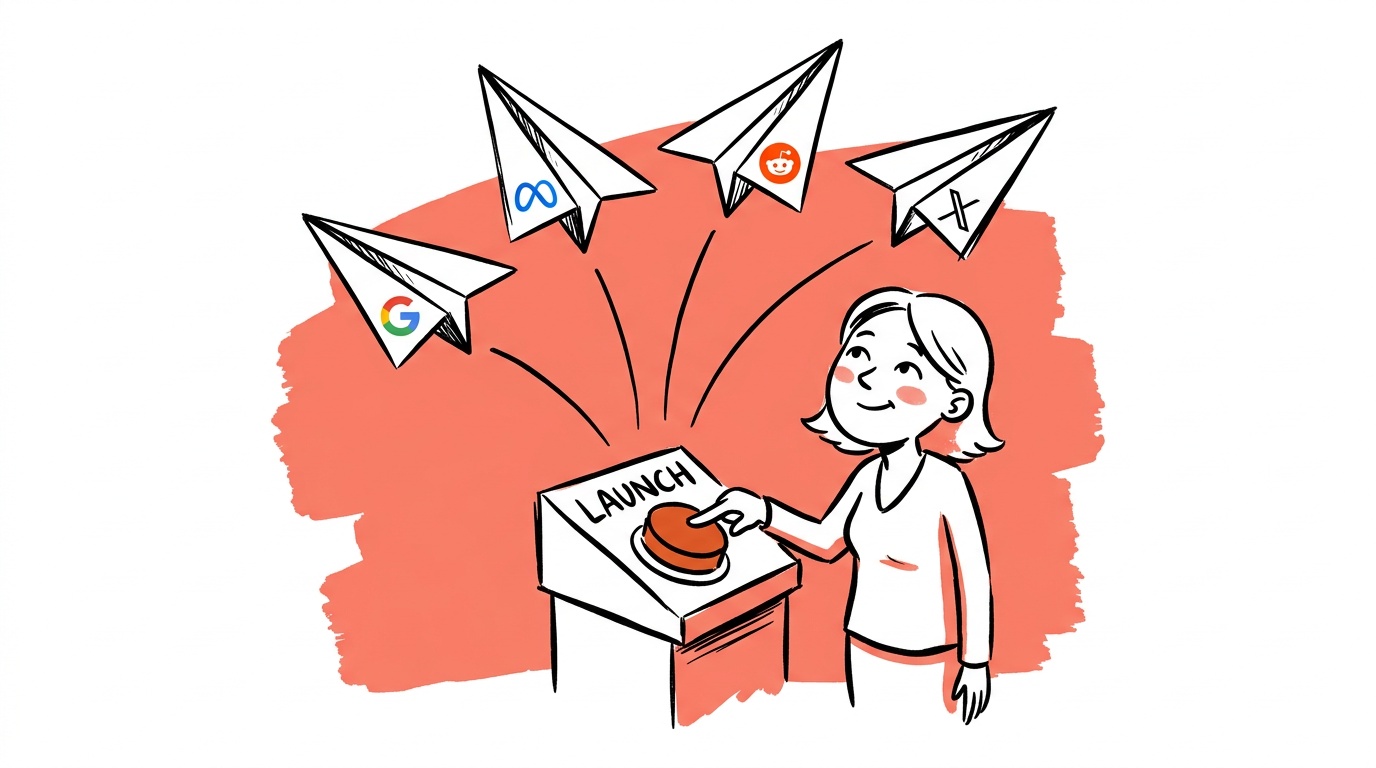
The full campaign — copy, images, targeting — generated for your site and deployed paused for your approval.
What still requires a human
Offer and positioning strategy
An agent can tell you that your current offer converts at 3.2% and a competitor's similar landing page exists. It cannot tell you whether the right response is a price cut, a repositioning, or a new creative angle. That call requires understanding your margin structure, your brand, and your customer — context that lives outside the ad account.
The agents that claim to do this are, in practice, doing something cheaper: A/B testing copy variants and surfacing the winner. Testing variants is not strategy. A well-chosen losing variant can teach you more than a winning one.
Creative judgment
Generating ad copy with an LLM is real and useful as a first draft. We separate the hype from real results for generative AI in ad ops elsewhere. Deciding which creative direction to bet on — funny vs. serious, product-feature vs. social-proof, direct vs. indirect — is a judgment call that depends on brand voice and audience intuition. When we look at the highest-performing creative in our labeled corpus, the common thread is a sharp insight about the customer that no model we've tested would have surfaced unprompted.
Budget allocation across channels
Should this month's incremental $50k go into Google Search, Meta Prospecting, or YouTube? This is a capital allocation decision with a time horizon of weeks and dependencies on organic performance, sales team capacity, and competitive context. An agent optimizing within a channel is poorly positioned to reason across channels. We've seen accounts where an agent correctly maximized ROAS on Google while the obvious move was to shift budget to Meta, where the client had a temporarily cheaper CPM window. The agent had no way to know that. It was doing its job. The problem was that nobody was doing the job the agent couldn't see.
Landing page and post-click experience
Conversion rate is partly a function of your ad. It is mostly a function of your landing page. Agents cannot fix your page. If conversion rate drops and the agent responds by cutting bids, it may be doing exactly the wrong thing — reducing traffic to a page that needs a headline rewrite, not fewer visitors.
The new role: agent supervisor
The organizational shift nobody talks about enough is that running agents well is itself a job. It is not the same job as running ads manually, and it is not no job at all.
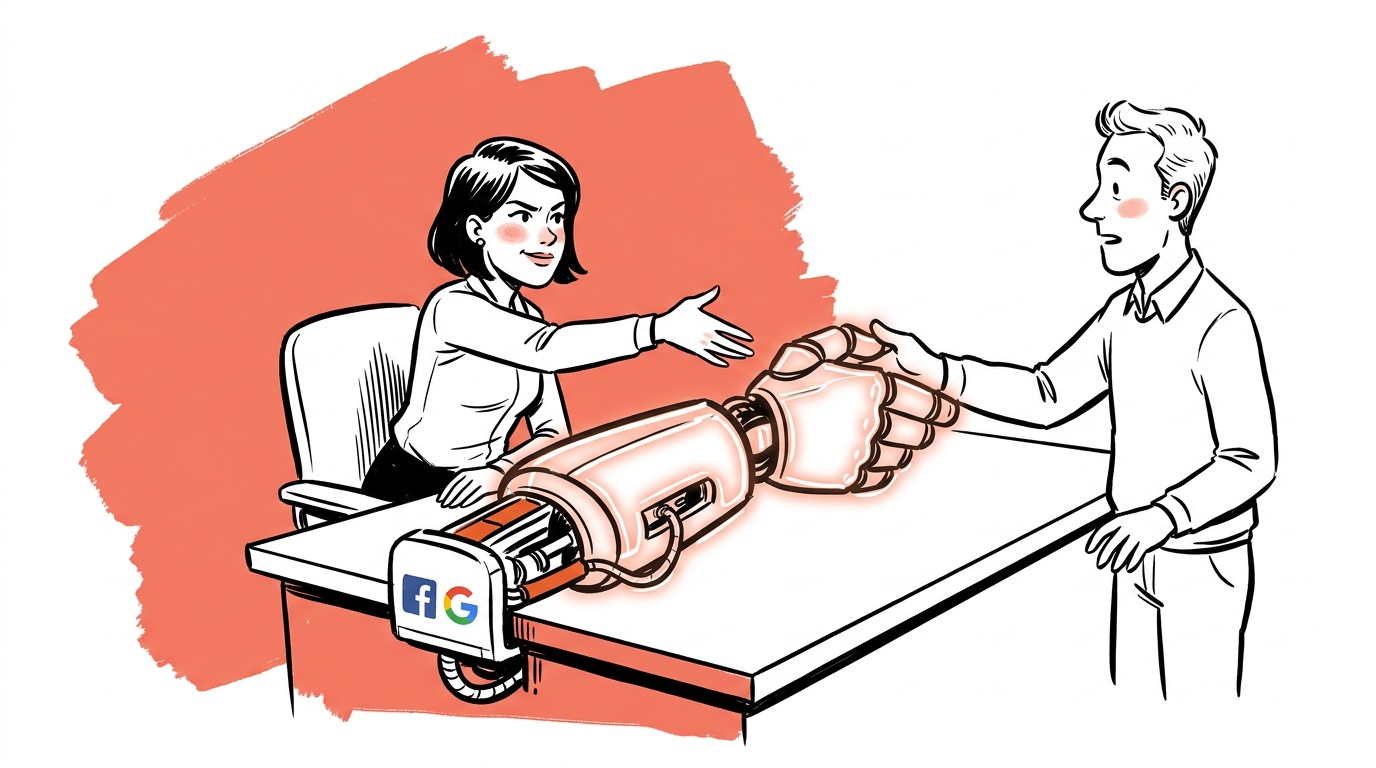
The media buyers who are busiest right now are not the ones who resisted automation. They are the ones who got specific about what they would and wouldn't delegate to an agent, built a daily log review into their process, and freed the time they saved to go deeper on offer development and creative strategy. That's the "agent supervisor" role in practice: configure the action space, review the log, handle everything the agent flags as outside its scope.
The ones losing ground are the ones who were doing only the mechanical half — bid monitoring, budget checks, search term reports — and handed all of it to an agent without replacing it with anything harder.
Job postings for PPC roles that explicitly mention "AI agent management," "automation oversight," or "agent configuration" have increased substantially since early 2025. The title is different. The leverage is higher. The strategic ceiling is the same.
How to evaluate a vendor
Every PPC AI vendor in 2026 claims agents. Here is what to actually ask:
1. What is the action space? Get an exact list of every action the agent can take without human approval. If the vendor can't produce this list in under two minutes, the answer is "we don't know," which is a problem.
2. Where is the kill switch? You need to be able to pause all agent actions instantly — not in the next polling cycle, not "within 15 minutes." Instantly. Ask for a live demo of the kill switch before you ask for anything else.
3. What is the approval workflow? The best agents in production today operate in a human-in-the-loop model: propose, approve, execute. Full autonomy should be opt-in, not default.
4. What happens during a learning phase? Every major platform penalizes frequent changes during learning (Meta's is the strictest — see how to escape the Facebook learning phase). Ask how the agent detects when an account is in a learning phase and what it does differently. If the answer is "it just keeps optimizing," the agent will fight the platform's own model and burn budget doing it.
5. Can you audit every action? Demand a full action log — timestamped, with the reason the agent gave for each action. No log means no accountability, and you cannot learn from mistakes you can't see.
6. What is the benchmark, and how was it constructed? "Improved ROAS by 23%" is meaningless without knowing the comparison period, whether spend changed, and whether the platform's own Smart Bidding was running. Ask for a controlled comparison, not a before/after during a seasonality shift.
Vendors who lead with benchmark numbers and bury the action log requirement are optimizing for the sale, not for your account. The log is more important than the benchmark. You can verify one of them.
The real risk is speed, not intelligence
People worry that AI agents will make wrong decisions. The more expensive failure mode is that they make fast wrong decisions. A human making a bad bid change on a $500/day campaign costs you an afternoon. An agent making the same bad change across 200 campaigns simultaneously costs you the month.
The accounts we've seen get hurt badly by agents almost always had the same configuration: full autonomy enabled, action log never reviewed, no per-action budget caps. The agent wasn't broken. It was doing exactly what it was configured to do — just in a direction nobody had anticipated.
The fix is not to distrust agents. It is to treat agent configuration as a risk-management exercise. Use the autonomy ladder. Set caps. Read the log. The founders who are getting real value from agents in 2026 are the ones who spent a day on configuration before they spent a dollar on automation.
Sources consulted: Google Smart Bidding documentation, Meta Ads Learning Phase guidelines, How foundation models are used in agentic settings — Anthropic research overview
FAQ
What is an AI agent for PPC? An AI agent for PPC is a system that observes your ad account data, reasons toward a goal (such as hitting a target ROAS or staying within a budget cap), takes an action (bid change, budget reallocation, pause, alert), and then observes the result to inform its next action. It is distinct from a simple rule or script because it updates its behavior based on outcomes rather than firing once when a fixed condition is met.
Can AI agents fully automate Google Ads management in 2026? Not safely. Agents handle bid management, budget pacing, anomaly detection, negative-keyword drafting, and structural QA well. They do not handle offer strategy, creative direction, cross-channel budget allocation, or landing-page decisions. Accounts that ran fully autonomous agents without human oversight have, in several documented cases, experienced significant budget waste when agents optimized correctly within a flawed setup.
How is an AI PPC agent different from Google's Smart Bidding? Smart Bidding is itself a narrow agent built into Google's auction system — it sets bids in real time using signals Google holds. Third-party agents operate at a higher level: they watch Smart Bidding's outputs, detect when it is underperforming or stuck in a learning phase, and adjust targets or budgets to guide it. They do not replace Smart Bidding; they supervise it.
What should I look for when buying a PPC AI agent tool? Ask for: (1) an exact list of every action the agent can take autonomously, (2) a real-time kill switch with a live demo, (3) a full timestamped action log, (4) a clear human-approval workflow for high-impact changes, and (5) a benchmark that includes a controlled comparison, not just a before/after during different market conditions.
What are the biggest risks of using AI agents for paid ads? Speed at scale. An agent making a suboptimal decision across hundreds of campaigns simultaneously can cause damage that takes weeks to reverse. The risk is compounded when action logs are not reviewed and when there are no per-action budget caps. Think of agent configuration as a risk-management decision, not a setup task.
Do AI agents work on Meta Ads as well as Google Ads? Meta's API exposes enough bid and budget controls for agents to operate, but Meta's auction dynamics are different — creative fatigue matters more, and the learning phase is more sensitive to frequent changes. Agents built primarily for Google Search and applied to Meta without adjustment tend to over-optimize bids and under-weight creative refresh signals. If you're running agents across both platforms, the action space and cap settings should be configured separately.
Will AI agents replace PPC managers? Agents are replacing the mechanical, repetitive half of PPC work — bid monitoring, budget pacing, anomaly watching. They are not replacing the strategic half — offer development, audience insight, creative direction, and cross-channel thinking. The PPC managers losing work are the ones who were only doing the mechanical half. The ones who are busier than ever are the ones who used the reclaimed time to go deeper on strategy, and who now also manage the agents themselves.
The specific question worth sitting with: if you pulled your current agent's action log right now and reviewed every decision it made in the last seven days, how many of those decisions would you have made the same way? If you haven't looked at the log lately, that's the first thing to fix — not the bidding strategy.
Live today.
The full campaign — copy, images, targeting — generated for your site and deployed paused for your approval.

We build AdControlCenter — AI-powered ad management for small businesses, online stores, SaaS companies and service providers. We write what we'd want to read: real numbers, no fluff, the things we wish we'd known when we started.
More from the team →