

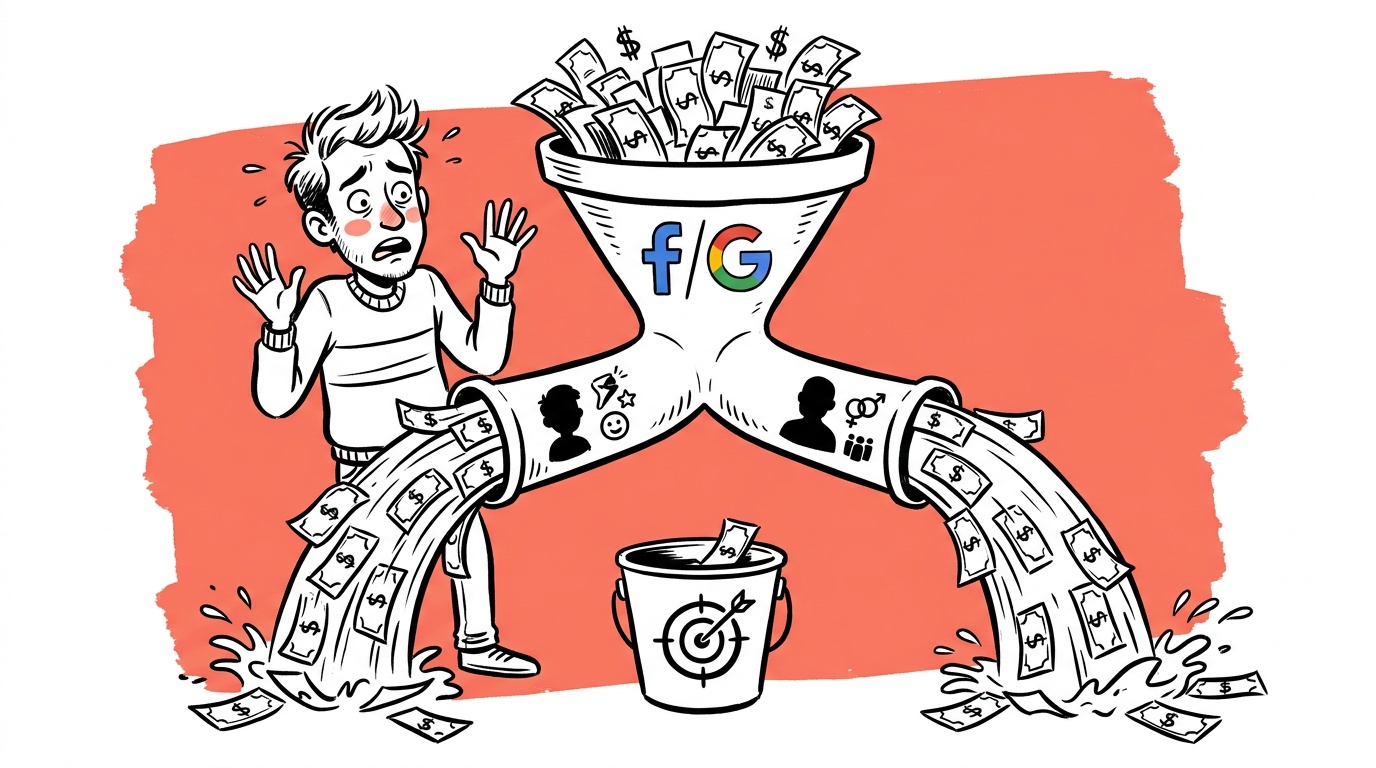
Most founders pick a budget split by instinct or imitation — they do what a peer did, or what an agency pitched. The split is almost always wrong, and the wrongness is expensive in a specific way: money lands on a second platform before the first one is profitable, so neither channel gets enough data to exit the learning phase.
The right question isn't "which platforms should I be on?" It's "what is the minimum spend that produces a real signal on one platform, and how much do I have left after that?" Everything flows from that calculation.
- At $500/mo, run one platform only. Splitting means both accounts stay in perpetual learning mode and you learn nothing useful from either.
- At $1k/mo, you can graduate to one primary + one small remarketing layer, but only after the primary is profitable.
- At $2k/mo, a two-platform split becomes defensible — roughly 70/30 between a proven primary and a second channel.
- At $5k/mo, three platforms can work, but the split should still be unequal: one channel should always hold at least 50% of total spend.
- Adding a new platform costs more than the incremental budget — it costs your attention. Price that in before you diversify.
The minimum viable signal problem
Before talking about splits, it helps to understand exactly what "enough data" means at each budget level. The table below shows the implied monthly budget required to exit the learning phase by campaign objective, using Meta's published threshold of 50 conversion events per ad set per week as the baseline. Google's Smart Bidding has a similar threshold documented in its auction-time bidding guidance.
| Objective | Conversions needed/week | Example CPA | Implied weekly spend | Implied monthly spend |
|---|---|---|---|---|
| Purchase (ecom) | 50 | $25 | $1,250 | $5,000 |
| Purchase (ecom) | 50 | $15 | $750 | $3,000 |
| Lead (B2B) | 50 | $10 | $500 | $2,000 |
| Lead (B2B) | 50 | $5 | $250 | $1,000 |
| Add to cart / initiate checkout | 50 | $5 | $250 | $1,000 |
The practical conclusion: at budgets below $2k/mo, most purchase-focused campaigns will never exit the learning phase on a conversion objective. The right response is not to split your budget further — it is to use a higher-funnel objective (traffic, add-to-cart, lead) on a single platform until volume justifies switching to purchase optimization.
$500/mo: one channel, maximum data density
$500/mo is roughly $16.50/day. On Meta, that budget is well below what a purchase-optimized campaign needs to learn. You are running a traffic or lead-gen campaign and relying on downstream economics — which is fine, but it means you need every dollar producing signal on the same platform.
For most direct-to-consumer physical products, that platform is Meta. For most B2B or high-intent search, that is Google Search. For entertainment or impulse consumer products targeting younger audiences, that is TikTok — but only if you have native-feeling video creative, because static ads perform poorly there regardless of budget.
Suggested split at $500/mo:
| Platform | % | $/mo |
|---|---|---|
| Primary (Meta or Google or TikTok) | 100% | $500 |
What you are buying here is not scale — it is signal. You need to know your real cost per acquisition before you spend anything on a second platform.
$1k/mo: primary + a thin remarketing layer
At $1k/mo you have real options, but only one of them is usually right.
If your primary channel is not yet profitable at $500, spending $1k/mo by adding a second channel is the wrong move. Double down on the primary first. The correct use of the budget increase is more spend on what already works, or a structured creative test on the same platform. (If the platform you're eyeing is Reddit, $1,000 is also roughly what it takes to get a real verdict — see what $1,000 on Reddit Ads taught two founders.)
If your primary is profitable — meaning you have a measured, repeatable CPA below your target — then a small remarketing layer starts to make sense. Remarketing audiences are cheaper to reach on a CPM basis than cold prospecting audiences, and they convert at higher rates because those people already know you. The tradeoff is that the audience is capped by your existing traffic volume. At $1k/mo, your traffic volume probably limits how much remarketing spend is actually useful, which is why 20% is the ceiling, not the floor.
Suggested split at $1k/mo (primary profitable):
| Platform | % | $/mo |
|---|---|---|
| Primary (prospecting) | 80% | $800 |
| Remarketing (same or second platform) | 20% | $200 |
Suggested split at $1k/mo (primary not yet profitable):
| Platform | % | $/mo |
|---|---|---|
| Primary (continue testing) | 100% | $1,000 |
The $200 remarketing budget matters less than it looks in the short term. The real value of adding it is that it forces you to set up your pixel, your audiences, and your attribution cleanly — infrastructure that becomes expensive to fix later if you skip it now.

Live today.
The full campaign — copy, images, targeting — generated for your site and deployed paused for your approval.
$2k/mo: the first real two-platform split
$2k/mo is where multi-channel strategy becomes genuinely available to a small-budget operator. You have enough to run a real prospecting campaign on one platform and a meaningful test on a second.
The constraint is still attention, not money. Every new platform requires its own creative format, its own bidding logic, its own learning period, and its own attribution lens. Adding a second platform at $2k means you are managing two sets of variables simultaneously. That is only worth doing if your first platform has a stable, understood CPA.
Assume your primary platform is Meta and it is profitable. A reasonable second channel at this budget level is Google — specifically, Google Search if you have search volume, or YouTube if you have video creative.
At $2k/mo, a 50/50 split puts $1k on a platform that hasn't proven itself yet. That is a bet, not a strategy. The 70/30 split keeps your proven channel well-funded while giving the new channel enough budget to generate real data. For most non-competitive Google Search categories, $600/mo is enough to accumulate meaningful click and conversion volume within 60 days — though competitive categories with high CPCs will need more.
Suggested split at $2k/mo:
| Platform | % | $/mo |
|---|---|---|
| Primary (proven) | 70% | $1,400 |
| Secondary (testing) | 30% | $600 |
Run this split for 60 days. If the secondary channel's CPA is within 30% of your primary channel's CPA after 60 days, you have a real second channel. If it is not, either the creative is broken, the audience is wrong, or the channel genuinely does not work for your product. All three are useful findings.
$5k/mo: three platforms, still unequal
$5k/mo is the first budget level where a three-platform approach is defensible — but the allocation math is more important here, not less.
The instinct at this budget is to spread more evenly: maybe 40/30/30. Resist it. An even split means no channel is dominant, no channel is well-fed, and you are managing three sets of learning-phase problems simultaneously.
The correct structure is a clear primary, a clear secondary, and a small experimental slot.
Suggested split at $5k/mo:
| Platform | % | $/mo |
|---|---|---|
| Primary (proven, scaled) | 50% | $2,500 |
| Secondary (proven, growing) | 35% | $1,750 |
| Experimental (new channel / new format) | 15% | $750 |
The 15% experimental slot is not optional and not random. It exists to answer one specific question: "is there a third channel that can become my second channel?" You are not trying to make the experimental slot profitable in 30 days. You are trying to find out whether the economics are plausible.
At $5k/mo you also have enough budget to start separating creative testing budgets from scaling budgets within each platform. That matters because creative testing requires different bid strategies and campaign structures than scaling does. Running them in the same campaign corrupts both signals.
When we look at accounts that scaled past $5k/mo successfully, the common pattern is not that they found more channels — it is that they found one creative angle that worked at scale on their primary channel, then used the confidence from that to fund the second channel honestly. Diversification was a consequence of stability, not a cause of it.
When to add a new platform
The question "when should I add a second platform?" has a specific, answerable form: when your marginal CPA on additional spend on your current platform is rising faster than your target CPA.
In plain terms: if you can spend $500 more this month on Meta and the CPA on that incremental $500 is still below your target, do not add a new platform. You have not saturated your current one.
The signal that you have saturated a platform looks like this:
- Frequency climbs past 3.0 on Meta prospecting audiences with no corresponding CPA improvement
- Incremental spend produces CPAs 40% or more above your baseline
- Audience sizes are shrinking relative to reach
When you see those signals, adding a platform is the right move — not before. Adding a second platform to a channel that still has room to grow just splits your attention without increasing your ceiling. Our solo-founder ads routine has the weekly 90-minute structure that keeps that attention cost visible.
There is a second, simpler trigger: you have video creative and you have not tested YouTube or TikTok. Video-first platforms can outperform static-first platforms by a wide margin for certain product categories. If you have the asset, the test cost is low relative to the potential upside. The TikTok for Business campaign budget documentation is worth reading before you set up your first campaign — their budget minimums and learning phase mechanics differ meaningfully from Meta's.
Further reading:
- Meta's guidance on the learning phase and conversion event thresholds
- Google's Smart Bidding and auction dynamics documentation
- TikTok for Business: campaign budget recommendations
FAQ
How do I split my ad budget across platforms? Start with 100% on one platform until you have a profitable CPA. Then move to a 70/30 split (primary/secondary) once your primary is proven. Only consider a third platform at $5k/mo or higher, and keep it to 15% of total spend until it proves itself.
What is the minimum budget to run ads on multiple platforms at once? $1,000/mo is the practical floor for a two-platform approach, and only if your first platform is already profitable. Below that, splitting your budget means neither channel accumulates enough conversion data to exit the learning phase and produce reliable signals.
Should I use Meta or Google first with a small ad budget? It depends on your product and audience. Google Search works best when people are actively searching for what you sell. Meta works best when you need to create demand or when your audience is defined by interest and behavior rather than search intent. Most DTC physical products start on Meta; most B2B and high-intent service businesses start on Google.
How long should I test a new platform before cutting it? Run it for at least 60 days with a consistent budget before making a cut decision. Fewer than 60 days and you are likely seeing learning-phase distortion rather than true platform performance. At 60 days, if CPA is more than 40% above your primary channel's CPA with no downward trend, that is a real signal to pause.
What percentage of my ad budget should go to remarketing? At $1k/mo, roughly 20%. At $2k/mo, roughly 15%. At $5k/mo, roughly 10%. Remarketing audiences are cheaper to reach on a CPM basis than cold prospecting, but the audience size is capped by your traffic volume — at small budgets, remarketing audiences are too small to absorb more than a modest share of spend productively.
When should I stop scaling a platform and add a new one? When incremental spend on your current platform produces CPAs consistently 40% or more above your baseline, and when you are seeing frequency creep or shrinking audience sizes, it is time to add a new channel. Until those signals appear, adding a platform is a distraction, not a strategy.
Does TikTok work for small budgets? TikTok's minimum campaign budgets are low in absolute dollar terms, but the platform's algorithm requires significant conversion data to optimize efficiently. At $500/mo you are unlikely to accumulate enough events to drive efficient CPA. It becomes more viable at $1,500/mo or above, and only if you have native-feeling video creative. Static ads perform poorly on TikTok regardless of how much you spend on them.
The specific takeaway: before you add any platform, write down your current primary channel's CPA and your target CPA. If the current CPA is above target, the problem is your creative or your offer — and a second platform will not fix either of those.
Live today.
The full campaign — copy, images, targeting — generated for your site and deployed paused for your approval.

We build AdControlCenter — AI-powered ad management for small businesses, online stores, SaaS companies and service providers. We write what we'd want to read: real numbers, no fluff, the things we wish we'd known when we started.
More from the team →