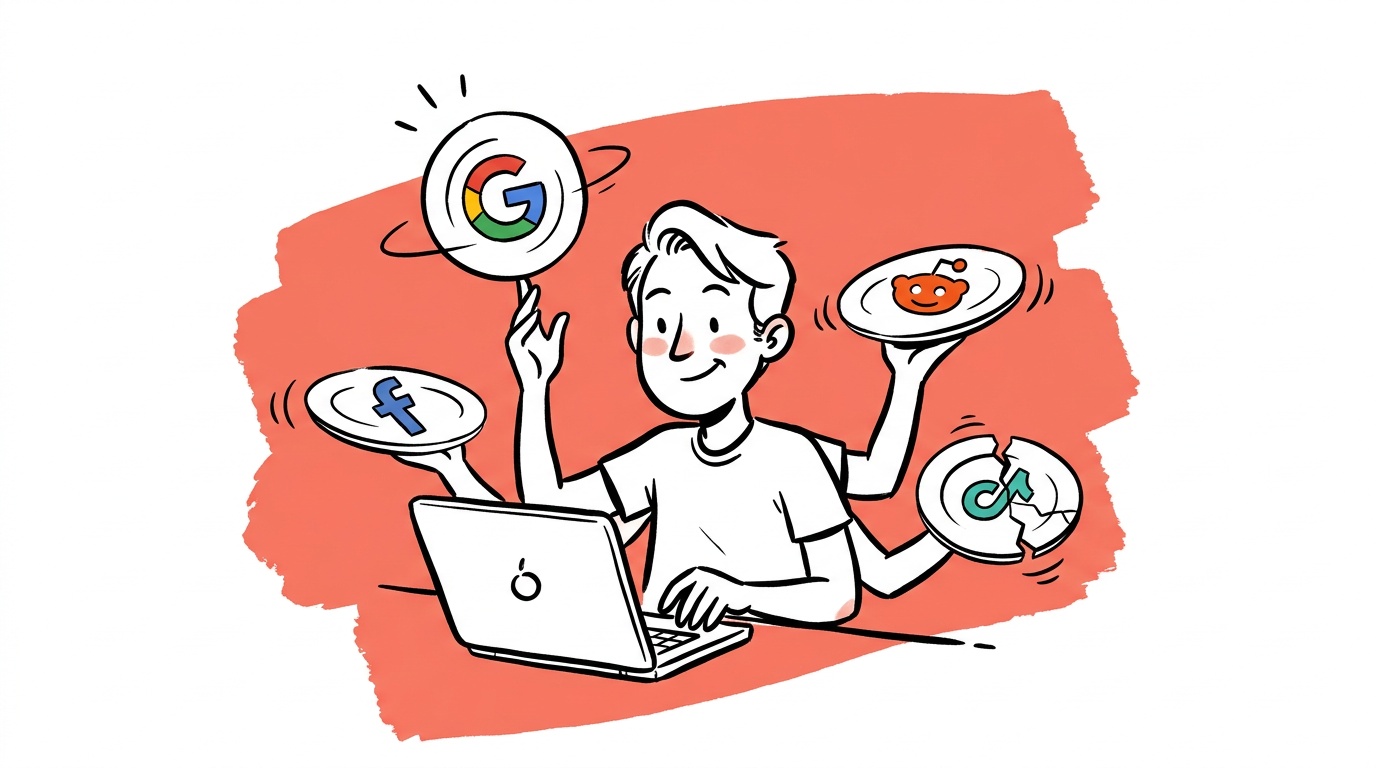
The dirty secret of multi-channel paid ads as a solo operator is that you're not actually running four channels. You're running one channel that's working, two channels that are sort of working, and one channel that you keep meaning to fix. Pretending otherwise is how budgets bleed.
This is the routine we've settled on after running our own paid ads (and watching customers run theirs) for the past 18 months.
Solo founders and small teams running their own paid ads with budgets between $500 and $10,000 per month. If you have an agency, this isn't for you. If you have $50/day across four channels, this is for you.
The 90-minute weekly routine
One window per week. We do it Friday morning. Three blocks:
Block 1 — Triage (20 minutes). Open each platform. Look at week-over-week spend, conversions, CPA. Note any deltas more than 25% in either direction. You're not fixing anything yet — you're just orienting.
Block 2 — One thing per channel (50 minutes). Pick the highest-leverage action per platform. Not five things. One. Examples: pause the worst-performing ad, add three negative keywords, increase budget on the one campaign that's working, write one new ad variant. Discipline matters more than volume.
Block 3 — Decide what to ignore (20 minutes). Write down — actually write down, in a Google Doc — the things you noticed this week but are choosing not to act on. This is the most important block. The list of "things I'm consciously ignoring" is shorter than the list of "things I haven't gotten to," and that distinction is what keeps you sane.

Budget split across platforms
A starting framework, by monthly budget:
$500/month. All on one platform. Whichever one is closest to your customer's real attention. Almost always Google for high-intent searches; Reddit for niche communities; Meta for visual products.
$1,000/month. Two platforms, 70/30 split. Lead with the working one. The 30% on the second platform is exploration, not expectation.
$2,500/month. Three platforms, 50/30/20. The 20% slot rotates — quarterly, you decide whether to double down on what worked or kill it and try a new platform.
$5,000/month and up. Four platforms is now defensible. Mix is roughly 40/30/20/10. Note: at this budget you've probably outgrown solo-founder mode and an agency starts to make economic sense. The agency math: a good agency adds 15–25% performance lift, costs 10–15% of spend, breakeven happens around $5K/month.
Which platform first — the actual decision tree
Not the abstract one. The one we use:
- Does your customer search for your problem in clear words? → Google Ads.
- Does your customer hang out in 1–3 specific communities? → Reddit Ads.
- Is your product visually evident at first glance? → Meta (Instagram in particular).
- Are you under 35 and selling something young people buy? → TikTok Ads.
Most founders fit two of these, not all four. Pick the strongest match, run it for 60 days, then add the next.
Cross-platform attribution for the rest of us
A short, honest take: at solo-founder scale, cross-platform attribution is mostly noise. The platforms each over-report their own contribution. Last-touch under-credits awareness platforms. Multi-touch models require data volume you don't have.
What works instead:
- Run one platform at a time for the first 90 days. Whatever conversions happen in that window are mostly attributable to that one channel.
- Use UTM parameters religiously. Source, medium, campaign at minimum. The data won't be perfect but it'll be honest.
- Trust patterns, not absolutes. "Reddit conversions feel slow but high-LTV" beats "Reddit's CPA is $X.YZ."


Live today.
The full campaign — copy, images, targeting — generated for your site and deployed paused for your approval.
When to add a platform
Three signals it's time:
- The current platform is at $80+ per acquisition and the math shows it'll only get more expensive.
- You're saturated. Your daily budget is no longer producing more conversions; you're just paying more per click.
- A specific customer cohort isn't reachable through your current channel mix.
Three signals it's NOT time:
- Boredom. Adding a platform because the existing one feels stale is the most expensive form of procrastination.
- Competitor copying. Just because they're on TikTok doesn't mean you need to be.
- Vendor pitch. A rep from a platform offered you a setup credit. Use it only if the platform fits the audience criteria above.
When to drop a platform
The honest test: kill the platform for 30 days. If your business notices, bring it back. If your business doesn't notice — kill it permanently.
We know this sounds aggressive. It is. But solo founders consistently keep platforms running long after they've stopped contributing, because the spend is small and the cognitive overhead of officially killing it feels heavier than just letting it run. That cognitive overhead is real. It accumulates across multiple platforms until your weekly routine stretches to four hours and you stop doing it.
The platforms that quietly bleed are more dangerous than the ones that loudly fail. A platform losing 5% per week is worse than one losing 30% per month — you'll notice the second; you won't notice the first.
The hand-off checklist
When (if) you eventually hire help — agency, freelancer, in-house — the things you'd want to hand over cleanly:
- One-paragraph brand brief
- The 5 ads currently working, with notes on why
- Negative-keyword lists per campaign
- Audience definitions per platform, in plain English
- Spend cap and KPIs
- The "things I'm consciously ignoring" doc
Most operators don't write any of this down. The hand-off then takes weeks instead of days, and the agency rebuilds half of it from scratch — losing the institutional memory you accumulated.
What we'd ship first
If you're starting from zero, this week:
- Pick the one platform from the decision tree
- Open the platform, set up tracking, set a hard daily cap
- Launch with three ads, narrow targeting
- Block 90 minutes on Friday for the routine
The compounding only happens if the routine happens. The platform doesn't matter as much as the discipline of looking at it once a week.
Live today.
The full campaign — copy, images, targeting — generated for your site and deployed paused for your approval.
We build AdControlCenter — AI-powered ad management for small businesses, online stores, SaaS companies and service providers. We write what we'd want to read: real numbers, no fluff, the things we wish we'd known when we started.
More from the team →