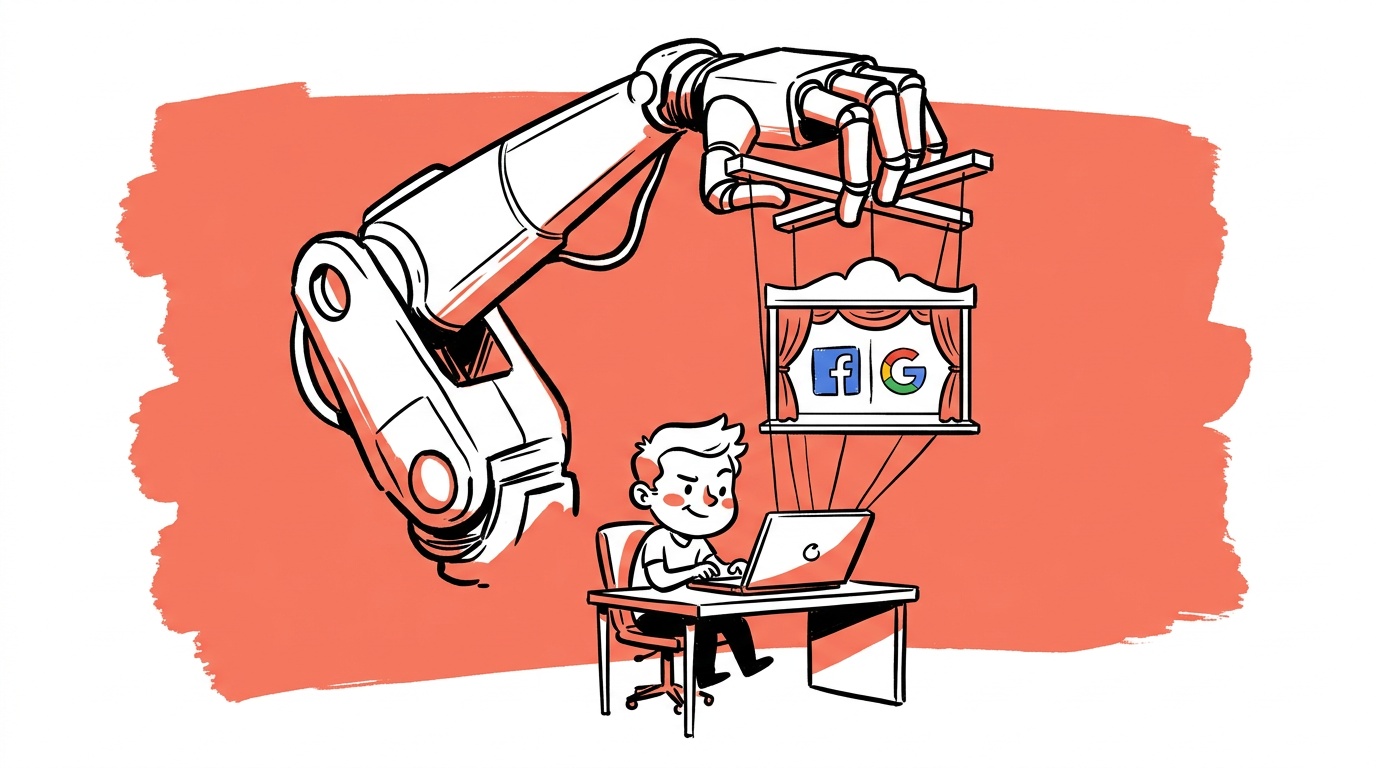
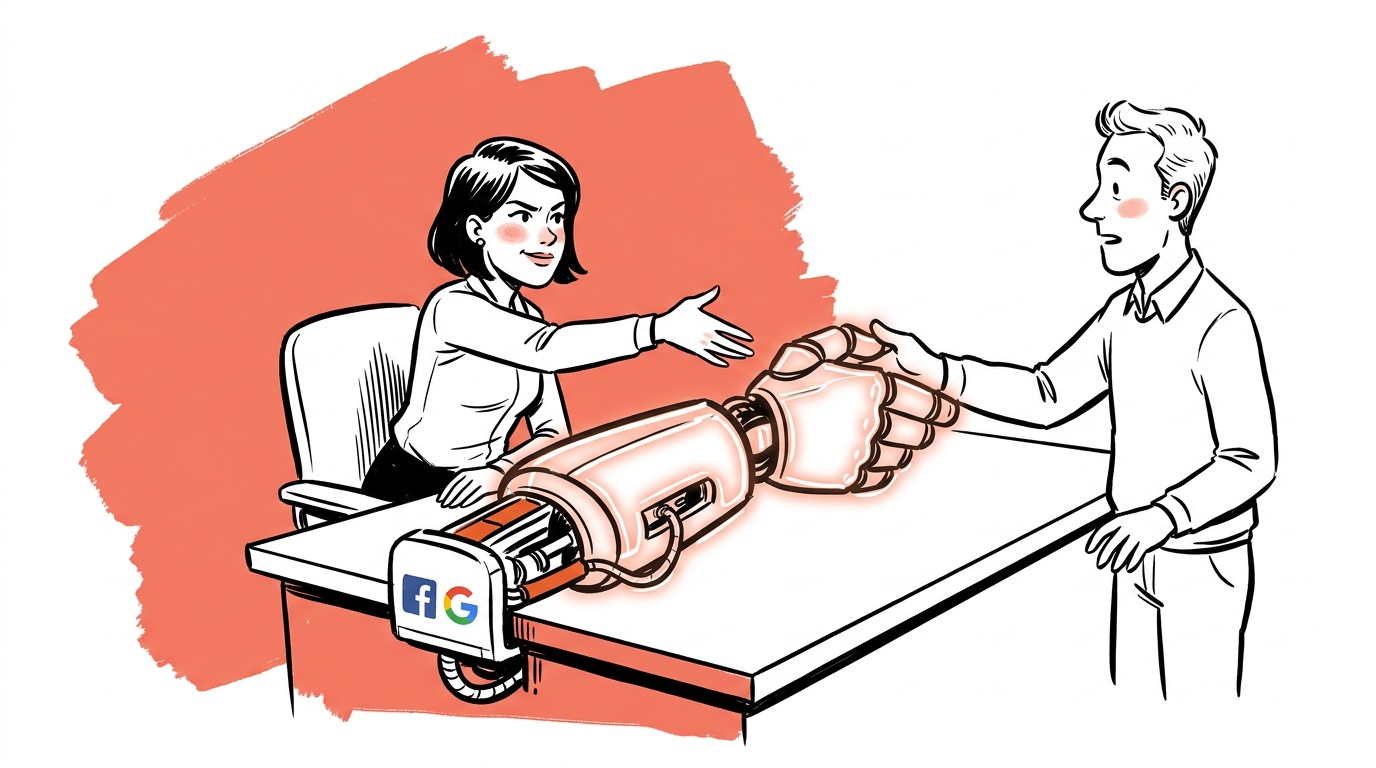
The pitch in 2026 is that AI runs your ads for you. The reality is that AI runs the ads it was already going to run, and the difference between a good account and a bad one still sits inside the operator's head. This is a tour of what's working, what's not, and which doors are about to open.
We've been operating an AdControlCenter campaign on Google + Reddit since April 2026, and we've audited around 40 small-to-mid-sized accounts since then. The patterns below are from that working dataset, not vendor decks.
What AI is actually good at right now
Three categories where AI is paying for itself:
-
Creative volume. Generating 30 ad variants in 90 seconds, with consistent brand voice, is no longer a research project. The bottleneck used to be writers and designers; the bottleneck now is approval and tagging. If you don't have a system to triage outputs, you'll drown in mediocre variants.
-
Pattern detection. Spotting that an ad's CTR has decayed 18% over 14 days, that a search term is converting at 3x the average, that a campaign is over-spending on mobile when desktop converts better — this is what the platforms themselves should be doing and aren't. Third-party AI eats that gap.
-
Triage and summarization. Ten minutes of "what changed in my account this week and what should I look at first" is the most valuable AI use case nobody talks about. It's not flashy. It saves hours.

What AI is still bad at right now
A short list, with intent to be honest:
- Strategic decisions. AI will happily pause a campaign because CTR dropped, then learn next week that the campaign was running brand awareness for a product launch. Models do not know your business unless you tell them, and most operators don't.
- Multi-platform attribution. Every AI tool will tell you the cost-per-conversion on every channel. None of them know which channel actually caused the conversion. The vendors that claim to have solved this are mostly just passing through Last-Touch with extra steps.
- Brand-specific creative judgment. The line between "on-brand" and "off-brand" is something humans agree on through taste. AI will get the safe middle right and miss the moments that make creative memorable.
The framework we use to evaluate AI tools
Three questions. If a tool fails any of them, walk away.
Does it expose the prompt matters because if you can't see what the AI was told, you can't reproduce a good result or fix a bad one. Tools that hide prompts are tools where you can't actually iterate. They're black boxes you have to trust on faith.
Does it show its work matters because every AI proposal should come with the data it looked at, the rule it applied, and the alternative it rejected. Without that, you're getting recommendations you can't audit. Audit is half of trust.
Will it stop when you tell it to is the most important. Tools that auto-execute are convenient until the day they auto-pause your best campaign. We default everything to human-in-the-loop. The cost of friction is much smaller than the cost of an AI-driven mistake.

Live today.
The full campaign — copy, images, targeting — generated for your site and deployed paused for your approval.
What's coming in the next 12 months
The boring predictions:
- Better attribution via probabilistic models. First-party data + AI inference is going to close some (not all) of the gap left by cookie deprecation and iOS opacity.
- Live optimization across platforms. Right now most "cross-platform" AI is reactive — pause this on Meta because Reddit is performing better. The next generation will pre-allocate budget based on predicted performance.
- Generative video at production parity. We're maybe 18 months from "type a brief, get a usable 15-second TikTok" being the default workflow.
The interesting prediction:
The winners in 2027 will be the operators who learned to ignore most AI suggestions, not the ones who acted on all of them.
The cost of acting on a bad suggestion is wasted spend. The cost of ignoring a good suggestion is missed lift. As AI volume goes up, the ratio of bad to good suggestions stays roughly constant — so the absolute number of bad suggestions goes way up. Strong filters become more valuable than fast hands.

Where to start if you're new to this
Skip the AI-marketing newsletters. Skip the LinkedIn thought leaders. Read the actual API documentation for the platforms you advertise on — Google Ads, Meta, Reddit. Then run a small test with one AI tool against one specific problem (creative volume, or weekly summary, or negative-keyword detection). Measure the time saved and the result quality. Iterate.
The operators who get the most out of AI in 2026 are the ones who treat it like a junior teammate: useful, fast, but supervised. The operators who get the least are the ones who treat it like an expert.
What we'd ship next
If we were starting an account from scratch tomorrow, the AI stack would be: one tool for creative volume, one tool for weekly diagnostic summaries, and a hard rule that nothing executes without a human approval. That's it. Adding more tools without first plugging the ones you have into your decision loop produces the same result as having no tools at all — the recommendations pile up and nothing changes.
If you take one thing from this guide: AI is not the operator. It's the operator's leverage. The leverage works only if there's an operator at the other end pulling.
Live today.
The full campaign — copy, images, targeting — generated for your site and deployed paused for your approval.
We build AdControlCenter — AI-powered ad management for small businesses, online stores, SaaS companies and service providers. We write what we'd want to read: real numbers, no fluff, the things we wish we'd known when we started.
More from the team →