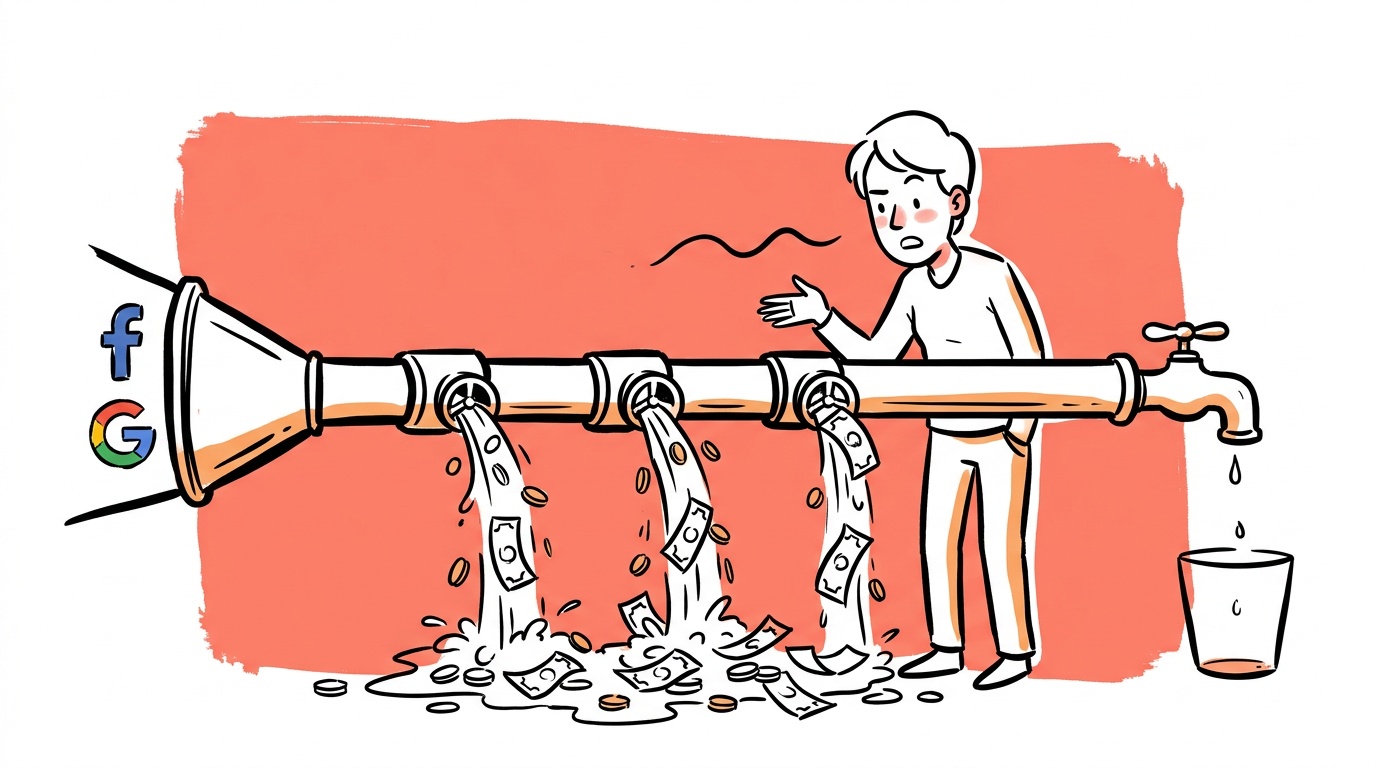

Most founders running paid ads spend their time arguing with the algorithm. Wrong bidding strategy. Wrong audience. Wrong creative. Meanwhile, the actual problem is sitting two clicks downstream from the ad, quietly eating their budget—a funnel with steps that were never supposed to exist in the first place.
The pattern that shows up most often in broken ad accounts isn't a bad ad. It's a good ad driving traffic into a broken funnel. You can double your CTR and still lose money if the structure after the click is wrong.
TL;DR — Funnel & Conversion Optimization
- Most paid ad losses happen inside the funnel, not in the ad auction itself.
- Unnecessary funnel steps compound drop-off: every extra click you force is a conversion you're paying for and not getting.
- Optimizing a step that shouldn't exist is worse than not optimizing at all—it buries the real problem.
- The three structural failure modes are: too many steps, mismatched intent between ad and landing page, and asking for commitment before delivering value.
- The fastest wins come from removing steps, not from A/B testing button colors on a page that shouldn't be there.
The Math Nobody Does Before Launching
Run the arithmetic once and it becomes impossible to unsee.
Say you're paying a reasonable cost-per-click. Your landing page converts at a typical rate. But between your landing page and the actual conversion event—a purchase, a booked call, a signup—you have three intermediate steps: an email opt-in to get to a VSL, the VSL itself, then a bridge page before the cart. Each step has a drop-off rate. By the time someone reaches the thing you actually want them to do, you've paid for far more clicks than you'll ever see conversions from.
The compounding effect is brutal. Drop-off at each step multiplies against every previous drop-off. A funnel with several intermediate steps—each converting at only a modest rate—can shed the vast majority of entrants before they ever see your actual offer. You can work this out yourself: multiply your estimated step-by-step conversion rates together and see what fraction of original clicks survives to the end. The number is almost always smaller than founders expect.
To make this concrete: if you estimate 60% of visitors pass each step, a four-step funnel retains roughly 13% of entrants at the final stage. At 50% per step, you're below 7%. This is why a single removed step can matter more than months of headline testing.
You're not running a paid acquisition campaign at that point—you're running a very expensive list-builder for people who will never buy.
Every unnecessary step in your funnel doesn't just add a little friction—it multiplies the friction that came before it. Several steps with modest individual conversion rates can quietly destroy most of your potential conversions before anyone reaches your actual offer. The math is simple and worth doing before you launch, not after you've spent the budget.
The fix isn't a better ad. The fix is fewer steps.
The Three Ways Founders Structurally Fail at Running Ads
These failure modes come up repeatedly in accounts where the ads look fine but the economics are broken.
Failure Mode 1: Building a Funnel Before Proving the Offer
The most expensive mistake is spending weeks building a "proper" funnel—opt-in page, bridge page, VSL, application form, booking page—before confirming that anyone actually wants what you're selling. You've now sunk time and money into infrastructure for an offer with unproven demand. When the ads underperform, it's unclear whether the problem is the ad, the audience, or the funnel. Usually it's all three, but the funnel is hiding the signal.
Before you build steps, validate the offer with the shortest possible path. A direct-to-booking-page test or a direct-to-product-page test will tell you faster and cheaper whether demand exists. Add structure only after you have evidence that the offer converts at all.
Optimizing Steps That Shouldn't Exist
This is the one that's hardest to see from inside your own account.
You notice your bridge page is converting poorly. So you rewrite the copy. You test two versions. You run the test for three weeks. The winner lifts conversion on that page. You feel good. The problem: that page was the wrong page to optimize because it was a page you never needed.
The question to ask before running any CRO test is: does this step need to exist at all? If removing it gets the user to the next stage faster, removing it beats any headline test you could run on it.
This pattern shows up constantly—teams doing rigorous A/B testing on friction points that are symptoms, not causes. The cause is structural: the funnel asks users to do too many things before they receive enough value to justify doing them.
Common steps that often shouldn't exist:
- An email opt-in gate before a user has seen the offer (you're asking for commitment before delivering value)
- A "qualify yourself" page when your ad targeting already qualifies the audience
- An intermediate "you're almost there" page between checkout and the cart
- A multi-page onboarding flow before a free trial user has experienced the core product
Each of these was probably added for a reason that made sense at the time. Most of them slow people down more than they help.

Live today.
The full campaign — copy, images, targeting — generated for your site and deployed paused for your approval.
Intent Mismatch: The Invisible Tax on Every Click
Even if your funnel has the right number of steps, there's a second structural failure that costs just as much: the experience after the click doesn't match what the ad promised.
Someone clicks a Facebook ad promising a free audit. They land on a homepage. They look around. They leave. You paid for that click.
Or: someone clicks a Google search ad for a specific product. The ad matches their query exactly. The landing page is a category page with twelve options. Decision paralysis. They leave. You paid for that click too.
Intent mismatch is an invisible tax. It doesn't show up as a line item in your ad account—it shows up as a high bounce rate and a conversion rate that never improves no matter how much you spend.
The fix is message match: the headline, the offer, and the call to action on your landing page should be a near-literal continuation of what the ad said. Not thematically similar. Specifically continuous. If your ad says "Book a free 30-minute strategy call," your landing page headline should be about booking a free 30-minute strategy call—not about your company's philosophy or your team's credentials.
Your ad sets an expectation. Your landing page either fulfills it or breaks it. When it breaks, the user doesn't give you a second chance—they hit back and your conversion is gone. Message match is the cheapest conversion rate improvement available because it costs zero dollars and requires only editing text you already have.
Commitment Before Value: Why Your Opt-In Rates Are Falling
Asking users for something before you've given them a reason to trust you is a structural error, not a copy problem.
The classic version is the email opt-in gate in front of a lead magnet. You ask for an email address to get a free resource. On paper, this is standard practice. In reality, the conversion rate on this step depends entirely on how much perceived value the user believes they're getting before they hand over their information.
If your ad is vague and your landing page headline is generic, the perceived value is low. You've asked for commitment—an email address—without delivering enough value to justify it. You get a low opt-in rate. You conclude the audience is wrong or the ad is wrong. Often, neither is wrong—you're just asking too early.
The fix: move value delivery earlier. Put a short proof point on the opt-in page itself—a key insight, a specific result, a sample of what they'll get. Give before you ask. The perceived value of what's behind the gate goes up. The opt-in rate follows.
This same principle applies further down funnel. Asking someone to book a call before they've watched a demo or read enough to know you solve their problem is asking for commitment before value. The stage of commitment you're asking for should always be proportional to the amount of value you've already delivered.
How to Audit Your Funnel in Under an Hour
You don't need a sophisticated analytics stack to spot structural funnel problems. You need to walk the funnel yourself and ask three questions at every step.
1. Does this step need to exist? Could the user get to the next stage without this step? If yes, seriously consider removing it.
2. Does this step match the intent of the previous step? Does what I'm seeing now feel like a natural continuation of what I just did? If there's a tonal or logical gap, users feel it as friction even if they can't name it.
3. Am I being asked for something before I've received enough to justify giving it? If you're being asked for an email address, a phone number, payment, or significant time before you've gotten enough value, that's the leak.
Do this audit as a user, not as a builder. Switch browsers. Clear your cache. Click your own live ad. Experience what your paid traffic experiences. Most founders haven't done this in months. When they do, the problems are usually obvious within minutes.
For accounts with proper analytics, pull your step-by-step drop-off data from Google Analytics 4's funnel exploration report or your equivalent. The step with the largest percentage drop is your primary leak—and in most funnels it sits somewhere in the middle, not at the final conversion event. Cross-reference it with your ad cost data to understand the true dollar cost of that drop-off.
You can also use Google Ads' Landing Page report to see where expensive traffic is bouncing fastest. The combination of where people drop and how much you paid to get them there gives you a true cost-per-leak.
For a first-principles view of how funnel structure connects to paid acquisition efficiency, CXL's conversion optimization research is one of the more rigorous public resources on the topic.
The Counterintuitive Fix: Do Less, Convert More
The instinct when conversion rates are low is to add things. Add a testimonial section. Add a trust badge. Add a FAQ accordion. Add a video. Add a step that pre-qualifies leads so the next step converts better.
Most of the time, the right move is the opposite.
Remove the step. Remove the page. Remove the form field. Remove the friction. The fewer decisions a user has to make between clicking your ad and completing your conversion event, the more of them will complete it.
The reason founders resist this is structural: removing something feels like giving up on it. Adding something feels like forward motion. But in a paid acquisition context, adding complexity to fix a structural problem is how you burn budget without learning anything useful. You end up with a more elaborate funnel that converts at the same broken rate—and now it's harder to diagnose why.
The structural question always comes before the optimization question. Get the structure right first. Then optimize.
FAQ
What is funnel optimization in paid advertising? Funnel optimization in paid advertising is the process of improving each step a user takes from clicking an ad to completing a conversion—purchase, sign-up, booked call, or similar—with the goal of converting a higher share of paid clicks into actual business outcomes.
Why is my ad spend high but conversions are low? High ad spend with low conversions usually means the problem is inside your funnel, not in the ad itself. Common causes include unnecessary funnel steps that create drop-off, intent mismatch between ad and landing page, and asking users for commitment before delivering enough value to justify it.
How many steps should a paid ad funnel have? There's no universal number, but the principle is to use the minimum steps necessary to move a user from ad click to conversion. Most funnels have at least one step that could be removed without hurting conversion—and removing it usually improves conversion by reducing friction. Start with the shortest possible path and add steps only when you have a specific reason to.
What is message match in paid ads? Message match is the degree of continuity between what an ad promises and what a user finds on the landing page. Strong message match means the headline, offer, and call to action on the landing page are a direct, specific continuation of the ad. Poor message match—even with a good ad—produces high bounce rates and low conversion.
How do I find which funnel step is causing the most drop-off? Use a funnel exploration report in Google Analytics 4 or your analytics tool of choice to see the step-by-step conversion rate across your funnel. The step with the largest percentage drop is your primary leak. Cross-reference it with your ad cost data to understand the true dollar cost of that drop-off.
Should I A/B test my funnel pages? Yes, but only after confirming each page should exist. A/B testing a page that shouldn't be in your funnel wastes time and can produce misleading results—you optimize the symptom and miss the cause. Audit structure first, then optimize individual pages.
What's the fastest funnel fix for a founder on a limited budget? Walk your own funnel as a cold user: click your live ad, go through every step, and write down every moment you felt friction or confusion. Then remove or simplify the worst offenders before spending more on ads. This costs nothing and consistently surfaces problems that weeks of data analysis misses.
Live today.
The full campaign — copy, images, targeting — generated for your site and deployed paused for your approval.
We build AdControlCenter — AI-powered ad management for small businesses, online stores, SaaS companies and service providers. We write what we'd want to read: real numbers, no fluff, the things we wish we'd known when we started.
More from the team →