
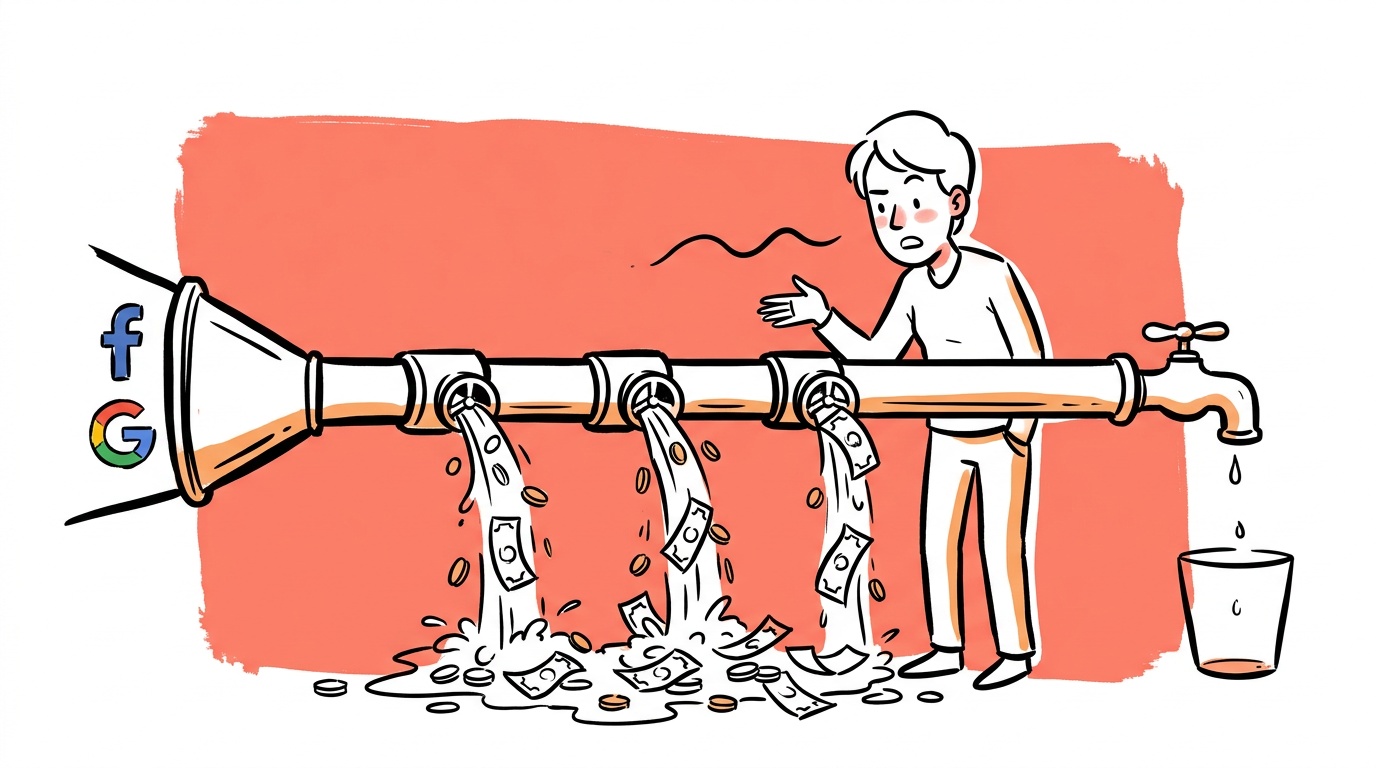


Your keyword rankings went up last month. Your YouTube video got thousands of views. Your ads earned a strong click-through rate. And yet your pipeline is flat. That is not a coincidence—it is what happens when a team optimizes for the metrics they can show in a slide instead of the ones that show up in the bank account.
The uncomfortable truth is that vanity metrics are not neutral. They actively mislead you. When a campaign is judged by impressions, your team will buy cheap, broad reach. When a content team is judged by views, they will chase topics that attract browsers instead of buyers. Measurement shapes behavior, and the wrong scorecard produces the wrong business.
TL;DR — Vanity metrics vs revenue metrics
- Vanity metrics (rankings, views, likes, impressions, CTR in isolation) feel good but have no guaranteed connection to revenue.
- Revenue metrics (pipeline influenced, cost per acquired customer, revenue per click, payback period) are harder to collect but make every budget conversation honest.
- Reporting keyword rankings to leadership focuses attention on a lagging, indirect signal—organic visibility matters, but it is not a business outcome.
- Views do not pay you. The question is always what happens after the view: did the viewer convert, subscribe, or buy?
- The fix is not a new tool—it is deciding, in advance, which number you will optimize and tracing a direct line from that number to revenue.
Why Vanity Metrics Survive (and Thrive)
Vanity metrics stick around because they are easy to generate, easy to understand, and almost always moving in the right direction. Impressions go up when you spend more. Rankings improve when you publish more. Views climb when you post more often. They reward activity, which is exactly what makes them dangerous.
When someone asks "is the program working?", a rising impressions chart ends the conversation fast. A cost-per-acquired-customer chart starts a harder one—about landing page conversion, offer quality, and whether you are targeting the right audience. Most teams, under time pressure, choose the chart that ends the conversation.
There is also a structural problem: vanity metrics live inside the ad platform, while revenue metrics live in a CRM or payment processor. Stitching those two data sources together takes real work. Teams often report what is easy to pull rather than what is important to know.
The Specific Problem With Keyword Rankings
Reporting keyword rankings to a CEO or board is one of the most common ways marketing teams accidentally destroy their own credibility. Here is why.
A ranking is three abstractions away from revenue. First, a ranking produces impressions. Then a share of those impressions produce clicks. Then a share of those clicks produce leads or purchases. Each step has its own conversion rate, and none of those rates are fixed. You can rank number one for a high-volume term and generate zero pipeline if the search intent does not match your offer.
Rank-tracking tools also measure a snapshot of position that varies by location, device, and personalization. The number your tool shows and the number your potential customer sees are often different. Showing that number in a board deck as evidence of business health is, at best, optimistic.
What to report instead: organic sessions from target-intent queries, organic-assisted pipeline, and organic revenue attribution. These require more instrumentation but they answer the actual question: is our organic presence generating customers?
The Specific Problem With Views and Impressions
Views do not pay you. A video with a large view count and a poor offer-to-audience fit generates nothing but hosting costs. This is obvious when stated plainly, yet many content and paid social teams still get evaluated primarily on view volume.
The same applies to paid impressions. A high impression count with low conversion tells you that you reached a lot of people who did not care. That is not a success to optimize toward—it is a signal that something upstream is broken: targeting, creative, landing page, or offer.
The metric that replaces view count depends on your funnel stage. For awareness-stage content, the right question is whether brand search volume or direct traffic is climbing in the periods after content goes live. For conversion-stage content, the question is simpler: did the viewer take the next step?
The Engagement Trap
Likes, shares, and comments are one level better than raw views because they signal active attention. But they are still not revenue. A post can go viral in a demographic that will never buy from you. We have seen ad sets with high engagement rates and cost-per-click that looked efficient—until we traced the clicks through to purchase and found that the engaged audience had near-zero purchase intent.
Engagement metrics are useful for creative testing (they tell you which message resonates) but they should never be the final scorecard. The same goes for CTR, impression share and platform ROAS — the ad metrics lying to you goes through each one.

Live today.
The full campaign — copy, images, targeting — generated for your site and deployed paused for your approval.
What Revenue Metrics Actually Look Like
Here is a concrete list of metrics worth reporting, mapped by what they tell you. Each one has a direct line to the income statement.
Cost per acquired customer (CAC). Total spend divided by new customers in the same period. If CAC is below lifetime value, you scale. If it is above, you stop and diagnose. Note that "acquired customer" needs a definition your whole team agrees on before you start measuring—see Step 1 below.
Revenue per click (RPC). Total revenue attributed to a traffic source divided by total clicks from that source. This normalizes quality across channels. A channel with expensive clicks but high RPC may be cheaper in real terms than a channel with cheap clicks and low RPC. It is especially useful for comparing paid search against paid social, where click costs are structurally different.
Payback period. How many months of customer revenue it takes to recover the cost of acquiring that customer. This matters enormously for cash-flow planning. A 3-month payback and a 14-month payback can show identical CAC figures if you are only looking at first-purchase revenue.
Pipeline influenced. For B2B or longer sales cycles, track how many open deals touched a given channel or campaign. Multi-touch attribution is genuinely hard, but this is far more honest than impressions as a proxy for impact.
Organic-assisted conversion rate. Of the visitors who arrived via organic search, what share eventually converted? This ties SEO investment to actual outcomes without requiring last-click attribution to work in your favor.
The right replacement for a vanity metric depends on your model. E-commerce teams should replace view count with revenue per session and replace impression share with return on ad spend by product line. SaaS teams should replace keyword rankings with organic-sourced trial starts and replace CTR with cost per paid conversion from trial. B2B lead-gen teams should replace form fills with cost per sales-qualified lead and replace engagement rate with pipeline influenced per channel. The instrumentation required scales in that order too—e-commerce is the easiest to close the loop, B2B the hardest.
How to Rebuild Your Reporting Stack
Switching from vanity to revenue metrics is not primarily a tooling problem. It is a sequencing and agreement problem. Here is the sequence that works.
Step 1: Agree on the definition of a conversion. Not a click, not a form fill—a paying customer, or the closest leading indicator you can reliably trace. For e-commerce that is a purchase. For SaaS it is often a paid conversion from trial. Get everyone in the same room and write it down before any measurement starts.
Step 2: Tag every source. UTM parameters on every paid link, every email, every social bio link. This is tedious and it has to be done before you spend money, not after. Retroactive attribution is mostly fiction.
Step 3: Connect your ad platform to your revenue source. Most ad platforms allow offline conversion imports or direct CRM integrations. Passing purchase events—or at minimum, lead-to-close status—back to the platform closes the loop and lets the algorithm optimize for revenue rather than clicks. This single step produces more improvement in campaign efficiency than any creative change, in our experience.
Step 4: Set a single north-star metric per campaign. Not three metrics, not a "balanced scorecard." One number that you will use to decide whether to scale, hold, or pause. Agree on it before the campaign launches.
Step 5: Kill the vanity metric reports. Literally remove them from your standing dashboards. If keyword rankings are not on the screen, no one will ask about them. What you measure in a meeting is what the team will optimize for between meetings.
The Founder's Specific Problem
Most founders reading this are not running a 30-person marketing org. They are running paid ads themselves, maybe with one contractor, and they are time-poor enough that the temptation to check the ad platform's built-in dashboard and call it a day is completely understandable.
The built-in dashboard always shows you vanity metrics first. Platform CTR, reach, frequency, video views—all of these are front and center because they are the metrics that make you feel good about spending money on the platform. The revenue metrics require you to leave the platform and look at your actual numbers.
A practical shortcut: once a week, open two tabs. Tab one is your ad platform. Tab two is your payment processor or CRM. The only question you need to answer is whether the spend in tab one produced more revenue than it cost, including your time. Everything else is optional reading.
When we analyzed a large sample of ad accounts in our data, campaigns explicitly optimized toward downstream revenue events—purchases, subscriptions, qualified leads—consistently outperformed campaigns optimized toward clicks or impressions, even when the click-optimized campaigns appeared cheaper by platform metrics. The platform optimizes for exactly what you tell it to optimize for. Tell it the right thing and the algorithm works for you. Tell it the wrong thing and it works against you at your expense.
Outbound Reading
- Google's guide to conversion tracking and offline imports — the technical foundation for closing the attribution loop between ad platforms and your CRM.
- Meta's Conversions API documentation — server-side event passing that survives browser-level tracking restrictions. Our own Meta Pixel and Conversions API setup guide covers the practical wiring.
- Avinash Kaushik's original writing on vanity metrics — still the clearest framework for distinguishing metrics that inform decisions from metrics that decorate slides.
FAQ
What is the difference between vanity metrics and revenue metrics?
Vanity metrics measure activity or visibility—impressions, views, follower counts, keyword rankings. Revenue metrics measure outcomes—customers acquired, revenue generated, cost to acquire a customer. The practical test: if a 20% improvement in the metric produces a predictable improvement in your income, it is a revenue metric. If it might not, it is probably vanity.
Are keyword rankings ever worth tracking?
Yes, but not as a primary business metric. Rankings are useful for diagnosing SEO health and identifying content gaps. They should not be the number you report to leadership as evidence that organic is "working." Organic-sourced pipeline and organic-assisted revenue are the right leadership-facing metrics.
Why do ad platforms show vanity metrics by default?
Because they are easy to calculate and almost always positive. Impressions go up when you spend more. The platform has a financial interest in you feeling good about spending. It is your job to override the default view and optimize toward the metric that matters to your business.
How do I attribute revenue to the right channel when customers touch multiple channels before buying?
Multi-touch attribution is genuinely hard. A practical starting point is first-touch attribution (which channel introduced the customer) combined with last-touch attribution (which channel closed them). Neither is perfect. The honest answer is that some ambiguity is unavoidable—the goal is to be directionally correct, not perfectly precise.
What is a good CAC to lifetime value ratio?
A commonly cited starting point is 3:1—lifetime value at least three times the cost to acquire the customer. The right ratio for your business depends on your payback period tolerance and growth stage. Early-stage companies often accept worse ratios to acquire market share; profitable companies tighten them as they scale.
Can I use engagement metrics at all in my reporting?
Yes, for creative testing and early-signal diagnostics. If two ad creatives have very different click-through rates or engagement rates, that tells you which message resonates before you have enough conversion data to be statistically confident. Use engagement as a filter, not a finish line.
How often should I review revenue metrics versus vanity metrics?
Revenue metrics weekly, at minimum. Vanity metrics only when they help diagnose a specific problem—for example, a drop in impressions might explain why CAC suddenly spiked. Pull vanity metrics to answer questions, not to fill a standing report.
The specific takeaway: open your current weekly report and count how many metrics on it have a direct, one-step connection to revenue. If most of them require two or more intermediate steps, you are not running a marketing report—you are running a comfort report. Fix the dashboard first. The behavior will follow.
Live today.
The full campaign — copy, images, targeting — generated for your site and deployed paused for your approval.

We build AdControlCenter — AI-powered ad management for small businesses, online stores, SaaS companies and service providers. We write what we'd want to read: real numbers, no fluff, the things we wish we'd known when we started.
More from the team →