
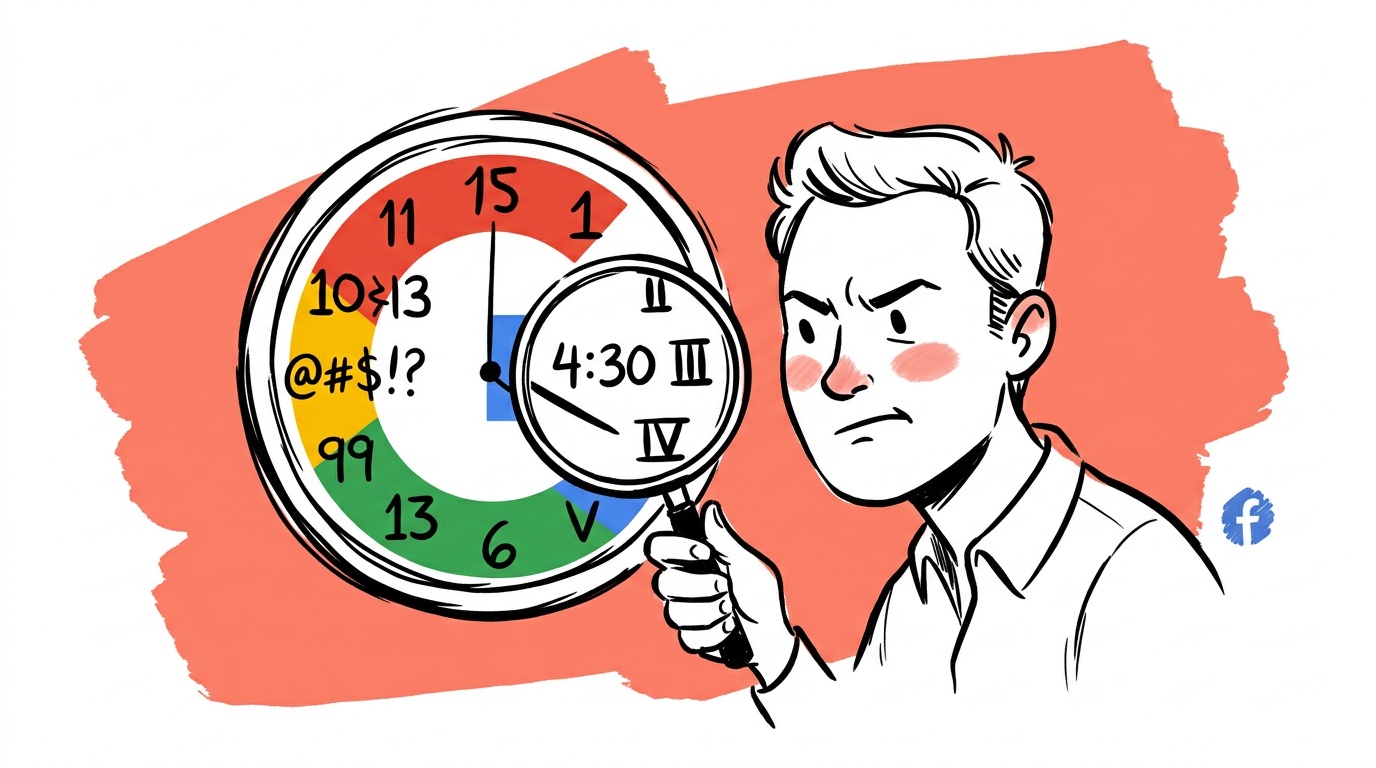


The metric your dashboard highlights first is usually the one the platform most wants you to celebrate. That's not a coincidence. Platforms are optimized to retain ad spend, and a high click-through rate or a strong impression share feels like progress even when revenue is flat.
The pattern we see repeatedly: a founder pauses a campaign because the numbers look dull, while the campaign was the one actually closing orders. The campaign they kept was visually impressive and converting nobody. In almost every case, the wrong metric was driving the call.
TL;DR — The Ad Metrics Lying to You
- Click-through rate, impression share, and email open rate are engagement signals, not revenue signals. Treating them as goals corrupts your decisions.
- Performance Max audience signals are inputs to Google's machine learning, not targeting rules — misunderstanding this causes founders to over-restrict campaigns and starve the algorithm of conversion data.
- View-through conversions are attributed to ad views that almost certainly didn't cause the purchase; counting them inflates ROAS and misleads budget calls.
- The metrics worth tracking are cost per real conversion, conversion value by channel, and incremental lift — not what the platform dashboard surfaces by default.
- The fix is not finding a better metric to obsess over. It's building a small set of numbers that connect directly to cash, and ignoring everything else.
CTR Is a Popularity Contest, Not a Profit Signal
A high click-through rate means your creative caught attention. That's it. It says nothing about whether the people clicking had any intention to buy, whether your landing page converted them, or whether the purchase was profitable after ad cost. (When the clicks are there and the sales aren't, diagnosing the funnel bottleneck is the next step.)
CTR is easy to inflate. Shock creative, misleading headlines, and curiosity-gap copy all drive clicks. So does targeting an audience that's broadly curious about your category but has no budget or urgency. Platforms surface CTR prominently because it signals that your ad is "relevant" — relevant to their quality score systems, not necessarily relevant to your P&L.
When we look at accounts where founders are steering by CTR, we consistently see the same pattern: they've optimized toward creative that generates traffic and away from creative that converts. The two are not the same list.
CTR is useful for one thing: creative comparison within the same ad set, targeting the same audience, on the same platform. If two ads show to identical audiences and one gets double the clicks at the same impression volume, the higher-CTR ad is worth testing further. Outside that narrow comparison, CTR tells you very little.
Track instead: Cost per conversion and conversion rate by landing page. If you're running enough volume, track revenue per click. (Stop reporting vanity metrics has the full replacement list, including revenue per click and payback period.) CTR can live in a secondary tab where it informs creative decisions, not budget ones.
Impression Share Feels Strategic. It Isn't.
Impression share — the percentage of eligible auctions where your ad appeared — is the metric that makes founders feel like they're "winning" a market. Losing impression share feels like ceding territory to competitors.
The reality is that impression share is a function of budget, bid, and quality score across every auction you're eligible for. If your impression share drops, it could mean a competitor raised bids, Google widened its eligibility criteria, or your quality score slipped. It almost never means customers are choosing a competitor over you.
Chasing impression share leads to bid inflation. You end up paying more per click to show up in auctions you were sensibly sitting out before. If you want more volume, scale Google Ads without inflating your CPCs instead of buying presence. The platform benefits. Your margin doesn't.
Track instead: Auction-level conversion rate segmented by keyword match type or placement. Know which auctions are profitable, and bid to win those — not to maximize your presence across all of them.
Why Email Open Rate Broke (And What It Tells You About Ad Attribution)
The email parallel is worth understanding because it exposes the exact same failure mode that makes view-through conversions dangerous.
Open rate was the headline metric for email marketers for years. Then Apple's Mail Privacy Protection, introduced in 2021, broke it. Mail Privacy Protection pre-fetches email content and triggers tracking pixels before a human ever opens the message. A large share of "opens" recorded in most ESPs since then are machine-triggered, not human-triggered. Marketers who didn't adjust kept sending to "engaged" segments that weren't engaging at all, while suppressing subscribers who were reading every email on a non-Apple client.
The ad-world equivalent is view-through attribution. A user sees your display ad, doesn't click, and then buys something a week later after a Google search. The display platform records that as a conversion. You see ROAS that looks strong. But the display ad may have had nothing to do with the purchase — the customer was going to buy anyway.
Both cases share the same failure mode: a platform records an event it can detect and attributes causation it cannot prove. You pay for the illusion of performance.
Track instead: For email, click-to-open rate and reply rate. For display, run a holdout test — suppress ads to a random sample and compare conversion rates between the exposed group and the holdout. The delta is your real number.

Live today.
The full campaign — copy, images, targeting — generated for your site and deployed paused for your approval.
Performance Max Audience Signals Are Not Targeting
This is the misunderstanding that burns the most ad spend in PMax campaigns right now. Google's own documentation on audience signals is explicit: signals tell the algorithm where to start, not where to stay.
Audience signals in PMax are not targeting constraints. They are hints. You're telling Google's algorithm "start looking here" — not "only show my ads to these people." Google will serve outside your signals whenever its model predicts a conversion is likely. That's by design.
The mistake is treating signal configuration like audience targeting from a standard campaign. Founders spend hours building detailed customer lists and interest segments, then feel reassured that their ads are "targeted." They're not targeted in any traditional sense. The algorithm will go wherever its model points it.
What Signals Actually Do
Signals accelerate the learning phase. A well-configured signal set — first-party customer lists, high-intent website visitors, custom segments built on competitor search terms — gives the model a warm start. Without them, PMax spends its learning budget exploring broadly, which is expensive early on.
Once the campaign exits the learning phase and accumulates enough conversion data, signals matter less. The model is learning from your actual converters, not from the population you pointed it at originally.
The most expensive PMax mistake we see is adding audience restrictions to a campaign that hasn't yet accumulated enough conversion data to learn from. Founders see irrelevant placements in asset group reports and panic-restrict the campaign, which starves the algorithm right when it needs volume. Let it learn first. Restrict after you have data.
Track instead: PMax conversion volume by asset group, and search terms appearing in the Insights tab. Watch where real conversions are coming from before you touch signals or exclusions. If brand terms are cannibalizing, add brand exclusions at the campaign level — but do it with data, not instinct.
ROAS Is Correct and Meaningless at the Same Time
Return on ad spend — revenue divided by ad cost — is mathematically accurate and operationally misleading for most businesses.
The problem is the denominator. ROAS only counts ad cost. It ignores COGS, fulfillment, returns, customer service overhead, and the cost of capital tied up in inventory. A campaign running at 4x ROAS can be unprofitable if your gross margin is 30% and your return rate is high.
The second problem is attribution. Platform-reported ROAS aggregates every conversion the platform claims credit for, including view-throughs, assisted conversions, and cross-device matches that may not reflect real causality. You're dividing real money spent by an inflated conversion count.
A Simple Contribution Margin Check
Before trusting any platform's ROAS figure, run this outside your ad tool:
- Pull orders by UTM source for the period.
- Subtract COGS, fulfillment, and returns from each order's revenue to get gross contribution per order.
- Subtract ad spend attributed to that source.
- What remains is your contribution margin from paid acquisition.
If that number is positive and growing, the channel is working. If it's negative or flat while platform ROAS looks healthy, you have an attribution problem.
Track instead: Contribution margin per acquired order, calculated outside the platform using your own order and cost data. Match order-level data to UTM source data regularly. It's slower than reading a dashboard. It's also real.
The Metric You're Not Tracking: Incremental Lift
Every metric above shares a flaw — none of them tell you what would have happened if you hadn't run the ad.
Incremental lift testing does. You suppress ads to a randomly selected holdout group and compare their conversion rate to the exposed group. The difference is your incremental impact. It's the only way to know whether your campaign is generating purchases or just intercepting people who were going to buy anyway.
Google's conversion lift studies and Meta's equivalent both offer this. Founders almost never run them because suppressing ads to any group feels like leaving money on the table. It isn't. Running ads to people who would have converted organically is leaving money on the table — you're paying for attribution credit on purchases you didn't cause.
Track instead: Run at least one lift test per major channel per year. Do it when you're scaling spend significantly, when platform-reported conversions and your internal revenue data diverge, or when you're genuinely uncertain whether a channel is working. It's the one number that can tell you whether any of your other metrics are connected to reality.
FAQ
What are the most misleading ad metrics? The most misleading are click-through rate (easy to optimize without improving conversions), impression share (a bidding signal, not a market share signal), view-through conversions (attributed to ad exposures that likely didn't cause the purchase), and platform-reported ROAS (which uses inflated attribution and ignores real unit economics).
Why is CTR a bad metric to optimize for? CTR measures whether your ad generated a click, not whether that click was worth anything. Creative designed to maximize CTR often uses curiosity or shock value that attracts unqualified visitors. Within a controlled test comparing two ads to the same audience, CTR is useful. As a campaign-level goal, it tends to push spend toward traffic that doesn't convert.
Are Performance Max audience signals the same as targeting? No. Audience signals in Performance Max tell Google's algorithm where to start learning, not where to confine delivery. Google will serve ads outside your signals whenever its model predicts a likely conversion. Signals speed up the learning phase. They don't restrict reach the way traditional audience targeting does.
How do I know if my display ads are actually driving conversions? Run a holdout test. Suppress ads to a randomly selected share of your eligible audience and compare their conversion rate to the exposed group. The difference is your incremental lift. Platform-attributed conversions include view-throughs and assisted conversions that may reflect coincidence rather than causation.
What should I track instead of ROAS? Contribution margin per acquired order, calculated outside the platform using your own order and cost data. ROAS divides revenue by ad spend without accounting for COGS, returns, or fulfillment costs. A campaign with strong ROAS can still be unprofitable. Build your break-even ROAS floor from your actual unit economics: 1 ÷ (gross margin % − target net margin %).
Why did my email open rate become unreliable? Apple's Mail Privacy Protection, introduced in 2021, pre-fetches email content and triggers tracking pixels before a human opens the message. This inflates open rates recorded in most email platforms. A large share of opens in Apple Mail clients are now machine-generated, not human-generated. Click-to-open rate and direct reply rate are more reliable signals of genuine engagement.
How often should I run an incremental lift test? At minimum, once per major channel per year. Run one when you're scaling spend significantly, when you're questioning whether a channel is working, or when platform-reported conversions and your internal revenue data diverge. Lift tests require accepting temporary suppression for the holdout group, but they're the only way to know whether your ads are causing purchases or just claiming credit for them.
The honest question underneath all of this: if you pulled your ad platform dashboards away and could only look at contribution margin by acquisition source for the next 90 days, would your current campaign decisions hold up? If the answer is uncertain, that's exactly where to start.
Live today.
The full campaign — copy, images, targeting — generated for your site and deployed paused for your approval.

We build AdControlCenter — AI-powered ad management for small businesses, online stores, SaaS companies and service providers. We write what we'd want to read: real numbers, no fluff, the things we wish we'd known when we started.
More from the team →