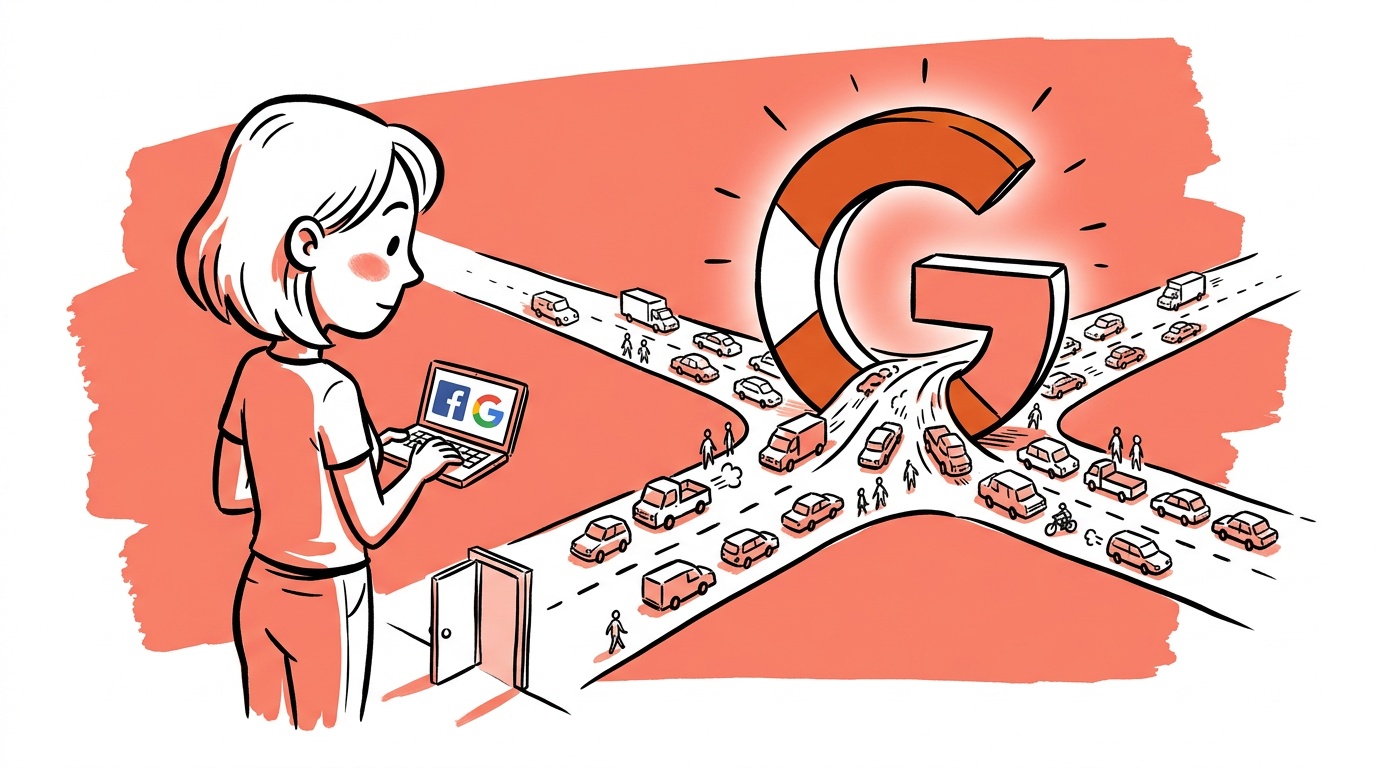
Paid ads still appear on AI Mode SERPs. Organic listings often don't make it above the fold. If that sentence surprises you, your traffic strategy is priced for a Google that no longer exists.
AI Mode, Google's full-page generative answer interface, synthesizes your content into an inline answer and keeps the user on Google. The site whose content informed that answer gets no session, no pageview, and no conversion opportunity. For a large share of informational queries, this is now the default experience — not a test, not a rollout. A fait accompli.
TL;DR — Zero-click search traffic loss
- Google's AI Mode generates complete answers in-SERP, cutting organic click-through rates on informational queries for many sites.
- Zero-click loss is not uniform — transactional, branded, and high-intent commercial queries still drive clicks; informational and navigational queries take the hardest hit.
- Paid search is now the most reliable way to guarantee placement on AI-heavy SERPs, but ad creative must be re-engineered for a shorter attention window.
- Generative Engine Optimization (GEO) — structuring content so AI systems cite it — is a real, measurable practice, not future speculation.
- The founders adapting fastest are doubling down on owned channels (email, SMS, community) while using ads as the floor, not the ceiling.
What AI Mode Actually Does to a SERP
Traditional Google gave you ten blue links. AI Overviews gave you a synthesized paragraph above them. AI Mode goes further: on qualifying queries it replaces the standard SERP with an expansive, multi-section generative response that pulls from dozens of sources simultaneously, collapses above-the-fold real estate to near zero, and buries organic listings below a wall of generated text.
For a user asking "what's a good daily budget for Google Ads for a small business," AI Mode can return a structured, numbered answer with caveats, follow-up questions, and sourced pull-quotes — all without a single click leaving Google. Your well-researched post may have contributed to that answer. You will not see it in your analytics.
This is qualitatively different from featured snippets, which at least surfaced a single brand prominently. AI Mode surfaces many sources in a synthesized blend. Attribution is diffuse. Traffic is near-zero.
Being cited inside an AI Mode response can build brand awareness with readers who never visit your site. That awareness is real but almost impossible to track in GA4. It tends to show up — eventually — as branded search volume and direct traffic growth, not as a referral session.
Which Queries Are Actually at Risk
Not every query loses its clicks. When we look at the categories of traffic our users report declining, the pattern is consistent:
High-risk query types:
- "How does X work" / definitional questions
- "Best X for Y" comparison lists
- Step-by-step how-to queries
- News and current-events questions
Lower-risk query types:
- Branded queries ("AdControlCenter pricing")
- Transactional queries with local intent ("plumber near me")
- Queries requiring login-gated or proprietary data
- Highly specific long-tail queries with purchase intent ("buy [specific SKU]")
The practical implication: if your SEO strategy was built on a large content moat of educational articles, that moat is being drained. If your SEO strategy was built on capturing buyers at the moment of purchase intent, you're more insulated — for now.
The "for now" matters. AI Mode's query coverage is expanding. What feels safe in mid-2026 may not be safe by 2027. The interventions are different depending on which category your most valuable pages fall into, so classify them before you do anything else.
Why Paid Search Is Your Most Reliable Floor
Ads still show up. On AI Mode SERPs, Google continues to serve paid placements — typically at the top and bottom of the generative block. Organic results shrink. Paid placements persist. This is not a coincidence; it is Google's business model.
That means paid search, which many content-heavy founders had been treating as optional, is now the most dependable way to guarantee presence on a high-intent SERP. If your organic click-through rate on informational queries has declined materially, and your paid impression share on commercial queries is still intact, the return on ad spend calculation looks very different than it did two years ago. How those placements actually behave is covered in Google Ads in AI Mode: what early testing shows.
There's a catch: users who click on ads from an AI Mode SERP have already consumed a substantial amount of information. They are not at the top of the funnel. Your landing page and ad creative need to reflect that. Generic awareness messaging will underperform. Specific, credentialed, offer-forward copy will outperform. The standalone-headline audit in what advertisers must do about AI Mode ads is the practical version.
Re-engineering Ad Creative for a Post-AI SERP
The patterns that held when we tested creative variants against audiences arriving from AI-heavy SERPs:
- Lead with proof, not promise. Users who've read a generative summary are skeptical of claims they've already seen AI make. Specific numbers, real customer names, and genuine differentiation outperform category-level benefit statements.
- Shorten the path. Fewer than three clicks from ad to conversion action. AI Mode users are efficient; they've already done their research.
- Make the CTA transactional. "Start free trial" beats "Learn more." The audience is past learning.

Live today.
The full campaign — copy, images, targeting — generated for your site and deployed paused for your approval.
Generative Engine Optimization Is Real — Here's What Works
GEO is the practice of structuring content so that AI systems select it as a source for generated answers. It's not speculative. Researchers have published work showing that specific content attributes measurably increase citation frequency in AI-generated responses. The signals that appear to matter:
Authoritative sourcing. AI systems prefer content that cites primary sources — original research, government data, official documentation. Posts that link to Google's own documentation on AI Overviews or peer-reviewed studies carry more weight as sources than posts that cite other blog posts.
Direct, structured answers. Content that answers the query in the first two sentences of a section gets pulled more often than content that buries the answer in paragraph three. Write like a reference document, not an essay.
Schema markup. FAQ schema, HowTo schema, and Article schema give AI parsers cleaner signals about what your content answers. Most sites still haven't implemented this completely. It is table stakes, not a differentiator. So is a well-formed llms.txt file.
Freshness signals. Dated content with clear publication and update timestamps gets treated as more reliable. Update your cornerstone posts with a visible "last reviewed" date and actually review them.
E-E-A-T at the author level. Named authors with verifiable credentials, real author bio pages, and bylines that match professional profiles all contribute. Generic brand content with no named author is increasingly disadvantaged.
A Template for a GEO-Optimized Paragraph
The structure that consistently gets pulled into AI-generated answers looks like this: answer first, source second, context third. One sentence that directly states the answer to the implied question. One sentence that names or links the source supporting it. One or two sentences that add the nuance or caveat. No preamble. No "great question." Sections written this way are far easier for a generative system to excerpt cleanly than sections written as flowing prose.
GEO and SEO are not the same practice with a new name. SEO optimizes for ranking. GEO optimizes for citation inside a synthesized answer. You can rank first and never get cited. You can rank fifteenth and get cited in every AI response on your topic. Run them as separate workstreams with separate success metrics.
Owned Channels Are the Actual Hedge
Every traffic source that runs through Google's infrastructure — organic, paid, Google Shopping, YouTube discovery — is subject to Google's platform decisions. AI Mode is a reminder that Google can restructure the economics of your traffic overnight without asking.
The founders who are most insulated are the ones who built substantial email lists, SMS subscribers, podcast audiences, and community memberships before the shift. Those channels don't have a Google layer in the middle.
This isn't new advice. It's newly urgent. If your email list is small relative to your organic traffic, that ratio is now a liability. The practical move: treat every piece of content as a list-building instrument first. Gate your highest-value content. Add inline email capture to your top organic pages before those pages lose all their traffic. Use paid ads to drive list subscribers, not just direct conversions — the owned relationship survives future algorithm changes in a way that SEO traffic does not.
The most resilient publishers across every platform are the ones who pulled audiences onto email, SMS, or a community platform before the algorithm changed. Founder-led brands face the same dynamic. Google is a distribution layer, not a foundation.
Measuring What You're Actually Losing — and What It Costs
Before you can fix the problem, you need to measure it accurately. Most founders underestimate zero-click losses because analytics tools only show sessions that arrive — they cannot show sessions that would have arrived but didn't.
Four diagnostics worth running right now:
1. Impression-to-click ratio by query in GSC. Filter Google Search Console for your top informational queries. Calculate clicks divided by impressions for each query over the past three to six months. If impressions are stable or rising while that ratio is falling, AI Mode is absorbing your traffic. This delta — the gap between expected clicks at your historical CTR and actual clicks — is your approximate AI Mode loss per query.
2. Revenue impact estimate. Take your average organic session value (revenue divided by organic sessions for a given period) and multiply it by your estimated monthly click loss. That number, however rough, converts an abstract traffic problem into a budget conversation. It also tells you the ceiling for what you should spend on paid to replace that traffic.
3. Branded search volume trend. Pull this from GSC or a keyword tool. Branded search growing faster than organic sessions is a signal that you're getting awareness credit inside AI answers without the click. Good for brand, difficult for pipeline in the short term.
4. Direct traffic trend. A slow, steady rise in direct traffic — people typing your URL or clicking a bookmark — can indicate AI Mode citation is building brand recall even without referral sessions. Pair this with the branded search trend; if both are rising while organic sessions fall, the AI Mode thesis is confirmed.
For a clean framework on understanding zero-click search behavior at scale, SparkToro's research on the topic is worth reading alongside your own GSC data. None of these metrics alone is conclusive. Together, they tell you whether you have an AI Mode problem, a content quality problem, or a genuine demand decline — and the interventions are different for each.
FAQ
What is zero-click search traffic loss? Zero-click search traffic loss happens when a user types a query into Google, reads the answer directly on the search results page — increasingly inside an AI-generated response — and never clicks through to any website. The site whose content informed that answer gets no session, no pageview, and no conversion opportunity.
Does Google's AI Mode affect paid ads or just organic results? Paid ads continue to appear on AI Mode SERPs — Google's ad placements are preserved above and below the generative block. Organic listings are pushed further down the page and often below the fold. AI Mode primarily harms organic traffic while paid placement remains relatively stable.
How do I know if AI Mode is hurting my specific site? Open Google Search Console and compare impressions versus clicks for your top informational queries over the past three to six months. If impressions are holding steady or rising while clicks are falling, AI Mode is likely intercepting your traffic. You can also manually search your target queries and observe whether an AI response appears above the organic listings.
What is Generative Engine Optimization (GEO)? GEO is the practice of structuring your content so that AI systems like Google's AI Mode, ChatGPT, and Perplexity select it as a cited source when generating answers. Key tactics include citing primary sources, putting direct answers at the top of each section, using structured schema markup, and publishing under a named credentialed author. GEO and traditional SEO require different strategies and should be tracked with separate success metrics.
Should I pause my SEO investment and move budget to paid search? Not entirely — but the allocation should shift. SEO still drives branded awareness, GEO citation potential, and long-term compounding value. For high-intent commercial queries where you need guaranteed placement, paid search is now more reliable than it was when organic traffic was healthy. Run both, but re-weight based on which query types are most affected on your specific site.
What types of content are most resistant to zero-click loss? Content tied to proprietary data, specific product details, local intent, login-gated tools, and branded queries is more resistant. Content that answers general how-to, definitional, or comparison questions is most vulnerable — that is exactly what AI Mode is optimized to synthesize and serve inline.
How do I build owned channels quickly if my email list is small? The fastest path is using paid ads to drive newsletter or waitlist signups rather than direct sales. The cost per acquisition for an email subscriber is typically far lower than for a purchase, and an owned subscriber who survives platform changes compounds in value over time. Add inline capture to your highest-traffic pages immediately — even if those pages lose organic traffic in the coming months, you'll have converted the remaining visitors into owned contacts before they disappear.
The specific move worth making this week: pull your GSC impression-to-click data for your five most important informational queries, calculate the CTR trend over six months, and manually check whether AI Mode appears on those SERPs today. If CTR is declining and AI Mode is present, you are not looking at a content problem. You are looking at a platform shift — and the fix starts with knowing exactly how much traffic you've already lost.
Live today.
The full campaign — copy, images, targeting — generated for your site and deployed paused for your approval.
We build AdControlCenter — AI-powered ad management for small businesses, online stores, SaaS companies and service providers. We write what we'd want to read: real numbers, no fluff, the things we wish we'd known when we started.
More from the team →