
The teams that burn out aren't the ones producing too little creative — they're the ones producing it wrong. We've watched founders run 40-hour weeks generating ad variations that never get tested, while their competitors ship six assets a week and find a winner by Thursday. Volume without system is just expensive exhaustion.
The real question for a lean operator isn't "how do I make more ads?" It's "how do I make fewer decisions per asset so I can ship more of them?" Those are completely different problems. One requires hiring. The other requires architecture.
- Small teams lose to content factories on volume, not quality. The fix is a modular creative system, not more headcount.
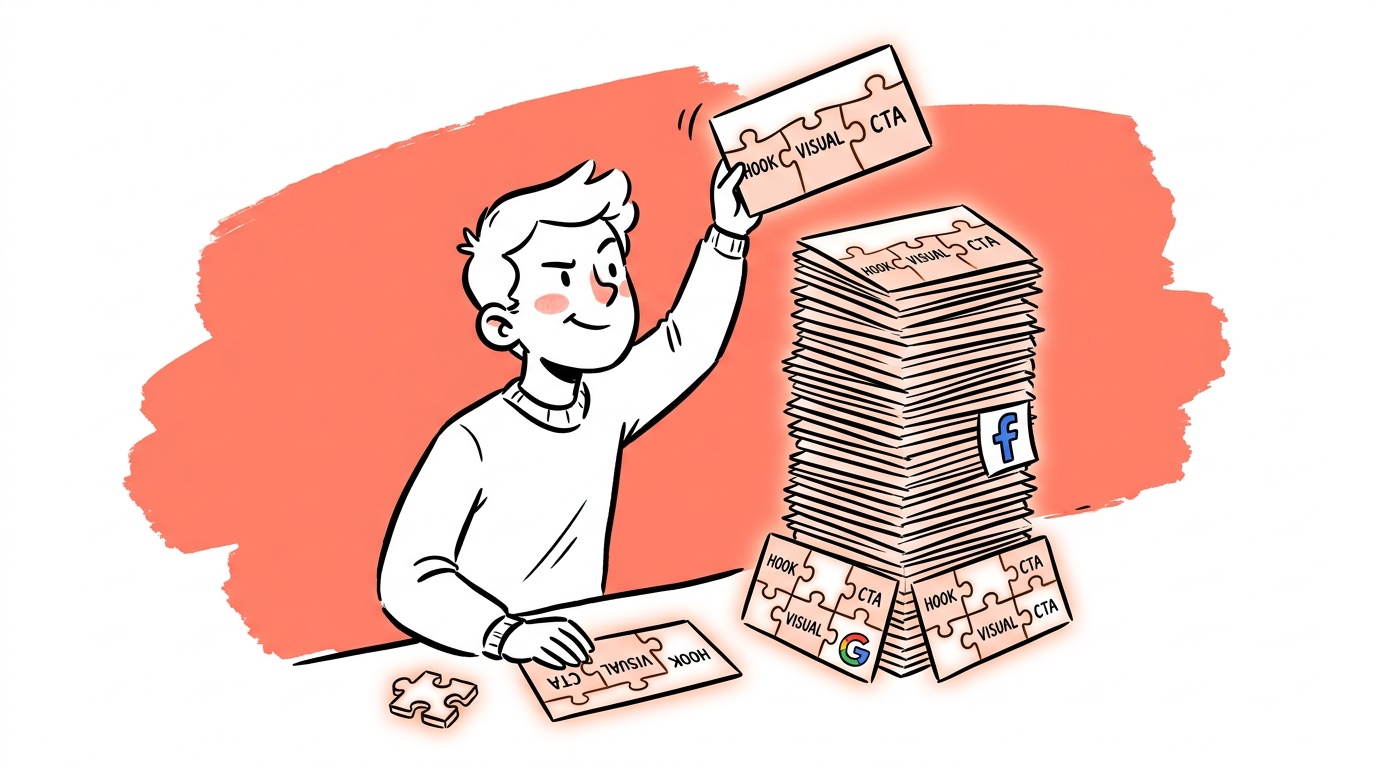
- The highest-leverage move is separating your creative components (hook, visual, CTA) so you remix rather than rebuild from scratch every time.
- Choosing which creatives to test is a distinct skill from making them — conflating the two is where most small teams waste the most time.
- Meta's delivery system rewards meaningful creative diversity — different value frames, not different background colors.
- A disciplined sprint process of three to five tests per month, analyzed cleanly, compounds into a real picture of what works. Fifteen blurry tests don't.
Why "Content Factory" Envy Is the Wrong Benchmark
When a frustrated PPC practitioner posted on r/PPC asking how a small team can compete with content factories, the thread filled up fast — because it's the exact anxiety most lean operators carry. The instinct is to look at a competitor running 50 active ad variations and assume they're winning because of volume.
That assumption is mostly wrong.
Big creative teams produce a lot of noise alongside signal. They can afford to because they have analysts sorting through the waste. A small team that copies the output rate without copying the analytical infrastructure just ends up with 50 untested, untracked assets and a depleted creative director.
The teams we see performing well with limited headcount aren't trying to match the factory's output. They're running a tighter feedback loop — fewer assets per cycle, cleaner test conditions, faster reads. A single honest winner found in week two beats 30 variations that never get a real traffic budget.
Build a Component Library, Not a Campaign Library
The most expensive part of creative production isn't design time — it's the blank-page problem. Every time a team starts a new ad from scratch, they're paying a cognitive tax that compounds across the week.
The fix is modular architecture. Break your ads into components:
- Hook (the first 3 seconds of video or the headline in static — see what makes a great hook)
- Value frame (the core claim — price, outcome, social proof)
- Visual treatment (lifestyle, product-only, UGC-style, text-heavy)
- CTA (direct offer, curiosity, urgency)
When you build these as separate, interchangeable pieces, a "new" ad becomes a remix, not a rebuild. Four hooks × three value frames × two visual treatments = 24 logical combinations. You don't ship all 24, but you have them available without starting from zero.
This also changes how you brief creative. Instead of "make an ad for the summer sale," you say: "Use hook #3, swap the value frame to free shipping, keep the visual treatment from last month's winner." That brief takes 30 seconds to write and 45 minutes to execute.
Where Teams Usually Get This Wrong
The component library only works if you actually label and store the pieces. Most teams keep everything inside campaign folders in Meta Ads Manager or a Google Drive organized by launch date. Neither structure surfaces the element — it surfaces the campaign.
A simple tagging system — even a Notion table or a spreadsheet with columns for hook type, value frame, and visual treatment — turns your asset library from an archive into a workbench. And once you have that tagging system, it maps directly onto your UTM naming convention and your Meta ad names. We'll come back to the exact schema in the tracking section below.
Creative Selection Is a Separate Job From Creative Production
The thread on choosing ad creatives surfaces something most operators don't consciously separate: making an ad and deciding which ad to run are two different cognitive tasks that require two different mindsets.
When the same person does both in the same sitting, they almost always over-index on effort sunk ("I spent four hours on this video, it has to go in the rotation") and under-index on strategic fit ("does this test a real hypothesis we haven't answered yet?").
The practical fix is a simple creative brief that forces the hypothesis before production starts:
- What behavior or belief are we trying to change in the viewer?
- What's the one claim this ad makes?
- How will we know in 7 days if it worked?
If you can't answer question three before you start making the asset, don't make it yet. "We'll see how it performs" is not a success metric — it's deferred thinking that eventually costs you a week of wasted spend.
Before greenlighting any new creative, ask: "If this ad fails, what's the most likely reason?" If you can't name a specific reason — wrong hook, wrong audience segment, wrong offer — the test design is too vague to learn from.

Live today.
The full campaign — copy, images, targeting — generated for your site and deployed paused for your approval.
Tracking Hygiene: The Minimum Viable Setup for Creative-Level Reads
This isn't a technical sidebar. It's the thing that determines whether your creative system produces real learning or expensive noise. When teams can't trust their attribution data, they compensate by running more variations to feel like they're making progress. More creative, worse signal, more creative — it's a loop that burns money and people.
The ongoing r/PPC conversation about Meta pixel tracking across products points at a real problem: teams running multiple products through a single pixel get attribution bleed that makes individual creative performance unreadable.
Here's the minimum setup that makes component-level analysis reproducible:
Campaign and ad set structure Separate campaigns per product line, not just per creative. If you're running two products through one campaign, you can't read creative performance cleanly — the audience overlap and budget allocation both distort the signal.
Ad naming convention Name every ad using a consistent schema that encodes the component tags. We use a pipe-separated format:
[product]-[hook-id]-[value-frame]-[visual-treatment]-[cta-type]
Example: bag-h03-freeship-ugc-directoffer
This means when you pull creative-level data from Meta Ads Manager or our AdControlCenter dashboard, you can filter and group by any component without needing a separate spreadsheet lookup.
UTM parameters
Your UTM content parameter should mirror the ad name exactly. That connects Meta creative-level data to your analytics platform and closes the loop if you're doing any post-click attribution work.
utm_source=meta&utm_medium=paid&utm_campaign=[product]&utm_content=bag-h03-freeship-ugc-directoffer
Weekly ritual Pull creative-level cost-per-result every Monday before making any new production decisions. A campaign that looks like it's performing is often two winning ads and three dead ones. You can't see that at campaign level. The Meta Ads reporting documentation covers creative-level breakdowns, but the default view buries them — you have to build a custom column set and save it.
When we built our creative performance views, we prioritized creative-level cost-per-result specifically because campaign-level data hides too much. The naming convention above is what makes those views actually useful rather than a column of unlabeled asset IDs.
The Sprint Model for Small Team Creative Production
Here's the operational model we've seen work for teams of one to three people:
Week 1: Learn Pull last month's creative performance at the ad level. Rank assets by cost-per-result. Identify the single biggest unanswered question ("we don't know if price-first hooks beat outcome-first hooks for this product").
Week 2: Brief and build Write briefs for exactly three to five new creatives that test the identified hypothesis. No more. Each brief includes hook ID, value frame, visual treatment, CTA type, and the success condition expressed as a specific cost-per-result target or CTR threshold.
Week 3: Launch and observe Ship the new assets. Give each one a real budget — enough to generate meaningful impressions before you make a kill decision. Resist the urge to tweak mid-flight. Changes during a live test invalidate the read.
Week 4: Decide Kill what lost. Iterate on what showed signal. Log the component tags and the outcome in your library. Start Week 1 again.
Four weeks, three to five tests, one documented learning. Twelve months of this and you have a real, tested picture of what works for your specific product and audience — which is worth more than a content factory's volume of untested guesses.
AI Tools Are a Force Multiplier for Components, Not for Strategy
The obvious move right now is to use AI to increase creative volume. That's not wrong, but it's almost always applied in the wrong place.
AI is fast and cheap at generating:
- Hook variations (give it five hooks, ask for twenty more in the same voice)
- Headline rewrites for static ads
- Copy variations testing different value frames
- Image prompts for visual concepts
AI is slow and expensive — in the "costs you real money when it's wrong" sense — at:
- Deciding which hypothesis to test next
- Identifying why a creative failed
- Matching offer to audience segment
- Reading the emotional subtext of what's working in your category
Use AI to do the remixing work that used to eat your component-library build time. Keep the hypothesis selection and the performance reads as human work. The failure mode we see most often is founders using AI to generate 30 new concepts when what they actually need is to understand why their last three tests lost.
What "Good Enough" Creative Actually Looks Like
Most small teams are waiting for a creative to feel polished before they ship it. That standard is wrong and expensive.
"Good enough" for a paid ad means:
- The hook is clear in the first three seconds (video) or at a glance (static)
- The claim is specific and singular — one thing, not four
- The visual doesn't distract from the claim
- It doesn't look careless
That last one matters less than people think. UGC-style, lo-fi content frequently outperforms polished studio creative in performance channels because it pattern-interrupts the feed and reads as authentic. We break down which Meta formats and hooks to test first in Meta ad creative that actually converts. Our labeled creative corpus consistently shows this pattern across multiple verticals — lo-fi doesn't mean low-effort, it means the format signals realness rather than production budget.
Ship faster. Learn faster. Polish the winners.
FAQ
What is ad creative production at scale? Ad creative production at scale means systematically generating, testing, and iterating on ad assets fast enough to feed your campaigns with fresh signal — without requiring a large in-house creative team. For small teams, scale is achieved through modular systems and disciplined testing cadences, not headcount.
How many ad creatives should a small team test per month? The constraint isn't effort — it's analytical bandwidth. If you can read and act on the results of three to five tests per month with clean data, that's more valuable than running 20 tests you can't interpret. Start with what you can actually analyze, then increase as your tracking and review process gets faster.
How do I choose which ad creatives to run? Before production, write a one-sentence hypothesis for each asset ("price-first hooks will lower CPL vs. outcome-first hooks for cold audiences"). Then define a clear success condition — a specific cost-per-result target or CTR threshold. Creative selection should happen before design, not after. Otherwise you're choosing based on effort invested rather than strategic fit.
Does Meta's algorithm favor creative variety? Meta's delivery system does benefit from creative diversity within an ad set because it can optimize toward the best performer for each sub-audience. But variety only helps if the variations are meaningfully different. Three creatives testing the same hook with different background colors is not meaningful variety — three creatives testing different value frames is.
How do I avoid creative fatigue on a small team? The main driver of creative burnout isn't volume — it's starting from zero every time. Build a component library of hooks, value frames, and visual treatments you can remix. A remixed brief takes a fraction of the time and cognitive energy of a blank-page build. The naming convention also helps: when every asset is tagged by component, you can see at a glance which elements you've tested and which you haven't.
Should I use AI to generate ad creatives? AI is a real time-saver for generating component-level variations — hook rewrites, headline alternatives, copy tests. It's not a substitute for hypothesis selection or performance analysis. Use it to speed up remixing; keep the thinking about what to test and why as human work.
How do I know when a creative has enough data to make a decision? This depends on your CPM and daily budget, but the principle is: set your decision criteria — a cost-per-result target, a CTR floor — when you launch the test, not after you see the numbers. If performance is catastrophically bad (cost-per-result more than 3× your target in the first 48 hours), kill it early. Otherwise, hold to the date you set and resist reading the data mid-flight.
The specific takeaway: pick one unanswered creative hypothesis this week — not a creative to make, a question to answer — and build the minimum number of assets required to answer it cleanly. Set up your ad naming convention before you launch. That's the whole system. Everything else is a detail.
Live today.
The full campaign — copy, images, targeting — generated for your site and deployed paused for your approval.
We build AdControlCenter — AI-powered ad management for small businesses, online stores, SaaS companies and service providers. We write what we'd want to read: real numbers, no fluff, the things we wish we'd known when we started.
More from the team →