Most founders who bring a $79 product to TikTok Shop assume the problem is their creative. They iterate on hooks, swap out UGC, test three different CTAs. Conversion rates stay flat. The real problem was never the creative—it was the price tag.
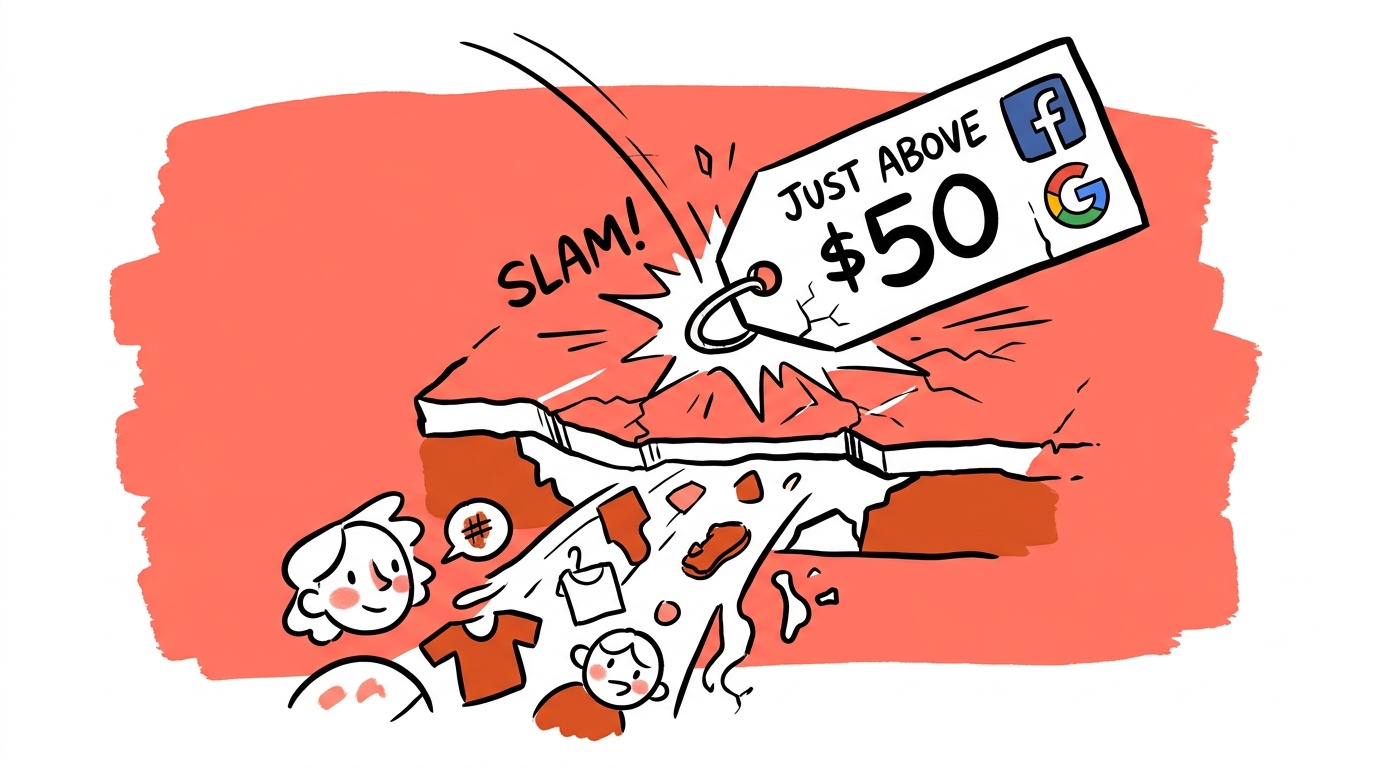
TikTok Shop is structurally optimized for impulse purchases. The scroll-to-checkout loop is fast, frictionless, and emotionally driven. That architecture works brilliantly for products priced below roughly $50. Above that threshold, a different psychology kicks in, the platform's native advantages start to erode, and your ad economics quietly fall apart. This post explains the mechanism, what we've observed across accounts, and how to think about it if you're sitting on a product that costs more than fifty dollars.
TL;DR: TikTok Shop's Price Ceiling
- TikTok Shop's checkout flow is built for impulse decisions—products priced above roughly $50 face a friction spike that the platform's UX does not resolve.
- Higher-priced items trigger longer consideration cycles that the short-form video format structurally cannot support.
- The clearest signal of a price problem isn't a weak add-to-cart rate—it's a strong add-to-cart rate paired with a collapsed purchase completion rate.
- Brands that succeed with higher-ticket items on TikTok Shop typically use a price-anchoring or bundle strategy to make the perceived unit cost feel sub-$50.
- Meta's ad infrastructure is better suited for longer consideration cycles, making it a natural complement when TikTok Shop stalls above the price ceiling.
Why TikTok Shop Is a Different Animal Than Meta or Google Shopping
TikTok Shop is not a product-search marketplace. Nobody opens TikTok to find a water bottle. They open it to be entertained, and then they buy the water bottle. That distinction is load-bearing.
On Google Shopping, purchase intent is declared. Someone types "insulated water bottle 32oz" and the platform serves results. The buyer is already in decision mode. On Meta, intent is constructed—you interrupt someone's feed, build desire over multiple impressions, and eventually convert. TikTok Shop compresses that entire arc into a single video view, sometimes under sixty seconds.
That compression is the platform's superpower for low-ticket goods. It is also the source of its price ceiling.
When a product costs $12, the risk calculus is simple: the viewer sees the product, feels a want, and taps buy before the rational brain engages. When a product costs $79, the rational brain has time to show up. Questions appear: Is this brand legitimate? Will it actually work? Can I return it easily? A sixty-second video cannot answer those questions with enough depth to overcome a $79 hesitation in a first-touch moment.
The higher the price, the more a buyer needs to feel they've "researched" the purchase—even if that research is just watching three videos instead of one. TikTok Shop's single-session checkout flow doesn't leave room for that behavior to happen natively inside the platform.
What the Price Ceiling Actually Looks Like in Practice
The ceiling isn't a hard wall. It's a friction gradient. Conversion rates don't cliff-edge at exactly $50—they start softening somewhere in the $40–$60 range and deteriorate more steeply as prices climb above that band.
A few patterns that show up repeatedly across the accounts we manage:
Add-to-cart rates hold, purchase rates collapse. Shoppers tap into the product page because the video creative is working—the hook lands, the product looks appealing. But they don't complete the purchase. The gap between add-to-cart and completed purchase widens as price increases. This is the clearest signature of a consideration problem, not a creative problem. If you're seeing strong ATC and weak checkout completion, stop shooting new videos and look at the price.
Return on ad spend drops faster than CPMs rise. Sometimes the CPM on a higher-ticket product campaign is actually reasonable—you're reaching people efficiently. But the conversion value per click doesn't compensate because the close rate is low. The ad spend is doing its job; the price point is doing the damage.
Organic does better than paid, proportionally. A $75 product may have an audience that discovers it organically, watches multiple pieces of content across several sessions, and eventually converts. Paid forces the single-session decision. The delta between organic and paid conversion rates tends to be larger for higher-ticket items on TikTok than on platforms where multi-touch retargeting is standard.
A rough benchmark by price band
These are directional, drawn from accounts we manage directly—not industry-wide survey data. Use them as a starting point for diagnosing where your funnel breaks, not as targets to hit.
- Below $30: TikTok Shop is often the fastest and cheapest channel to close. Impulse dynamics work fully in your favor.
- $30–$50: Workable with strong anchoring creative. Purchase completion rates are lower than below $30, but the unit economics can still work.
- $50–$100: This is where the friction gradient steepens. Add-to-cart may look healthy; expect the purchase completion rate to suffer. Bundles and discount anchors become necessary, not optional.
- Above $100: TikTok Shop rarely closes the purchase efficiently at first touch. It can be useful as a discovery and desire-building layer, but counting on it as your primary sales channel at this price is expensive.
The Psychology Behind the Ceiling
TikTok's interface is explicitly designed to minimize friction. The "Buy Now" button is prominent. Checkout is stored. The experience is closer to a vending machine than a store.
That design is a gift when you sell a $22 skincare product. It becomes a liability when you sell a $150 piece of home hardware.
The mechanism is regret aversion. Behavioral economics research on purchase regret consistently shows that higher-priced purchases trigger more deliberate decision-making, regardless of channel. Consumers slow down, seek validation, look for social proof beyond a single content creator, and often delay. TikTok's UX does not accommodate that delay gracefully—the algorithm will have moved the buyer through dozens of other videos by the time they think about returning to checkout.
Meta's ad infrastructure, by contrast, is built for the multi-touch arc. You can retarget, sequence creative, suppress recent buyers, and build frequency in a controlled way. The Meta Business AI roadmap that Meta has been publicly discussing leans further into that strength—automating audience management and bid optimization across longer consideration windows. That is exactly the infrastructure a $79 product needs and TikTok Shop currently doesn't offer at the same depth.

Live today.
The full campaign — copy, images, targeting — generated for your site and deployed paused for your approval.
How Brands Work Around the Ceiling
The ceiling is real but not immovable. Brands that succeed with higher-ticket items on TikTok Shop tend to use one or more of these approaches:
The Bundle Approach
Bundle multiple units or complementary products until the per-unit perceived value is below $50, even if the total order value is higher. A $45 item paired with a $30 accessory, sold as a bundle for $65, activates different buyer psychology than a standalone $65 item. The buyer is evaluating a deal relative to two separate prices, not asking whether a single object is worth $65. The emotional framing shifts from "is this worth it?" to "this is a better deal than buying separately."
This works because it keeps the purchase feeling like a win, which is the emotional state that drives TikTok Shop completions.
Aggressive Price Anchoring in Creative
Show the "before" price prominently and early. If a product retails for $89 but runs at $49 on TikTok Shop, the creative should establish $89 as the anchor within the first three seconds. The buyer isn't evaluating a $49 product—they're evaluating a $40 discount. That's a meaningfully easier decision.
TikTok's own publicly available seller guidance points to visible discount framing as a consistent driver of purchase completion. The nominal price is the same. The psychological price is lower.
Use TikTok as a Discovery Channel, Not a Close Channel
For products genuinely priced above what TikTok Shop can close in one session, stop trying to close in one session. Run TikTok campaigns optimized for video views or product page visits rather than purchases. Let TikTok do what it's actually good at—awareness and desire creation—and retarget those warm audiences on Meta or through email capture before the checkout ask.
This approach sacrifices TikTok Shop's native checkout convenience but saves your budget from funding a checkout flow that isn't going to convert at your price point. The audiences TikTok warms are real and valuable; you're just asking Meta to close them instead.
Where This Leaves Your Pricing Strategy
If you're a founder deciding whether to launch a product on TikTok Shop, the price point question deserves to come before the creative question. Ask:
- Can this product be priced or bundled to sit comfortably below $50?
- If not, can the creative establish a strong enough anchor that the effective perceived price lands there?
- If neither, is TikTok Shop the right primary channel—or is it better as a discovery layer that feeds a Meta or email retargeting funnel?
The instinct when conversion rates drop is to fix the creative. Sometimes that's right. But if your creative is genuinely working—strong hook rate, strong ATC—and your purchase completion rate is still weak, check the price before you shoot another video.
Every marketplace has a sweet spot price range that matches its audience psychology. Amazon's sweet spot skews toward considered purchases with review infrastructure to support them. TikTok Shop's sweet spot skews toward fast, low-regret buys. Pricing your product to fit the platform isn't a compromise—it's a distribution decision.
The Cross-Platform Reality
The pattern here isn't unique to TikTok. Every ad platform has structural constraints that favor certain product types and price ranges. Google Shopping favors products with clear search demand. Meta favors products that benefit from repeated visual exposure. TikTok Shop favors products that can close on emotional impulse.
What's changing is that platform AI is making each of these systems more efficient at what they already do well—which means the mismatches become more expensive, not less. As Meta's AI gets better at finding buyers with longer consideration windows, and as TikTok's algorithm gets better at optimizing for fast-checkout signals, the cost of being on the wrong platform for your price point will increase. The gap between a correct platform choice and an incorrect one will widen as both systems become sharper.
Founders who understand their product's natural consideration cycle and match it to the right platform will spend less and convert more. Founders who don't will keep blaming their creative.
FAQ
What is TikTok Shop's price ceiling? There's no ceiling set by the platform, but in practice, products priced above roughly $50 see meaningfully lower purchase completion rates on TikTok Shop. The platform's fast, impulse-driven checkout flow doesn't give buyers enough space to deliberate on higher-ticket purchases, so conversion rates soften as price climbs above that band.
Why do high-ticket products struggle on TikTok Shop specifically? TikTok Shop compresses the entire awareness-to-purchase journey into a single short video session. Products that require research, trust-building, or comparison shopping don't close well in that environment. Above a certain price, the buyer's deliberate decision-making process activates—and the platform's UX doesn't accommodate it. The result is high add-to-cart, low purchase completion.
Can I sell a $100 product on TikTok Shop successfully? Yes, but it typically requires a strong discount anchor, a bundle strategy that makes the effective per-unit cost feel lower, or treating TikTok Shop as a top-of-funnel channel rather than the primary close mechanism. Many advertisers find that warming audiences on TikTok and retargeting on Meta is more efficient than trying to force a $100 close through TikTok Shop alone.
What price range works best on TikTok Shop? Products priced below $50—and especially below $30—see the strongest impulse-buy conversion rates. The $30–$50 range is workable with strong anchoring creative. Above $50, friction increases noticeably. Above $100, TikTok Shop is rarely the most efficient primary sales channel, though it can still play a useful role in building awareness.
Is TikTok Shop's price ceiling the same as Meta's? No. Meta's ad infrastructure is better suited for higher-consideration purchases because it supports multi-touch retargeting, longer campaign windows, and sequential creative delivery. TikTok Shop is structurally optimized for the opposite—speed and impulse. The two platforms aren't competing for the same purchase type above the $50 threshold; they're complementary.
What should I fix first: my TikTok creative or my price point? Look at where the funnel breaks. If your add-to-cart rate is weak, the creative needs work—the hook isn't landing or the product isn't appealing on screen. If your add-to-cart rate is strong but your purchase completion rate is weak, the creative is doing its job and the price is the problem. Most founders misread the second pattern as a creative problem and waste time on videos that won't move the needle.
Does TikTok Shop work for higher-ticket consumer products at all? It can, but not as a standalone close channel. For products priced above $100, TikTok Shop works best as a discovery and desire-building layer. The purchase itself is better closed through a retargeting sequence on Meta, a direct email capture, or a landing page optimized for considered buyers. Trying to force the full purchase journey through TikTok Shop at that price point is expensive and usually disappointing.
The most expensive mistake on TikTok Shop isn't bad creative—it's spending months optimizing videos for a product that was never going to convert at its price point through that channel. If your add-to-cart is strong and your completions are weak, you already have your answer. Check the price first. Then decide whether to shoot another video.
Live today.
The full campaign — copy, images, targeting — generated for your site and deployed paused for your approval.
We build AdControlCenter — AI-powered ad management for small businesses, online stores, SaaS companies and service providers. We write what we'd want to read: real numbers, no fluff, the things we wish we'd known when we started.
More from the team →