
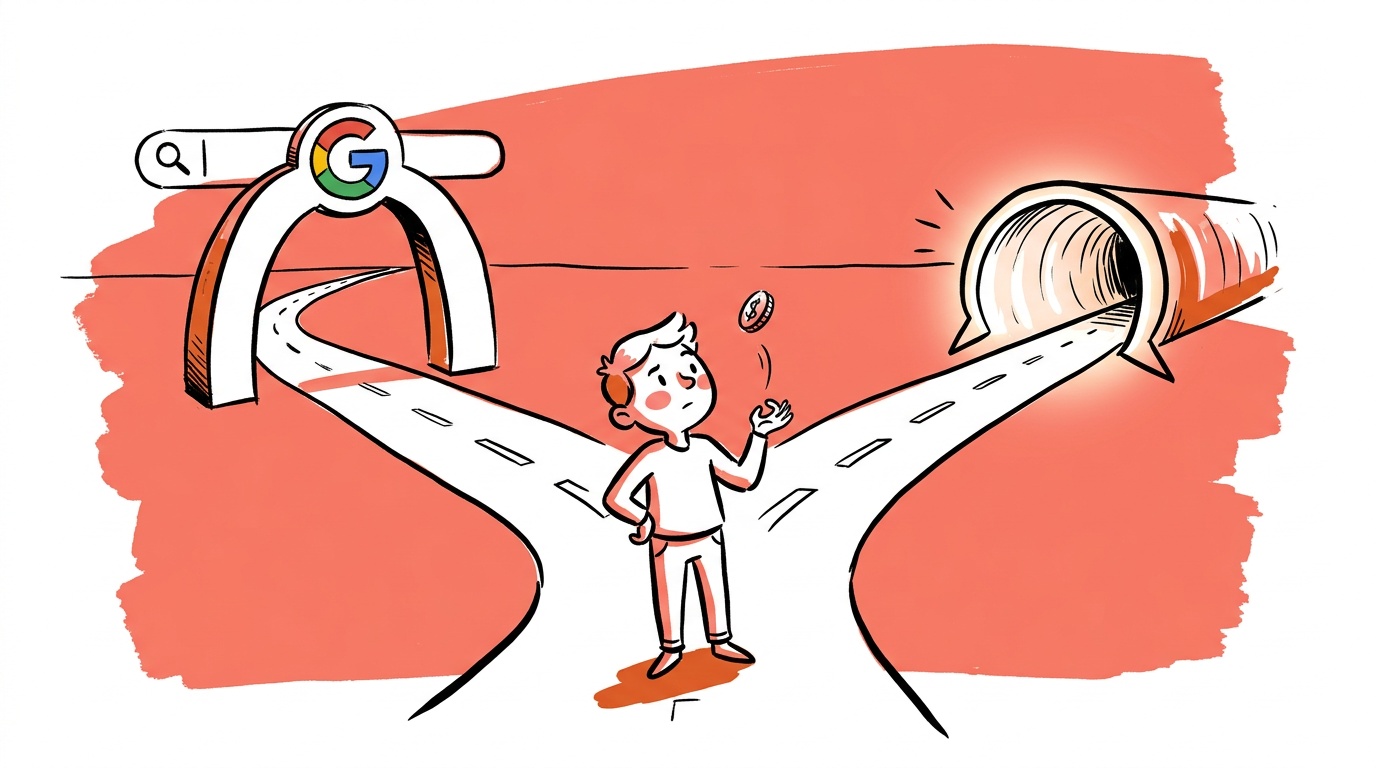

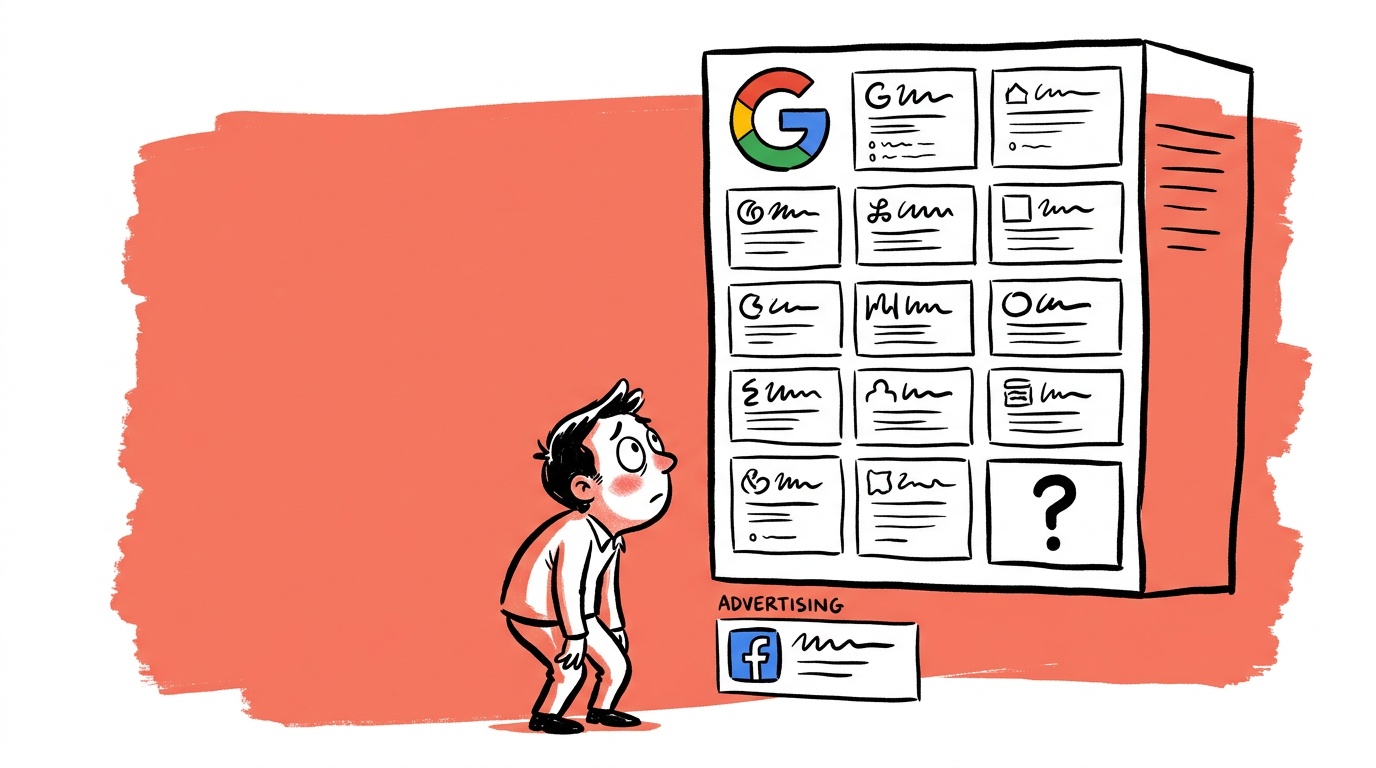
Google started showing ads inside AI Mode before most advertisers noticed the surface existed. The placements appeared, and most accounts kept running the same keyword lists and creative they built for a 2019 SERP. That gap — between where ads now appear and how most campaigns are actually structured — is the expensive problem this post is about. (For what the placements look like in practice, see what early AI Mode ad testing shows.)
The shift is not incremental. AI Mode doesn't surface ten blue links with ads bolted on top. It generates a synthesized answer, and ads live inside that answer. The implication: relevance signals that worked for traditional search are not the same signals that get you placed in an AI-generated response. If your campaigns aren't ready, you won't just lose clicks — you'll become invisible in the fastest-growing surface in search.
TL;DR — What You Need to Know About Ads in AI Search
- Google AI Mode serves ads directly inside AI-generated answers, not alongside traditional search results.
- Agentic commerce is accelerating this: AI agents are beginning to complete purchases on behalf of users, which changes what "a click" even means.
- Feed quality, structured data, and product information completeness matter far more than keyword bids in AI-surfaced placements.
- Performance Max campaigns are Google's preferred vehicle for AI Mode inventory, which means your asset groups and audience signals need immediate attention.
- Advertisers who optimize for AI-native signals now will build a structural advantage before most competitors notice the surface exists.
What AI Mode Actually Changes About Ad Placement
Traditional search ads work on a simple model: a user types a query, Google matches it to keywords, and an auction decides who gets the slot above the results. The page layout is predictable. The auction is transparent enough to manage.
AI Mode breaks that layout. The entire results page is replaced by a conversational, synthesized response — Google answering the question rather than listing pages that might answer it. Ads that appear in this surface are embedded in or adjacent to that generated answer, not in discrete labeled slots at the top and bottom of a keyword-matched results page.
This matters because the matching logic changes. Google's systems have to decide which ads are relevant to an entire generated answer, not to a single keyword string. That pulls weight away from exact match terms and toward semantic relevance, entity coverage, and the richness of your underlying product and landing page data.
Most advertisers running Search and Shopping campaigns have no visibility into how much of their impression share is now being competed for in AI Mode auctions. Google doesn't break this out as a separate segment yet — which means campaigns you think are performing fine may already be losing ground on this surface.
Agentic Commerce Is the Next Layer
If AI Mode ads are the immediate problem, agentic commerce is the medium-term one. The concept, discussed in recent industry analysis around Google Ads in 2026, is that AI agents will increasingly act on behalf of users — not just answering queries but completing purchases, comparing options, filling forms, and making decisions without the user ever manually clicking through to a product page.
When that happens, the traditional click-through funnel breaks down. An agent might evaluate your product listing, compare it against competitors, and either recommend it or dismiss it — all without generating a session in your analytics. The advertisers whose products are structured in ways that AI agents can actually read and evaluate will be the ones getting recommended. The ones relying on persuasion copy and brand imagery alone will get skipped.
Google has been explicit about building agentic capabilities into its search and shopping infrastructure. The practical implication for advertisers: your data needs to be machine-readable at a level of detail that goes well beyond what most Google Merchant Center feeds currently contain.
Feed Quality Is Now a Competitive Moat
For anyone running Shopping or Performance Max, this is the section to send to your ops team.
Feed quality has always mattered. In AI Mode and agentic contexts, it becomes the primary lever. When an AI system is generating a response about "the best waterproof running shoes under a certain price," it is pulling structured product attributes — category, material, waterproofing rating, size range, return policy, price — not reading your product description for vibes.
Feeds with incomplete attributes, missing GTINs, vague product titles, or thin descriptions simply won't surface. The AI has nothing to match against the query's semantic content. Meanwhile, a competitor with complete structured data on every attribute field wins the placement without having a higher bid.
What good looks like right now
- Product titles that include the attributes a buyer would actually search for, not just the brand name and SKU.
- All optional attribute fields filled — Google calls most of them optional, but in AI ranking contexts they function as tiebreakers.
- Custom labels that let you segment products by margin, seasonality, or strategic priority so your bidding logic reflects actual business value.
- Rich descriptions written for comprehension, not keyword stuffing — AI systems penalize the latter.
A useful way to pressure-test this: pick your ten highest-revenue products and open each one in the feed. Count the empty optional fields. That number is a direct proxy for how much AI Mode relevance signal you're leaving blank.

Live today.
The full campaign — copy, images, targeting — generated for your site and deployed paused for your approval.
Performance Max: The Vehicle You Have to Fix, Not Replace
Performance Max is Google's way of accessing all its AI-driven inventory from a single campaign type, and that now explicitly includes AI Mode placements. AI Max is the parallel lever for Search campaigns — here's what advertisers must do now. If you've been skeptical of PMax — and there are good reasons to be — this isn't the moment to abandon it. It's the moment to make it actually work.
The most common failure mode we see in PMax accounts is treating it as a set-and-forget campaign. You load assets, let Google optimize, and hope for the best. In AI Mode contexts, that's especially dangerous because poor asset groups give Google's systems nothing to work with when constructing relevant ad experiences inside a generated answer.
What to fix in your PMax asset groups
Asset variety and specificity: Each asset group should reflect a coherent product or audience theme. Generic headlines like "Shop Now" or "Great Deals" are not useful signals in an AI-matching context. Specific, descriptive headlines that mirror how buyers describe the product to themselves are far better.
Audience signals: PMax can use first-party audience data to improve its targeting model. Most accounts don't feed it enough. Customer lists, high-value purchasers, and remarketing segments give the model real signal. Without them, it's guessing.
Negative keywords at the campaign level: PMax now supports campaign-level negative keywords. Use them. Letting AI Mode route your brand budget to irrelevant synthesized queries is an expensive and quiet leak.
AI Mode Readiness: A Practical Audit
This doesn't require a new platform or a consultant. It requires being honest about the current state of your inputs. Work through this in order — each step has a clear pass/fail outcome.
1. Merchant Center disapprovals Pull your feed diagnostics report. Any disapproved product cannot enter AI Mode auctions. This is a hard exclusion, not a soft disadvantage. Fix disapprovals before touching anything else.
2. Attribute completeness on top-revenue products For your highest-revenue SKUs, count empty optional attribute fields. If the answer is "many," that's your first real project. These aren't optional in a competitive AI auction context.
3. PMax asset group segmentation How many asset groups do you have per campaign? One asset group means no thematic segmentation — Google's AI is trying to match every product you sell to every possible query with a single set of creative. That's both wasteful and ineffective.
4. Landing page consistency AI systems follow the data chain from feed to landing page. If the page doesn't reflect the structured attributes in your feed, relevance scores drop. Product pages need to match what you're telling Google in the feed.
5. First-party data recency Do you have customer lists uploaded to Google Ads? When were they last refreshed? Agentic systems increasingly favor advertisers whose audience signals give the model confident predictions. Stale or thin lists are a measurable disadvantage.
6. Schema markup on your site Does your site implement structured data markup for products, reviews, and offers? Organic AI visibility and paid AI visibility are increasingly correlated — weak structured data hurts both simultaneously. Our GEO checklist for founders covers the organic half.
Score yourself honestly: if you have clean answers for four or more of these six, you're ahead of most advertisers. Fewer than three means you have immediate structural work to do before optimizing anything else.
The Organic Side You Can't Ignore
Ads in AI Mode don't exist in isolation from organic AI results. Google's AI Overviews and AI Mode organic answers pull from the same web — and the businesses cited organically in those answers tend to be the ones with strong structured data on their sites, clear entity relationships, and content that directly answers specific questions.
This matters to paid advertisers because the same infrastructure improvements that lift your paid AI visibility also lift your organic AI visibility. Investing in schema markup, entity clarity, and content that directly answers buyer questions is not a pure SEO project — it's an ads-adjacent one.
The Google Search Central documentation on structured data is unglamorous reading, but it directly affects how Google's AI systems understand and represent your products across both paid and organic surfaces.
What We're Watching and Testing
We've started routing a segment of our own test accounts toward more explicit AI Mode optimization — specifically, completing every optional Merchant Center attribute field for high-priority products and tightening PMax asset group themes to match specific product categories. Early directional signals suggest attribute completeness has a disproportionate effect on impression share in AI-surfaced placements compared to its effect on standard Shopping, though we're still building enough data to say that cleanly.
We're also watching how agentic purchase flows develop through the rest of this year. The specific question we're trying to answer: when an AI agent is the one evaluating purchase options, which campaign settings and feed attributes most influence whether your product is included in the evaluation set at all. We don't have a clean answer yet, but the test is running.
FAQ: Ads in AI Search
What are AI search ads and how are they different from regular Google search ads?
AI search ads appear inside Google's AI Mode, where the results page is a generated answer rather than a list of links. Instead of matching a keyword to a labeled ad slot, Google's systems match your product or service to the semantic content of an AI-generated response. The matching logic is heavier on structured data and entity relevance than on exact keyword strings.
Does my existing Google Ads campaign automatically enter AI Mode auctions?
Not necessarily, and not always effectively. Performance Max campaigns have the broadest access to AI Mode inventory. Standard Search campaigns have more limited exposure. If your PMax asset groups are thin or your Merchant Center feed has disapprovals, you may be structurally excluded from AI Mode placements even if your campaign is technically eligible.
How important is Google Merchant Center feed quality for AI Mode ads?
Extremely important — more so than in traditional Shopping. AI systems need complete structured attributes to match your products to synthesized queries. Products with missing GTINs, vague titles, or empty optional attribute fields are at a systematic disadvantage.
What is agentic commerce and why does it matter for advertisers?
Agentic commerce refers to AI agents completing purchase-related tasks on behalf of users — comparing products, checking availability, and in some cases initiating transactions — without the user manually searching and clicking. For advertisers, this means the product information in your feed and on your site needs to be machine-readable and complete, because an AI agent evaluating your product may never render your visual creative or read persuasion copy.
Should I pause my standard Search campaigns and switch everything to Performance Max for AI Mode?
No. PMax and Search serve different strategic purposes, and abandoning Search campaigns entirely creates its own risks around brand terms and high-intent queries. The right move is to ensure your PMax campaigns are properly structured for AI Mode inventory — strong asset groups, complete feeds, real audience signals — while maintaining Search coverage for queries where you have proven performance.
How do I know if my ads are showing in AI Mode?
Google's current reporting doesn't offer AI Mode as a standalone breakdown in most standard views. Watch impression share trends in PMax and Shopping campaigns — unexpected drops may reflect AI Mode auction dynamics rather than traditional competitive shifts. As Google expands its reporting, this visibility should improve.
What's the single highest-leverage thing I can do right now to prepare?
Fix your Merchant Center feed. Every disapproved product is a product that cannot enter any AI-driven auction. Every missing optional attribute is a missed relevance signal. Feed quality is the foundation everything else sits on — and it's the one input you fully control.
The specific thing to do this week: open Merchant Center, pull the diagnostics report, and count your disapproved products. That number is the clearest measure of how much AI Mode inventory you're currently locked out of. Fix that list before you touch anything else.
Live today.
The full campaign — copy, images, targeting — generated for your site and deployed paused for your approval.
We build AdControlCenter — AI-powered ad management for small businesses, online stores, SaaS companies and service providers. We write what we'd want to read: real numbers, no fluff, the things we wish we'd known when we started.
More from the team →