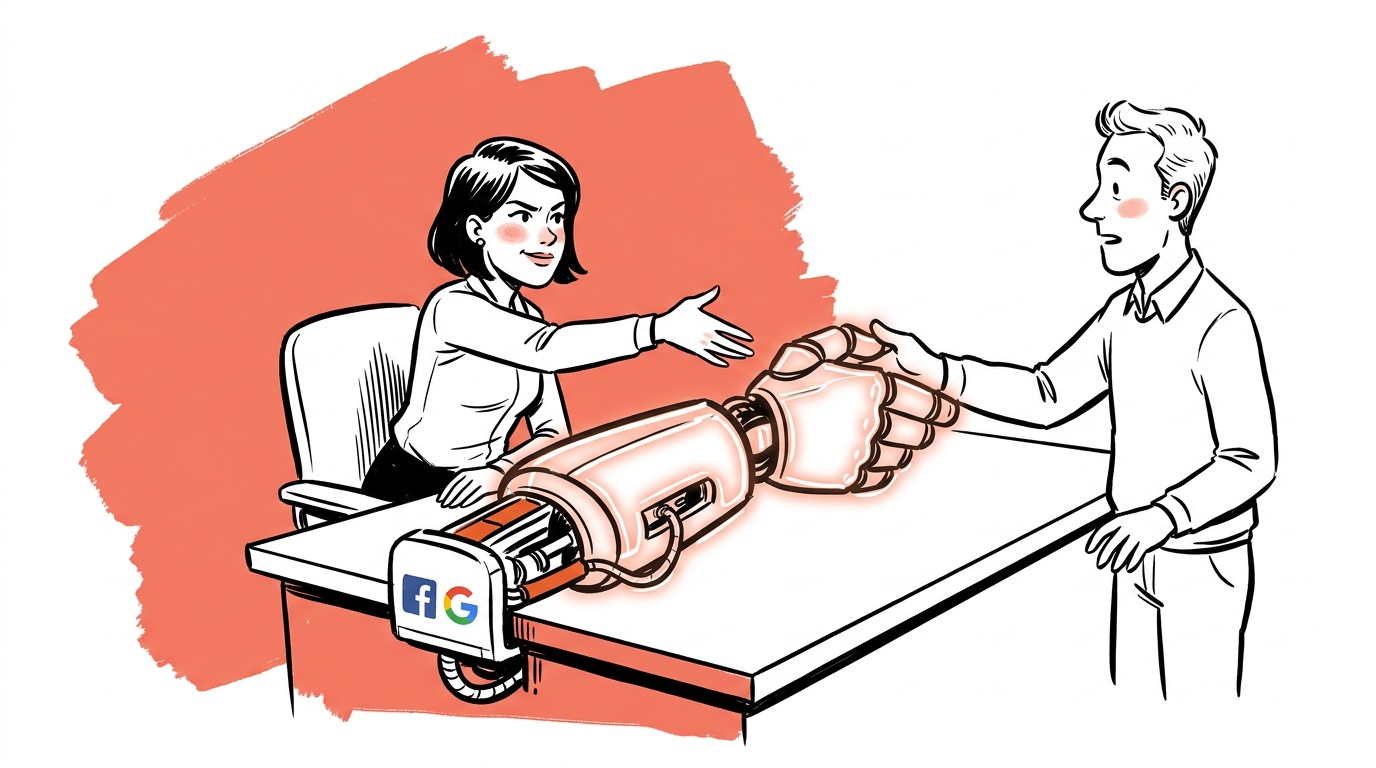
By the time someone clicks your ad — if they click at all — an AI system has already summarized your brand, weighted your credibility against competitors, and handed the user a verdict. You weren't in the room.
That shift is not coming. It's already embedded in Google's AI Mode, in Perplexity's answer engine, in ChatGPT's browsing responses, and in the AI Overviews sitting above paid results. The first impression is now a machine-generated paragraph you didn't write and can't directly edit. Founders who treat brand reputation as a post-click problem are already behind — the work now starts at the corpus level.
TL;DR — AI brand trust signals in 2026
- AI intermediaries (Google AI Mode, Perplexity, ChatGPT) now summarize brands before users reach any ad or website, making AI-generated perception a real pre-click signal.
- What those AI systems pull from: reviews, structured data, editorial mentions, social proof, and the consistency of your brand voice across the open web.
- Brands with thin or contradictory digital footprints get flattened by AI summaries — either omitted or described in the blandest possible terms.
- Google has confirmed ads will appear inside AI Mode results, which means trust signals will coexist directly with ad placements in a single AI-generated response.
- Founders who treat brand reputation as a post-click problem are already behind; the work now starts at the corpus level.
The Moment That Changed the Funnel
Google's AI Mode is the clearest example of how the funnel has been restructured. Rather than returning a list of blue links with ads interspersed, AI Mode composes a conversational response — and ads are being integrated directly into those AI-generated answers. A user asking "what's the best project management tool for a 10-person startup" doesn't first see a list of results. They get a synthesized answer. Your ad, if it appears, lives inside that synthesis.
The implication: your ad creative is no longer the first brand signal a user processes. The AI's framing of your category — and whether your brand appears in it at all — comes first.
For paid advertising, this isn't just a philosophical shift. It changes which brands appear, how they're described, and how much credibility they arrive with before a click ever happens.
How AI Systems Decide What to Trust
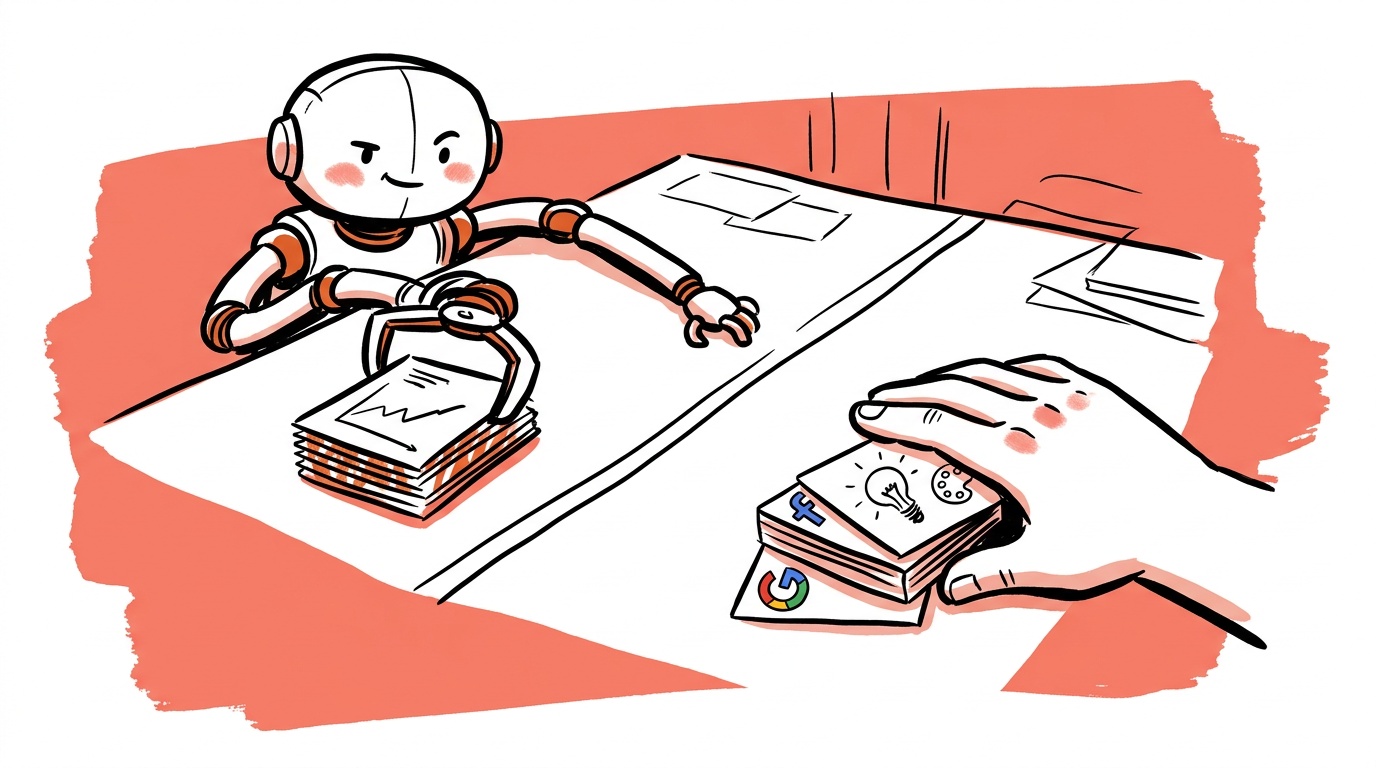
AI-generated answers draw from a corpus of existing content — reviews, news coverage, Reddit threads, structured data on your website, third-party directories, social media mentions. The system weights these sources and constructs a picture of your brand from whatever is already out there.
The signals AI answer engines tend to pull: review platform ratings and review volume, presence in authoritative editorial sources, structured schema markup on your site, consistency of brand claims across channels, and the recency of those signals. A brand that has been quiet or inconsistent for 18 months often looks indistinct in an AI summary — not because the AI is punishing it, but because there isn't enough signal to say anything meaningful.
The problem for most founders is that they've optimized their owned channels — website copy, ad creative, email sequences — and largely ignored the signals that exist outside those owned channels. Reviews go unanswered. Schema markup is missing or outdated. The brand's positioning in press and editorial coverage is years old. When an AI system goes looking, it finds a thin or incoherent picture.
That thin picture gets reflected back to your next potential customer before they've ever heard your pitch.
Your Ad Creative Runs Inside an AI Frame
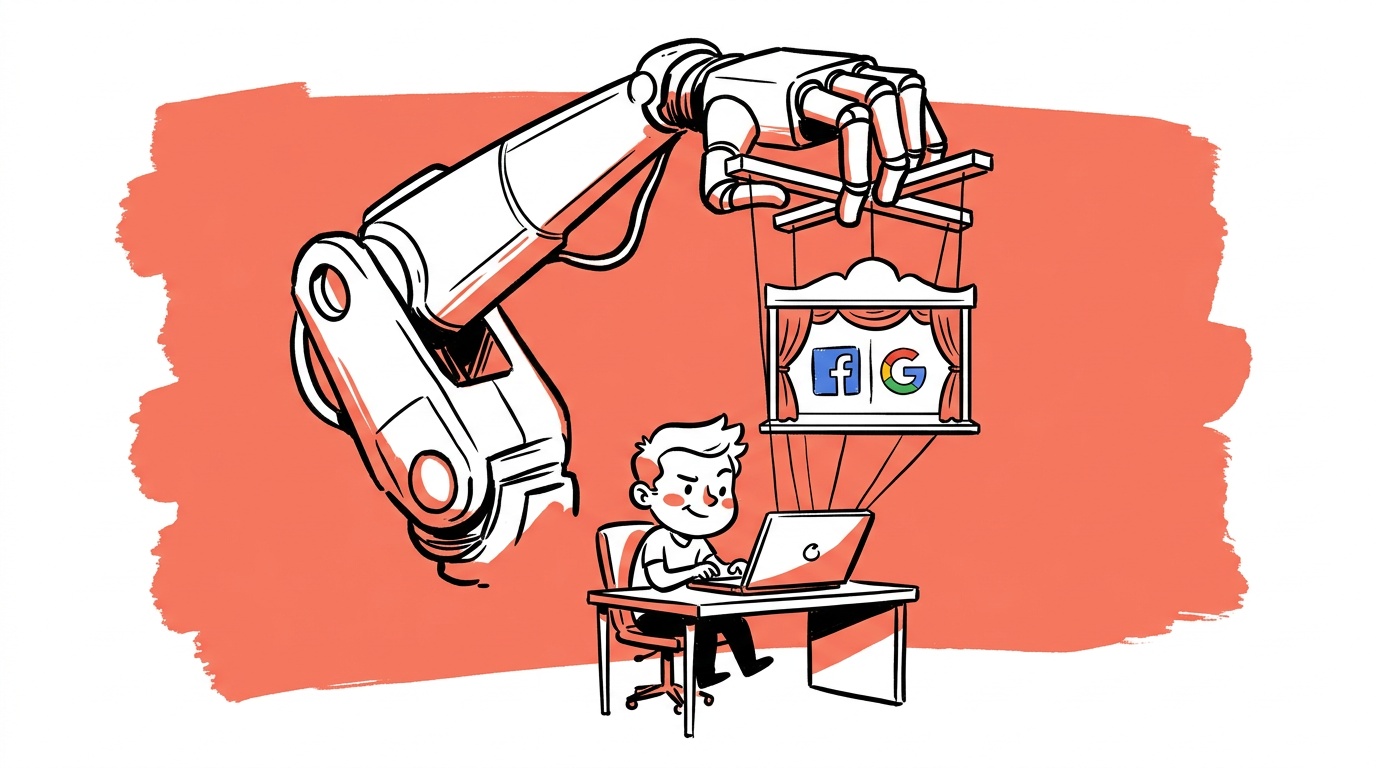
This is the part that founders managing paid ads need to sit with: ad creative is now displayed inside an AI-generated context that the advertiser doesn't control.
In traditional search, a user saw your headline, your description, your display URL. The surrounding content was other ads and blue links — neutral, not interpretive. In AI Mode, the surrounding content is an AI's synthesis of the topic. That synthesis carries implied endorsements and omissions. If the AI's answer names two competitors as solid choices and your brand appears as a sponsored unit below that paragraph, you've already lost the framing battle before a word of your copy is read.
The practical consequence: ad performance is increasingly a downstream function of brand signal quality. Click-through rate, conversion rate, and even quality score are all influenced by how credible your brand looks before the click. Founders who are puzzled by rising CPCs and falling CVRs without any change in their campaigns should look upstream — at what the AI is saying about them before the ad renders.

Live today.
The full campaign — copy, images, targeting — generated for your site and deployed paused for your approval.
What "Brand Signal" Actually Means in This Context
"Brand signal" gets used loosely. In an AI-mediated environment, brand signals are the specific data points that AI systems use to construct a summary of your credibility and relevance. Here's what actually matters:
Review signals. Volume, recency, sentiment, and the specificity of reviews on Google, G2, Trustpilot, Capterra, or wherever your category shops. An AI summarizing your product will often pull from these directly. A brand with many generic five-star reviews and no detailed ones looks just as thin as a brand with few reviews.
Editorial and citation signals. When credible third-party sources — industry publications, newsletters, analyst reports — mention your brand in a specific and positive context, AI systems treat those as trust anchors. A single well-placed editorial mention in a niche publication often carries more weight than a large volume of self-published blog posts.
Structured data and schema. AI systems parsing your website rely heavily on structured markup to understand what you do, who you serve, and what your product claims are. Missing or broken schema means the AI is guessing — and guessing conservatively. Schema is item 4 of our 12-item checklist.
Consistency across surfaces. If your LinkedIn page says one thing, your website says another, and your G2 listing is two years out of date, the AI's synthesis will reflect that inconsistency as ambiguity. Ambiguity in AI summaries tends to resolve toward competitors who are clearer.
Social proof specificity. Vague claims ("trusted by thousands") are invisible to AI summarizers. Named customers, specific use cases, and quantified outcomes are legible. If those specifics exist somewhere on your site or in your reviews, they can surface in an AI answer. If they don't, they won't.
The Ads-in-AI-Mode Problem Is Real and Coming Fast
Google's rollout of ads inside AI Mode is an active product direction, and for paid advertisers it introduces a dynamic with no precedent in traditional SEM: your paid placement and an AI brand summary appear in the same viewport, simultaneously.
This creates three concrete dynamics:
-
A user can read an AI summary that doesn't mention your brand, then see your ad. The cognitive gap — "if this brand were good, wouldn't it have come up in the answer?" — is real and will suppress click-through.
-
A brand that appears in both the AI answer and the ad slot benefits from dual presence. The AI mention functions like an organic endorsement sitting next to the paid unit.
-
Advertisers who invest in the upstream brand signals that drive AI mentions get more from every dollar of paid spend. The brand halo effect is now mechanically embedded in the results page.
We haven't run a controlled study of the CTR delta between brands that appear in AI answers versus those that only appear in the ad unit below. What we have seen from early Google AI Mode ad testing is in a separate post. The directional logic is straightforward enough: presence in the synthesis is a different kind of signal than presence only in the ad.
The AI Brand Trust Audit: What to Check and How
This isn't a call to abandon paid ads and pivot to brand building in the abstract. It's a call to do specific, measurable things that improve your signal quality. The table below maps each signal to where you fix it, how you test it, and what good looks like.
| Signal | Where to fix it | How to test it | What "good" looks like |
|---|---|---|---|
| Review volume and specificity | Google, G2, Trustpilot, Capterra | Ask ChatGPT: "Summarize reviews of [brand]" | Recent reviews with named use cases, not generic praise |
| Schema and structured data | Site source code | Google's Rich Results Test | Zero errors, product/org schema complete and current |
| Editorial mentions | Industry publications in your category | Search Perplexity: "What is [brand] known for?" | At least one specific mention in a publication your buyers read |
| Cross-channel consistency | LinkedIn, G2 listing, website, ad copy | Compare your About sections side by side | Same positioning, same ICP, updated within 12 months |
| Social proof specificity | Case studies, landing pages, review responses | Ask AI Mode: "Best [your category] for [your ICP]" | Named customers, specific outcomes, clear before/after |
Monitor what AI systems actually say about you. Ask ChatGPT, Perplexity, and Google's AI Mode to summarize your product in your category. Do it monthly. Treat the output as a mirror, not a curiosity. Searching once a quarter is not monitoring — it's tourism.
Set up a simple monthly cadence: query your top three competitor comparisons ("X vs Y", "best tool for Z"), your brand name alone, and your core use case. Log what the AI says. Track whether it changes after you make upstream improvements. This is the feedback loop that matters now.
Create AI-legible proof points. Case studies with named customers, specific numbers, and clear before/after narratives are exactly the kind of content AI systems can cite. They also convert on landing pages. These aren't separate workstreams — the same asset does both jobs.
Build editorial presence in your category. Identify the publications your buyers actually read. Get mentioned in them specifically — a product review, a quoted expert comment, a use-case story. One specific mention in a relevant publication beats many generalist press releases. For the full sequence — comparison page, reviews, editorial mention, community thread — see how to show up in AI answers before rivals do.
FAQ
What are AI brand trust signals? AI brand trust signals are the data points — reviews, editorial mentions, structured data, social proof specifics, and cross-channel consistency — that AI answer engines use to construct a summary of your brand's credibility before a user reaches your website or ad.
Does AI Mode affect my Google Ads performance? Yes. Google is actively integrating ads into AI Mode results, which means your paid unit appears alongside AI-generated content. If that content omits or contradicts your brand, it can suppress click-through even when your ad is technically shown.
How does an AI system decide which brands to mention in a summary? AI systems draw from their training data and, in retrieval-augmented systems, from live web content. Brands with higher review volume and specificity, more editorial citations, complete structured data, and consistent messaging across channels are more likely to surface in AI-generated answers.
Can I directly control what an AI says about my brand? Not directly. There's no equivalent to a meta tag that tells an AI what to say. You influence AI summaries indirectly by improving the underlying signals — reviews, schema, editorial coverage — that those systems pull from.
Is this different from traditional SEO? Related but distinct. Traditional SEO optimizes for ranking in link-based results. AI signal optimization focuses on being cited or summarized accurately in conversational AI answers. Schema markup and editorial authority matter in both; keyword density matters far less in AI contexts.
How quickly do AI summaries update when I improve my signals? It varies by system and depends on crawl frequency and model update cycles. Retrieval-augmented systems like Perplexity update relatively quickly — sometimes within days of new content being indexed. Model-based systems may reflect changes more slowly. Improvement is rarely instant, which is why starting earlier matters.
If my brand doesn't appear in AI answers, will my ads still show in AI Mode? Ads in AI Mode are served through separate systems from the AI-generated content, so a paid unit can appear even if your brand isn't mentioned organically in the answer. The concern isn't whether your ad shows — it's the trust gap created when users see your ad without seeing your brand mentioned in the AI's answer above it.
The specific thing to do right now: open ChatGPT or Perplexity and ask it to summarize the best options in your category for your exact customer type. See if your brand appears, how it's described, and whether the description matches what you'd say yourself. That gap — between what the AI says and what you'd want it to say — is the work.
Live today.
The full campaign — copy, images, targeting — generated for your site and deployed paused for your approval.
We build AdControlCenter — AI-powered ad management for small businesses, online stores, SaaS companies and service providers. We write what we'd want to read: real numbers, no fluff, the things we wish we'd known when we started.
More from the team →