

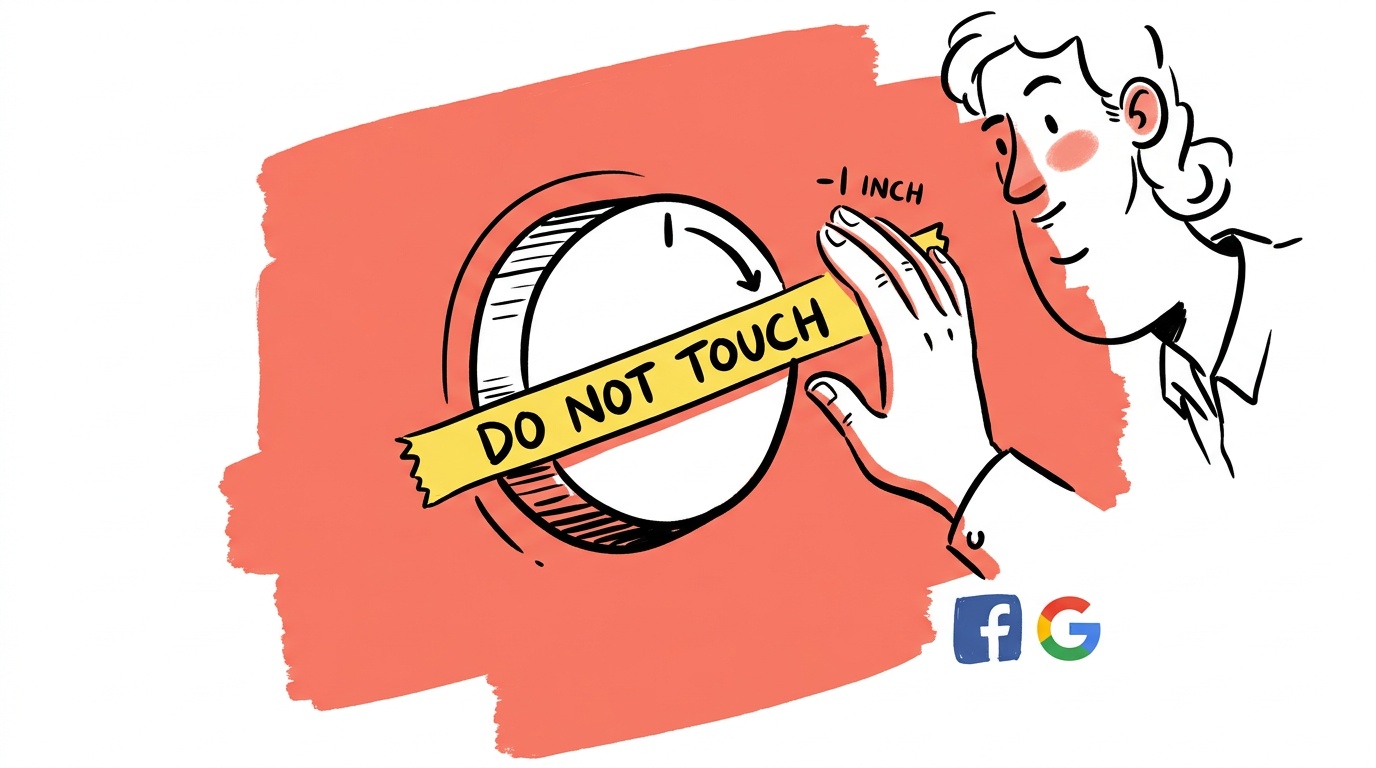
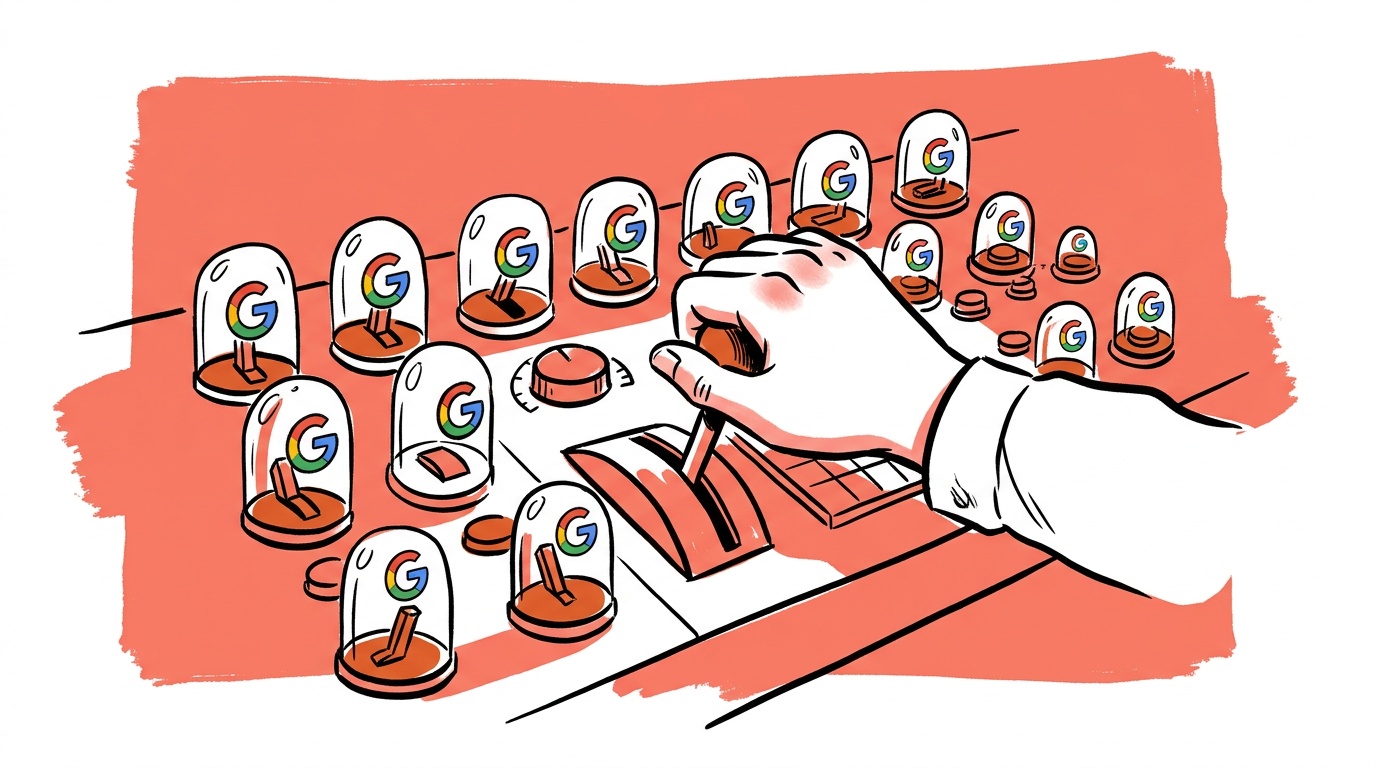
Splitting budget across too many campaigns is more damaging than bad ad copy. When no single campaign accumulates enough conversion data, Smart Bidding stops learning and starts guessing—and you pay for the exploration. The fix isn't collapsing everything into one campaign, though. That trades a data problem for a control problem. The real answer is the smallest number of campaigns that gives you both sufficient data volume and meaningful control. That number is almost never one. It's rarely more than six.
TL;DR — Google Ads Campaign Structure
- Smart Bidding (Target CPA, Target ROAS) needs a minimum conversion volume per campaign per month to exit the learning phase—spreading budget too thin across too many campaigns starves each one of signal.
- The right number of campaigns depends on three variables: budget size, product or service diversity, and how differently your audiences behave.
- A focused account structure—typically two to five campaigns—outperforms sprawl for most founders running their own ads.
- Performance Max and Search serve different roles and should generally coexist, not replace each other.
- Before adding a new campaign, ask whether the new split gives you control or just complexity.
Why Campaign Count Is a Data Problem First
Google's Smart Bidding doesn't run on keywords. It runs on conversion signals. Every time someone converts in a campaign, that event feeds a model that adjusts bids in real time across dozens of auction signals—device, time, location, audience membership, query intent, and more.
The problem: that model needs enough conversions to be statistically meaningful. If a campaign generates only a handful of conversions a month, the algorithm is essentially operating blind. It defaults to exploration mode, spending your budget testing bids rather than exploiting patterns it has already learned.
When a campaign is stuck in learning—or repeatedly re-enters learning after bid strategy changes—it typically performs worse than a simpler, better-funded campaign would. Every time you create a new campaign or change a bid strategy, you reset the clock.
The question "how many campaigns should I run?" is really: "how can I segment my account without starving any single segment of conversion data?" That is the structure-first logic behind bidding and campaign structure that actually works.
The Three Variables That Set Your Floor and Ceiling
Before picking a number, answer these three questions honestly.
1. What is your total monthly ad budget?
A small monthly budget spread across five campaigns means each campaign might generate only a trickle of conversions. That's a structural problem. A larger budget can support more segmentation because each campaign can still hit a meaningful conversion volume. There's no universal threshold published by Google, but the practical reality is that thin budgets force consolidation.
2. How different are your products or services?
If you sell one SaaS product to one buyer type, one or two campaigns can cover you. If you sell to both SMBs and enterprise, or if you have products with dramatically different margins and conversion values, you need separate campaigns—not because the algorithm prefers it, but because you need to bid differently and report separately.
3. How different are your audiences or geographies?
Targeting a single country with one language? Consolidate. Running ads in three countries with different CPCs, conversion rates, and seasonal patterns? Separate campaigns let you set budgets and bids appropriate to each market without one market cannibalizing another.
A Practical Campaign Count by Conversion Volume
The table below maps monthly conversion volume to a sensible starting structure. These aren't Google's published rules—they're the patterns we see work in practice.
| Monthly conversions (account-wide) | Recommended structure |
|---|---|
| Fewer than 30 | One campaign. Full stop. Feed the algorithm before you segment it. |
| 30–80 | Two campaigns: one Search (high-intent keywords), one Performance Max. |
| 80–200 | Two to three campaigns: add brand defense or a geo split if the economics justify it. |
| More than 200 | Three to five campaigns: separate by product line, margin tier, or geography—each with its own justified bid target. |
The Baseline Structure That Works for Most Founders
For a founder running a single product or service with a focused audience and a modest-to-mid-range budget, a two-to-three campaign structure is usually the right starting point:
- One Search campaign targeting your highest-intent, bottom-of-funnel keywords (branded and non-branded, tightly match-typed)
- One Performance Max campaign to capture demand across Search, Display, YouTube, Shopping, and Gmail
- Optionally, one brand defense campaign if you have meaningful search volume on your own name and competitors are bidding on it
Three campaigns, each with a clear job, each able to accumulate signal. If you're building that first Search campaign from scratch, Google Ads structure for beginners covers the ad-group and match-type setup.

Live today.
The full campaign — copy, images, targeting — generated for your site and deployed paused for your approval.
When to Add a Fourth or Fifth Campaign
More campaigns are justified—not just tempting—in a few specific situations.
Product lines with different economics
If you sell two products with different margins and different average order values, a single campaign with a blended Target ROAS will optimize toward whichever product converts cheaper, not whichever is most profitable. Separate campaigns let you set separate ROAS or CPA targets aligned with actual unit economics.
Brand vs. non-brand search is the same logic applied to query type. Branded search converts at a much higher rate and much lower CPA than non-branded. Mixing them in one campaign either makes your CPA look artificially low (biased by branded) or forces you to set a blended target that underserves both segments. Separating them is a small structural decision with a real impact on reporting clarity and bidding accuracy.
Geographies that behave differently are the third justified reason. If your conversion rate in one market is significantly higher than another, Smart Bidding will over-invest in the cheaper conversions unless you separate by geography. Budget segmentation alone is reason enough to split here.
Performance Max: Run It, But Don't Let It Run Everything
Performance Max finds inventory you wouldn't find manually, cross-channel bids in real time, and—when fed good creative assets and a clean conversion setup—drives volume that Search alone misses. It earns its place in the account.
But it has real limitations that founders often discover too late:
- You have limited visibility into where your budget is actually going across channels
- It can cannibalize branded search traffic, attributing conversions that would have happened anyway
- Asset groups are not campaigns—you can't set separate budgets for different creative angles within a single PMax campaign
The practical answer: run PMax alongside Search, not instead of it. Use Search to anchor your highest-intent keywords with exact and phrase match. Use PMax to expand reach. Monitor impression share and watch for signs that PMax is poaching branded queries—if it is, add your brand terms as campaign-level negative keywords in PMax.
A common pattern: a founder launches PMax, sees conversion volume jump, celebrates, then realizes a large share of those conversions are branded—people who already knew the product and were going to convert anyway. The incremental lift is smaller than the headline number suggests. Check your Search Impression Share report and segment by brand vs. non-brand to test this.
The Consolidation Case: When Fewer Is Actually Better
If you already have a sprawling account—eight or ten campaigns, many with thin volume—consolidation is almost always the right move before any other optimization work. It is also the prerequisite for scaling past $10k/month without wrecking ROAS.
When campaigns are merged, the algorithm has access to a larger conversion pool. It can identify patterns it couldn't see in any individual fragmented campaign. Advertisers who consolidate from many campaigns down to a handful typically exit the learning phase faster and see more stable CPAs—not because they changed bids or creative, but because they stopped starving the algorithm.
The practical process:
- Audit every campaign for trailing 90-day conversion volume
- Identify campaigns that share audience intent (similar keywords, similar landing pages, similar offers)
- Merge lowest-volume campaigns into logical parents
- Reset bid strategies after merging and give the consolidated campaign four to six weeks before judging performance
Optimization Timing: Don't Touch Campaigns While They're Learning
This is where founders most often self-sabotage. A campaign goes live, CPA looks high in week two, and the instinct is to change something—adjust bids, pause keywords, tweak the bid strategy target. Each change can restart the learning phase.
The exception: if something is clearly broken—ads disapproved, conversion tracking firing incorrectly, budget exhausted by hour two—fix it immediately. Normal performance volatility in the first two weeks is not a broken campaign. It's a learning campaign.
A Practical Decision Framework
Before adding any new campaign to your account, run through this checklist:
- Does this new segment have a meaningfully different bid target than existing campaigns? (If not, why segment it?)
- Will this new campaign generate enough conversions monthly to exit the learning phase on its own?
- Am I splitting because I need control, or because I'm anxious and this feels like doing something?
- If I add this campaign, which existing campaign loses budget—and does that campaign have enough volume to survive the cut?
If you can't answer the first two questions with "yes," don't add the campaign. Complexity is expensive. Every new campaign is a new learning phase, a new budget to monitor, a new set of auctions to diagnose when something breaks. The Google Ads Help Center's Smart Bidding documentation and the Performance Max best practices guide are worth reading once you have your structure set—they clarify what the algorithm actually needs to perform. The Google Ads attribution models overview is useful context when you're evaluating whether PMax is generating incremental conversions or just capturing credit.
FAQ
What is the ideal Google Ads campaign structure for a small budget?
For a small monthly budget, start with one Search campaign targeting your highest-intent keywords and one Performance Max campaign. Two campaigns that accumulate sufficient conversion data will almost always outperform five campaigns that don't. As budget grows, add campaigns only when you have a specific, justified reason to segment—different products, different geographies, or different bid targets.
How many conversions does a Google Ads campaign need per month?
Google doesn't publish a hard requirement, but the practical floor for Smart Bidding to work reliably is in the range of 30 or more conversions per campaign per month. Below that threshold, the algorithm is operating with insufficient signal and will perform inconsistently. If you can't hit that volume in a given campaign, consider merging it with a related campaign.
Should I run Performance Max and Search campaigns at the same time?
Yes. They serve different functions. Search gives you control over high-intent, bottom-of-funnel queries. Performance Max expands reach across channels and surfaces demand you might not find through keyword-only targeting. Run both, but monitor for brand cannibalization in PMax—add brand terms as negative keywords at the campaign level if you see PMax taking credit for branded conversions.
When should I split one Google Ads campaign into two?
Split when you have a legitimate reason to apply different bid targets (different product margins, different audience values) or when you need separate budget control (different geographies, different seasonal patterns). Don't split to get more granular reporting alone—that's what segments and dimensions are for within a single campaign.
How do I know if my Google Ads account has too many campaigns?
A clear signal: most of your campaigns are generating a handful of conversions per month and frequently cycling back into the learning phase. Another signal: your total budget is spread so thin that no single campaign has enough to spend its way out of exploration mode. If you recognize either pattern, consolidation is the right first move before any other optimization.
What happens if I change my bid strategy in Google Ads?
Changing your bid strategy—switching from Manual CPC to Target CPA, or changing your Target CPA by a large amount—typically restarts the learning phase. During learning, performance is volatile and often looks worse than it will at steady state. Make bid strategy changes deliberately and infrequently, and give the campaign enough time and conversion volume to stabilize before drawing conclusions.
Does campaign structure affect Google Ads Quality Score?
Not directly. Quality Score is calculated at the keyword level and reflects the relationship between keyword, ad, and landing page—not how many campaigns you're running. But structure affects how much data feeds into Smart Bidding, which affects actual auction performance in ways that Quality Score alone doesn't capture. Good structure enables good bidding. It doesn't substitute for relevant ads and strong landing pages.
Start with two or three campaigns. Earn the right to add more by hitting conversion volume thresholds in each. Pause any campaign that can't justify its own existence with data. The founders who run the best-performing accounts aren't the ones who built the most sophisticated structures—they're the ones who resisted the urge to build more until the data told them to.
Live today.
The full campaign — copy, images, targeting — generated for your site and deployed paused for your approval.
We build AdControlCenter — AI-powered ad management for small businesses, online stores, SaaS companies and service providers. We write what we'd want to read: real numbers, no fluff, the things we wish we'd known when we started.
More from the team →