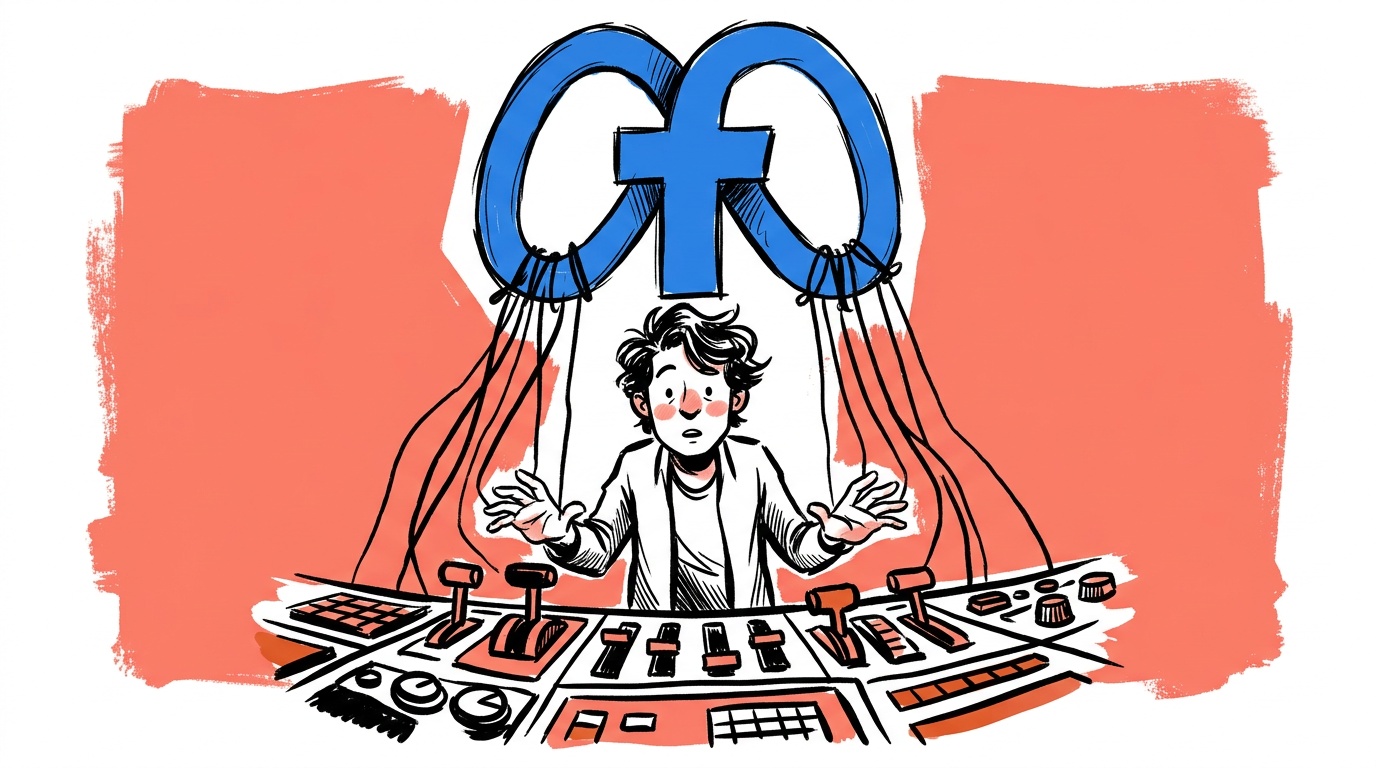
Most founders who come to us with underperforming Meta accounts share a common story: they tried to out-think the algorithm. They built tight audience stacks, micro-segmented by interest, capped their bids manually, and refreshed creatives on a schedule they invented themselves. Then performance cratered, and they couldn't tell why.
The uncomfortable truth is that Meta's system is often better at finding your buyer than your manual targeting logic—but only when you give it the right inputs. The question isn't "algorithm or me?" It's knowing exactly which decisions belong to the machine and which ones you have to own.
TL;DR — Meta Ads Algorithm: Trust It or Control It?
- Meta's algorithm needs creative volume, signal quality, and time to learn—starving it of any one of those will produce bad results that look like platform failure.
- Audience controls (interest stacks, narrow custom audiences, manual bid caps) are the most common way founders accidentally constrain the system and kill reach.
- Creative is the one lever that remains entirely yours—and it's the highest-leverage place to spend your attention.
- The biggest mistake isn't trusting the algorithm too much; it's making frequent structural changes that reset the learning phase every time performance dips.
- A small, stable campaign structure with fresh creative rotation outperforms complex account architectures for most early-to-mid-stage accounts.
The Algorithm Isn't Asking for Your Trust. It's Asking for Your Inputs.
There's a framing problem in how most founders think about Meta's system. They treat it as a black box they either surrender to or fight. Neither posture is right.
Meta's ad delivery system is an optimization engine. It needs three things to work: enough budget to generate meaningful data, enough creative variety to test against, and enough time without structural interference to exit the learning phase. When you give it those three things, it does something no human can do at scale—it finds which person, at which moment, responds to which version of your message.
What it cannot do is make a weak offer interesting, write a hook that stops a scroll, or decide what your brand actually stands for. Those are your jobs.
The algorithm handles who and when. You handle what. Confusing those roles is where most accounts go wrong.
The Biggest Mistake: Touching the Campaign Too Often
When we look at accounts that are consistently underperforming, the most common pattern isn't bad creative or wrong audiences. It's excessive structural interference.
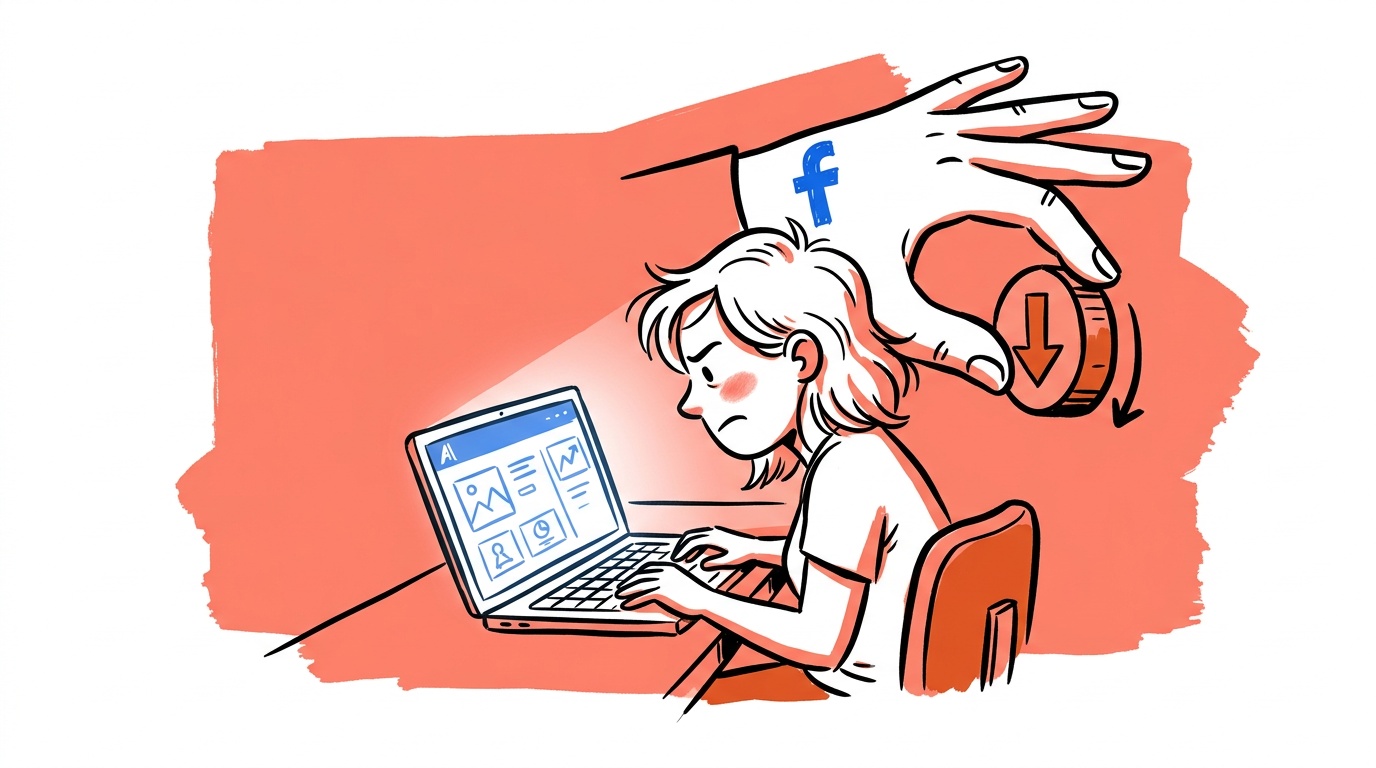
Every time you significantly change a campaign—edit the budget past Meta's recommended threshold, swap audience definitions, restructure ad sets—you risk triggering a new learning phase. During learning, Meta is gathering data, costs are often elevated, and performance looks worse than it will once the system stabilizes. If you interpret that normal variance as failure and make another change, you reset the clock again.
Many founders end up in a loop: they change something, see worse numbers, change something else, and never give the algorithm enough stable runway to actually learn. The account looks permanently broken. It isn't—it's perpetually restarting.
The fix is painful but simple: set your structure, fund it adequately, and let it run for a real window before making any changes. Meta's own documentation on the learning phase describes this explicitly—the system needs a sufficient number of optimization events per ad set before delivery stabilizes. Making changes before that point resets the counter.
Audience Controls Are Usually Costing You
This is the one that generates the most pushback, so let's be direct about it.
Tight audience targeting made sense in an era before Meta had deep behavioral data and strong on-platform purchase signals. Today, layering multiple interest categories, stacking custom audiences with rigid exclusions, and narrowing by demographic slices often just caps the pool the algorithm can work with—without improving the quality of that pool.
Broad targeting, where you give Meta a minimal audience definition and let the system find buyers within it, works better for most accounts than it intuitively should. The algorithm has seen enough purchase behavior across its network that it often outperforms human-constructed audience logic, especially for direct-response e-commerce and lead generation.
This doesn't mean you never exclude anyone. Excluding recent purchasers from acquisition campaigns is still sensible. But the eight-interest-category stack you built based on assumptions about your customer probably deserves a real test against broad before you treat it as settled strategy.

Live today.
The full campaign — copy, images, targeting — generated for your site and deployed paused for your approval.
What Still Belongs to You: Creative
Here's where the balance shifts back. If audience and structure largely belong to the algorithm, creative is entirely yours—and it's where most of the performance variance actually lives.
The algorithm can serve your ad to exactly the right person at exactly the right moment. But if the ad itself doesn't stop the scroll, answer the unspoken objection, or make the offer feel real and urgent, none of that delivery precision matters. Meta's system optimizes for engagement and conversion signals—it needs creative that earns those signals in the first place.
What this means practically:
- Volume matters. You need enough creative variations that the system has real options to test. Launching one video and two static images and expecting the algorithm to optimize is like asking someone to pick the best dish at a restaurant with one item on the menu.
- Hooks are the highest-leverage element. Most scroll decisions happen in the first two or three seconds. Your hook—the opening visual frame and first line—is where creative testing time should concentrate.
- Iteration speed beats perfection. The accounts we've seen scale successfully ship creative fast, learn from signal, and kill losers quickly. They don't wait for the perfect asset.
The creative process is also where you're most insulated from algorithmic changes. Meta's audience systems, bidding logic, and placement recommendations shift constantly. Your ability to make a compelling creative that resonates with a real human doesn't.
A Decision Matrix for What to Control
Use this as a working heuristic for where to spend your attention:
| Decision | Who owns it | When to intervene |
|---|---|---|
| Who sees the ad | Algorithm (broad) | Only if you have strong first-party data the system can't infer |
| When the ad runs | Algorithm | Only with hard business constraints (geo, time window) |
| Budget pacing | Algorithm | Increase incrementally once out of learning phase |
| Creative hook and offer | You | Always—this is your primary job |
| Creative rotation | You | Retire underperformers; introduce new variations regularly |
| Campaign structure | Keep it simple | Touch only with clear evidence, not discomfort |
Small Budget? The Playbook Is Different—But the Principles Hold
If you're running ads on a constrained budget, the temptation is to tighten control everywhere: limit reach, set manual bids, segment carefully to avoid "waste." The logic feels sound. The results are usually worse.
A small budget spread across a complex account structure is a small budget divided into pieces too small to generate signal. The algorithm can't learn anything useful from an ad set that barely spends. What works better on limited spend is extreme simplicity: one campaign, one or two ad sets, several creative variations, and enough budget concentration that at least one ad gets real data.
This runs counter to the instinct to spread risk. But with paid social, spreading a small budget thin means everything learns slowly and nothing generates enough signal to identify a winner. Concentrate, let the system learn, then expand from what's working. (How many ad sets a given budget can actually fund is a CPA calculation—we walk through it in CBO vs ABO campaign structure.)
When to Override the Algorithm (and When Not To)
There are real situations where you should override Meta's defaults rather than defer to them.
Override when: you have strong first-party data that Meta's broad delivery can't infer—for instance, a customer list with meaningful behavioral segmentation that the system genuinely can't reconstruct. Or when you're running a campaign with a hard geographic or timing constraint that the algorithm would treat as a soft preference.
Don't override when: performance looks bad during the learning phase. Don't override when a creative that doesn't match your aesthetic intuition is outperforming one that does. Don't override because a competitor appears to be running a complex structure and you assume that's why they're winning.
The algorithm tends to get blamed for human decisions. Before concluding the system is the problem, audit whether you've actually given it what it needs: sufficient budget, creative variety, and structural stability over a real testing window.
The Real Scaling Question
Founders who have a working offer and a profitable acquisition channel often hesitate to scale because they don't trust that what's working now will hold at higher spend. That hesitation is based on real experience—campaigns do break when budgets increase too fast.
But the scaling question is really a creative question. Meta's delivery system can spend more if you give it more. The constraint at scale is almost always creative fatigue: existing assets exhaust the audience, engagement drops, costs climb, and it looks like the algorithm broke. It didn't. You ran out of fresh inputs.
Meta's own guidance on scaling campaigns emphasizes gradual budget increases rather than sudden jumps, partly because rapid changes can trigger a new learning phase before the system has recalibrated. But even with careful budget management, the accounts that scale sustainably aren't the ones with the most sophisticated targeting architectures. They're the ones that ship new creative consistently and retire tired assets before they drag down delivery.
FAQ
Should I trust Meta's algorithm with my ad budget? Partially, yes. Meta's delivery and optimization system is genuinely good at finding buyers when it has enough data and structural stability to work with. The problem is most founders interfere with it too often or give it too little to learn from. The algorithm handles distribution—you still own creative and offer quality.
What is the Meta ads learning phase and how long does it take? The learning phase is the period after a significant campaign change when Meta's system is gathering data to understand how to optimize delivery. It exits once the ad set accumulates enough optimization events—purchases, leads, or whichever action you're optimizing for. Meta's documentation covers the threshold. Making structural changes before that point resets the counter.
Does broad targeting actually work on Meta? For many accounts, yes—often better than curated interest stacks. Meta's behavioral data is extensive enough that broad targeting lets the algorithm find buyers without the artificial constraints of manual audience definitions. It's worth running a real test rather than assuming tight targeting is always better.
What should I actually control in a Meta campaign? Focus your attention on creative: the hook, the offer framing, the volume of variations you're testing, and how fast you retire underperformers and introduce new assets. Campaign structure should be as simple as possible. Audience targeting should be as loose as your data allows.
Why does my Meta campaign performance drop when I increase the budget? Rapid budget increases can trigger a new learning phase and change delivery dynamics before the system recalibrates. Increasing spend incrementally gives the algorithm time to adjust. The other common cause is creative fatigue: more spend exhausts the audience faster, so assets that worked at lower budgets wear out sooner at scale.
How many creatives do I need to run on Meta ads? There's no universal number, but more variation is almost always better than less, provided you can produce quality assets. The algorithm needs real options to find a winner. Starting with several distinct creative directions—not just color swaps, but different hooks, formats, or angles—gives the system meaningful data to work with.
What's the biggest mistake founders make with Meta ads? Making frequent structural changes in response to normal performance variance. Changing campaign structure, audience definitions, or budgets too often keeps the account perpetually in learning mode and prevents the algorithm from stabilizing. Set a structure, give it a real runway, and save your intervention energy for creative decisions.
If you're staring at a Meta account that feels broken, the most useful thing you can do before touching any settings is count how many structural changes you've made in the past 30 days. The answer is usually the diagnosis.
Live today.
The full campaign — copy, images, targeting — generated for your site and deployed paused for your approval.

We build AdControlCenter — AI-powered ad management for small businesses, online stores, SaaS companies and service providers. We write what we'd want to read: real numbers, no fluff, the things we wish we'd known when we started.
More from the team →