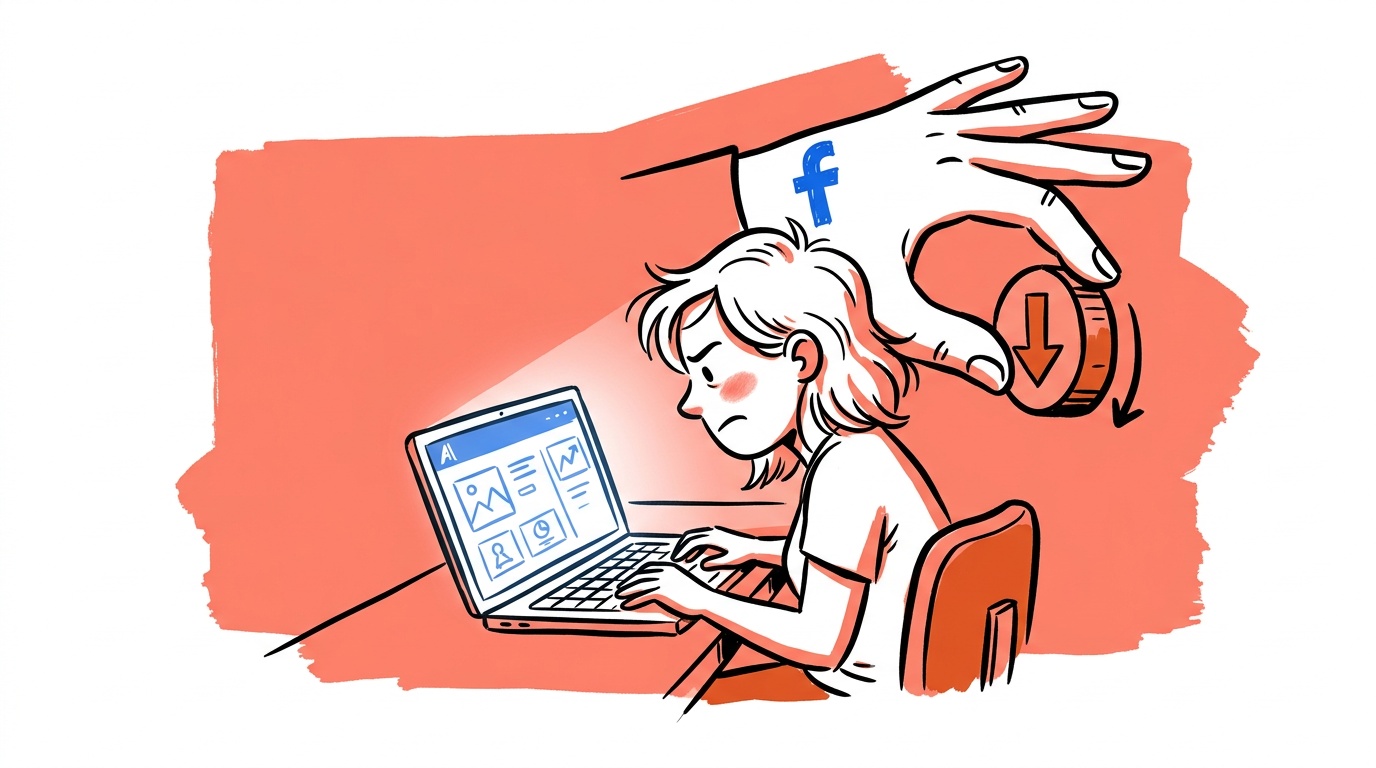

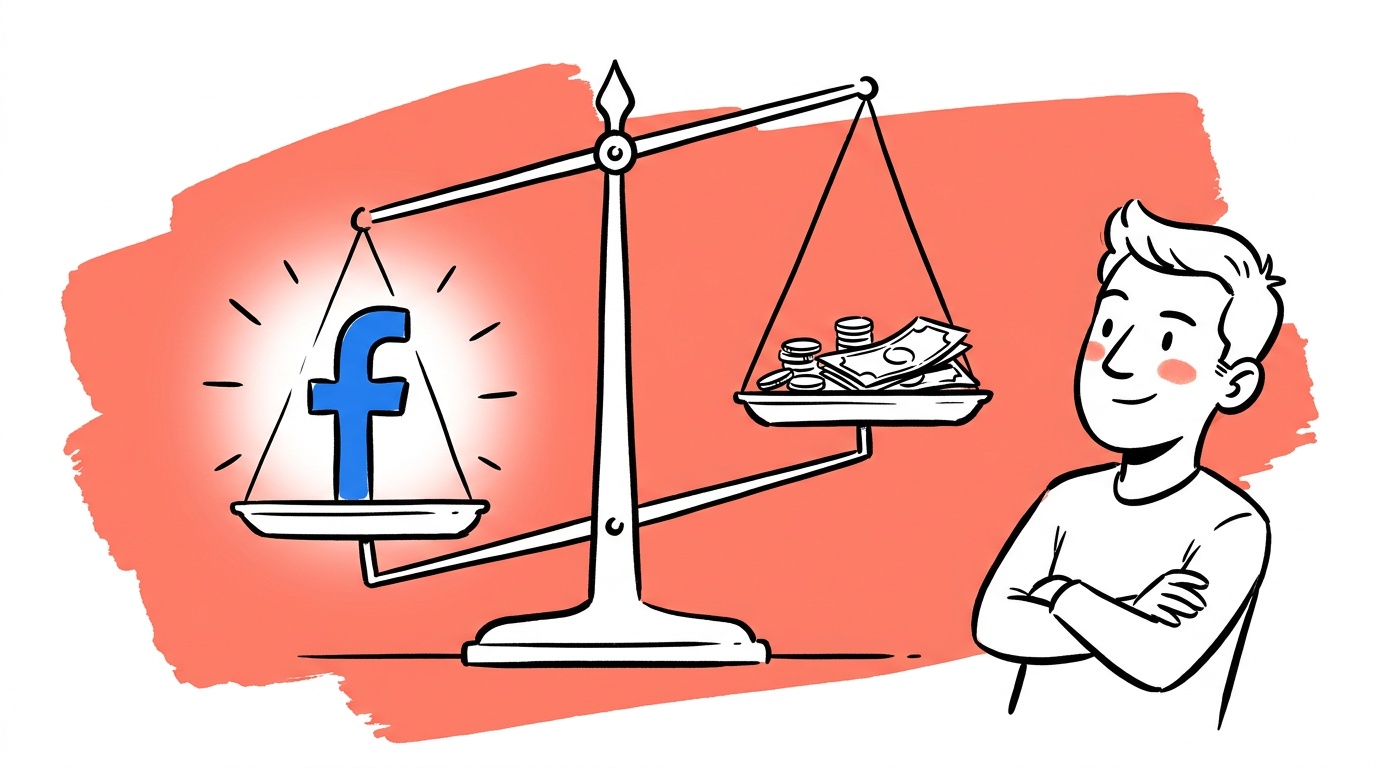
Your best-performing ad from 18 months ago probably wouldn't clear Meta's auction today. Not because it got worse — because the platform underneath it changed completely. Meta's AI systems now make decisions that used to belong to you: who sees your ad, when, in what format, and at what bid. Most founders haven't updated their mental model to match.
The result is a quiet erosion. CPMs that look stable. ROAS that drifts down quarter over quarter. Audiences that used to convert reliably that now barely register. The campaign dashboard doesn't tell you why. Meta's AI doesn't file a report. You just keep spending into a system that's been rewritten around you.
TL;DR — Meta AI Impact on ROI
- Meta's AI (Advantage+, broad targeting, on-platform AI assistants) has fundamentally shifted who controls ad delivery — and it's not you anymore.
- Meta AI is becoming a parallel discovery layer inside Facebook, Instagram, Messenger, and WhatsApp — one where your ads don't automatically appear.
- Broad match and automated placements mean your creative is doing more heavy lifting than ever — bad creative doesn't just underperform, it gets deprioritized by the algorithm entirely.
- Advantage+ Shopping Campaigns can be efficient for some accounts but actively destroy margin for others by serving existing customers at full acquisition cost.
- The right response is not to fight the AI — it's to feed it better signals: first-party data, tight conversion event hierarchies, and creative that communicates clearly to both the human and the model.
The Feed Is No Longer the Default Discovery Layer
For a long time, the mental model was simple: people open Facebook or Instagram, scroll, see your ad, click, buy. The ad unit was the discovery mechanism. You controlled the creative, the audience, the placement, and the bid. Meta was a pipe.
That model is broken.
Meta AI — the conversational assistant now embedded across Facebook, Instagram, Messenger, and WhatsApp — is becoming a parallel discovery layer. Instead of scrolling a feed, users are typing queries directly into Meta AI: "What's a good moisturizer for dry skin?" or "Where can I find affordable standing desks?" The assistant responds. Your ad may or may not be part of that answer.
This matters for ROI in a way that's easy to miss. If your target customer gets product recommendations from an AI assistant rather than from the feed, your impression volume from that segment drops. Your reach numbers may look fine in aggregate, but you're losing the highest-intent moments — the ones where someone was actively looking for what you sell.
The shift is still early, but the direction is clear. Meta has explicitly positioned Meta AI as a shopping and discovery tool, and usage is growing as the assistant becomes the default search bar across Meta's apps. Founders who built their growth model on feed-based discovery need to account for this new layer — even if they can't measure it precisely yet.
Most ad accounts track clicks, conversions, and attributed revenue. Almost none track how much potential demand is being routed to Meta AI queries instead of ads. You can't see this in Ads Manager. That invisibility is part of what makes it expensive.
Advantage+ Is Not a Shortcut — It's a Trade
Meta's Advantage+ suite — Advantage+ Shopping Campaigns (ASC), Advantage+ Audience, Advantage+ Creative — gets pitched as the "let the AI handle it" solution. For some accounts, it genuinely works. For others, it quietly bleeds budget in ways that only show up when you look hard at the data.
The specific failure mode we see most: ASC mixing prospecting and retargeting into a single campaign without clear budget controls. The AI, optimizing for conversion events, will naturally spend more where conversion probability is highest — which is often existing customers or warm audiences. You end up paying full acquisition CPMs to win back people who would have converted anyway, or who you could have reached with a much cheaper retention email.
Measuring the Damage Before You Fix It
Before you restructure, confirm the problem is real in your account. The simplest approach: pull your ASC audience breakdown report in Ads Manager and filter spend by the existing customer segment. If a disproportionate share of your ASC budget is going to people already in your customer list, you have the bleed problem. A cleaner test is a geo-split or holdout — pause ASC for existing customers in one region, run retention email only, and compare conversion rates. If the email-only region holds, you were paying acquisition CPMs for organic repeats.
The fix is not to abandon Advantage+. It's to use the existing customer budget cap aggressively (Meta allows you to set a cap on spend against your existing customer list within ASC), and to maintain at least one manual prospecting campaign so you can see what true cold acquisition actually costs. If you only run ASC, you lose that baseline. You can't improve what you can't measure separately.
Your Creative Is Now Your Targeting
This is the hardest mindset shift for founders who grew up on Facebook's detailed targeting: when you run broad audiences or let Advantage+ Audience do the work, the algorithm uses your creative as a targeting signal. It looks at who responds to each piece of creative and finds more people like them.
That means weak creative doesn't just underperform — it actively mis-targets. If your video ad gets engagement from the wrong audience early (because the hook is vague, or the product isn't clear in the first three seconds), Meta's AI locks onto that signal and keeps going in the wrong direction. Bad creative in a broad campaign is more expensive than it used to be, not less.
What "good creative for AI-driven targeting" actually looks like:
- Specific problem statement in the first three seconds. Not "tired of bad skincare?" but "if your skin is dry under the nose in winter, here's why." The specificity attracts the right viewer and repels the wrong one — which is useful signal for the algorithm.
- Show the product being used in context. Meta's vision models parse video content. Creative that clearly shows product, use case, and outcome gives the AI more to work with when matching to users.
- One CTA, not three. Conversion signal clarity downstream affects how the algorithm learns. If your landing page has five different goals, the model gets noisy feedback.

Live today.
The full campaign — copy, images, targeting — generated for your site and deployed paused for your approval.
The Signal Starvation Problem
Meta's AI optimization depends on conversion signals. It needs enough of them — at the right events, with the right frequency — to learn efficiently. When signal volume drops below the threshold Meta needs per ad set, the algorithm enters a persistent learning phase. CPMs rise. Delivery gets erratic. ROAS drops.
Meta has long cited a target of roughly 50 optimization events per ad set per week as the floor for stable learning — this is documented in their ad set learning phase guidance. Below that, ad sets stay in extended learning or never exit it.
Several things have compressed signal volume for many advertisers over the past few years:
- iOS 14+ and subsequent privacy changes reduced the share of conversions that get reported back to Meta via the pixel.
- Longer purchase cycles in some categories mean fewer conversion events per dollar of spend.
- Campaign fragmentation — too many ad sets chasing too few conversions — splits signal across campaigns until none of them learn properly.
The response to signal starvation is consolidation and event ladder optimization. Consolidate ad sets so conversion events concentrate. And if your purchase volume is too low to hit the learning threshold, move the optimization event up the funnel — optimize for Add to Cart or Initiate Checkout instead of Purchase, until volume supports moving back down. This is counterintuitive (you want to optimize for what you care about), but a model learning on rich signal from a proxy event beats a model starving on sparse signal from the true conversion.
Pair this with Meta's Conversions API if you haven't already. Server-side event matching recovers conversions that client-side pixel alone misses post-iOS 14. It's not optional at this point — it's table stakes.
How to Feed the Algorithm What It Actually Needs
Assuming you've consolidated campaigns and fixed your signal pipeline, the next lever is data quality. Meta's AI is only as good as what you give it.
First-Party Data as a Competitive Moat
Upload your customer list and use it — not just for exclusions, but for Lookalike Audiences built on your best customers (highest LTV, not just any purchaser). As third-party data quality erodes and targeting options narrow, your proprietary customer data becomes the asset that lets Meta's AI find better prospects than your competitors can.
Segment your lists before uploading. A Lookalike built on 90-day repeat purchasers performs differently than one built on one-time buyers. If your CRM has LTV data, create tiers. Feed the AI your best customers and let it find more of them.
Also consider Meta's Advantage+ Catalog Ads if you run e-commerce. Dynamic product ads backed by a clean, well-structured catalog give the AI rich product-level signal to match inventory to intent. Catalog quality matters: missing prices, vague descriptions, and low-resolution images degrade match quality in ways you can't see directly in Ads Manager.
What to Actually Do This Week
The Meta AI shift isn't a crisis you respond to once. It's a platform change you adapt to continuously. Here's what to prioritize:
Audit your ASC existing customer cap. If you're running Advantage+ Shopping Campaigns with no existing customer budget cap, pull the audience breakdown report and check your spend split. You may be paying prospecting CPMs to reach people who bought from you last month.
Consolidate ad sets. If you have more than three or four ad sets per campaign, you're probably fragmenting signal. Merge aggressively. One well-fed ad set learns faster than four starving ones.
Install or audit Conversions API. If you're running only pixel tracking, you're missing a real share of your conversions. The gap is larger on iOS-heavy audiences. Our Pixel and Conversions API setup guide covers the deduplication step most teams get wrong.
Rebuild your creative brief around specificity. Review your top five active creatives. In the first three seconds of each, can you tell exactly who it's for and what problem it solves? If not, that's your first creative iteration.
Start tracking branded search alongside Meta spend. You can't directly measure how many users discover you via Meta AI and then search your brand name — but you can watch branded search volume in Google Search Console alongside your Meta spend trends. A growing gap between Meta-attributed conversions and branded search volume is a signal worth investigating.
FAQ
What is the Meta AI impact on ad ROI? Meta AI affects ad ROI in two ways: it changes how users discover products (routing some queries to the AI assistant instead of the ad feed), and it controls ad delivery through systems like Advantage+ that make autonomous decisions about audience, placement, and bid. Both reduce the control advertisers have over where and how their budget gets spent.
Is Advantage+ Shopping good or bad for ROAS? It depends on your account structure. ASC can be efficient when it has clean signal and a well-defined customer exclusion list. It tends to hurt margin when it serves existing customers at full acquisition CPMs because there's no cap on existing customer spend. Most accounts benefit from using the existing customer budget cap inside ASC and maintaining a separate manual prospecting campaign as a benchmark.
Why is my Meta ad performance declining even though my budget hasn't changed? Several factors can cause silent performance decline: signal loss from iOS privacy changes reducing reported conversions, campaign fragmentation keeping ad sets below the learning threshold, Meta AI routing some of your target audience away from the feed, and creative fatigue in an environment where the algorithm over-serves winning ads until they burn out.
How does Meta AI affect customer discovery? Meta AI is embedded as a conversational assistant in Facebook, Instagram, Messenger, and WhatsApp. Users who previously would have discovered products by scrolling their feed may now type queries to Meta AI and receive recommendations directly. Advertisers don't have direct access to these recommendation placements the way they do with feed ads.
What is the minimum conversion volume needed for Meta ad sets to learn properly? Meta's documented guidance cites roughly 50 optimization events per ad set per week as the threshold for stable learning. Below that, ad sets stay in extended learning or never exit it. If your purchase volume is too low to hit that threshold, move your optimization event up the funnel — Initiate Checkout or Add to Cart — until volume supports optimizing for Purchase.
How do I improve signal quality for Meta's AI? Three things matter most: implement Meta's Conversions API for server-side event matching, consolidate ad sets so conversion events concentrate rather than fragment, and upload segmented first-party customer data to improve Lookalike Audience quality. These compound — better signal quality improves algorithm performance across every campaign in your account.
Should I stop using broad targeting on Meta? Broad targeting (no detailed interest or behavior selections) can work well when paired with strong, specific creative — because the creative acts as a targeting filter. It works poorly with vague creative, because the algorithm has no clear signal about who the ad is for. The question isn't broad vs. narrow — it's whether your creative is specific enough to do the targeting job the algorithm needs it to do.
The uncomfortable truth is that Meta built a powerful ad-targeting machine and then replaced it with an AI that doesn't take your instructions the same way. The founders who are winning right now aren't fighting that — they're learning how to communicate with a system that responds to data quality, creative specificity, and signal architecture rather than audience checkboxes. Start there.
Live today.
The full campaign — copy, images, targeting — generated for your site and deployed paused for your approval.
We build AdControlCenter — AI-powered ad management for small businesses, online stores, SaaS companies and service providers. We write what we'd want to read: real numbers, no fluff, the things we wish we'd known when we started.
More from the team →