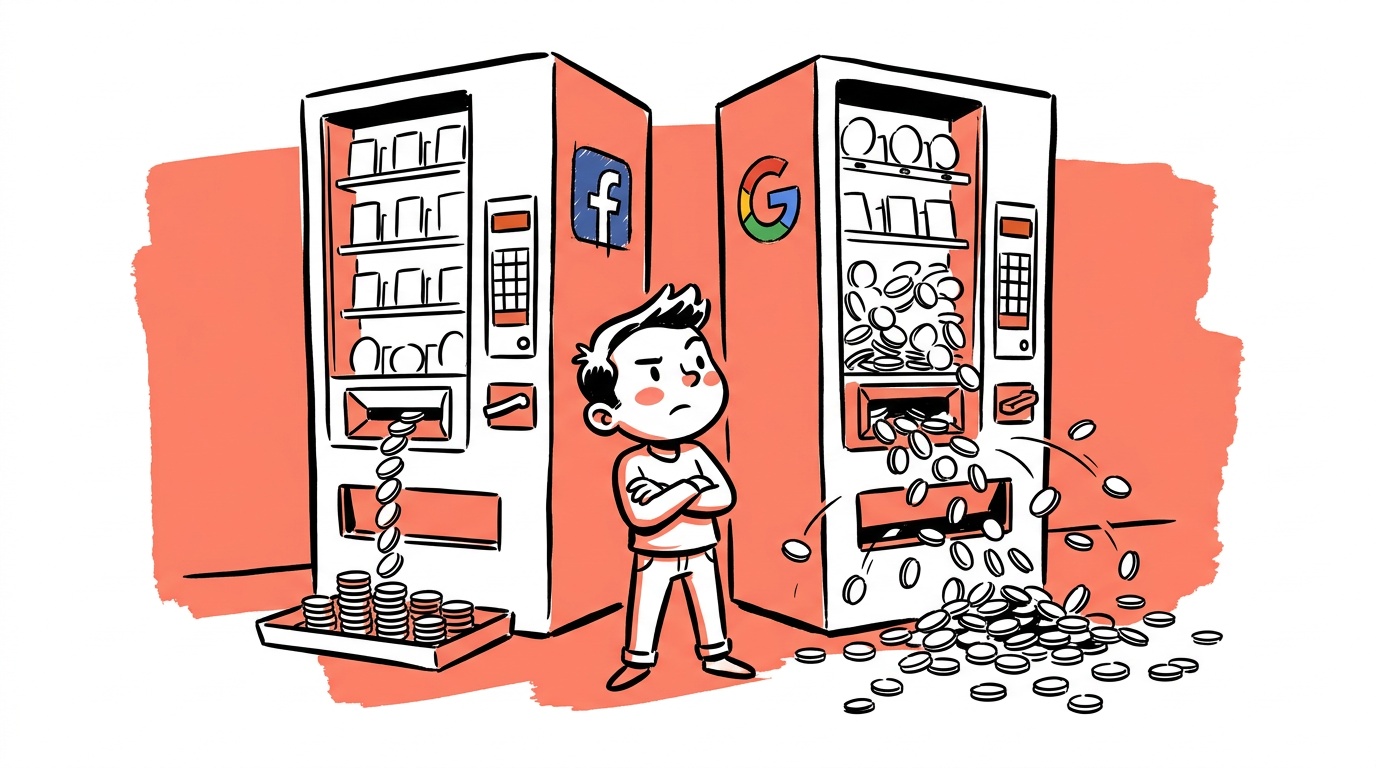



Most advertisers who come to us with a broken Meta account aren't running bad ads. They're running good ads inside a structure that's actively fighting them. Too many ad sets, too little budget per set, creatives split across campaigns for no reason. Meta's algorithm starves before it ever learns.
The good news: campaign structure is one of the few things you can fix in an afternoon without touching a single creative.
TL;DR — Meta Campaign Structure in 2026
- CBO (Campaign Budget Optimization) is the right default for most accounts; ABO is a specific tool for testing, not a philosophy.
- Consolidating ad sets is almost always the right move when your budget can't fund 50 conversion events per ad set within 7 days — calculate that number from your actual CPA before splitting anything.
- Run 3–5 creatives per ad set — enough for the algorithm to find a winner, not so many it splits spend into statistical noise.
- Broad targeting now outperforms stacked interests in the majority of accounts because Meta's placement and creative signals do the heavy lifting.
- Advantage+ Shopping Campaigns deserve a test slot for e-commerce, but they are not a replacement for understanding structure.
The Three-Layer Model and Why People Break It
Meta's hierarchy is Campaign → Ad Set → Ad. Every layer has one job:
- Campaign: sets the objective and, in CBO, controls the total budget.
- Ad set: defines audience, placement, schedule, and (in ABO) budget.
- Ad: holds the creative.
The mistake most first-timers make is using ad sets as a creative-sorting system. They create one ad set per creative variant, give each $5/day, and wonder why nothing exits the learning phase. When we audit accounts with this pattern, the fix is almost always to collapse those ad sets and stack the creatives inside one or two well-funded sets.
A Reddit thread on ad set consolidation captures this exactly: two ad sets targeting nearly identical audiences, each at $15/day, neither converting consistently. The answer there — and in our own testing — is yes, combine them. Give the algorithm a single larger pool to optimize against.
CBO vs ABO: The Real Decision
The framing of "which is better" is the wrong question. The real question is: what are you trying to learn right now?
CBO (Campaign Budget Optimization) lets Meta allocate your campaign budget dynamically across ad sets toward whichever is getting the cheapest conversions at that moment. It's faster to optimize, harder to starve. For most accounts that have passed the initial learning phase, CBO is the right steady-state setup. CBO's known side effect — concentrating nearly all spend on a single winning ad — is real; we cover how to contain it in why Meta's AI hijacks your budget.
ABO (Ad Set Budget Optimization) gives you manual control at the ad-set level. This is useful when you're testing a new audience or creative concept and you want to guarantee it gets a minimum spend before being undercut by a proven winner. ABO is a testing instrument. It's expensive to run at scale because you're manually doing what the algorithm would otherwise handle.
The practical threshold: if you have fewer than 3 ad sets in a campaign, CBO advantage is minimal. If you have 5 or more, CBO almost always outperforms manual ABO allocation over a two-week window — because you're unlikely to guess the right split as well as the model will.
How Many Ad Sets Should You Run?
This is where small-budget accounts get hurt the worst. A Reddit question about splitting a ₹1,500 (~$18) daily budget across multiple ad sets gets to the core issue: at that budget, any split creates ad sets that are too underfunded to exit the learning phase in any reasonable time.
Meta's own documentation states the learning phase requires approximately 50 optimization events per ad set within a 7-day window. That number is your structural anchor. Everything else follows from it.
The Budget-to-Ad-Set Calculator
Before you decide how many ad sets to run, do this math:
Required 7-day budget per ad set = CPA × 50
Three real-scenario examples:
| Vertical | Rough CPA | Min. 7-day budget per ad set | Practical daily minimum |
|---|---|---|---|
| E-commerce (sub-$50 product) | $25 | $1,250 | ~$180/day |
| Lead gen (B2C service) | $15 | $750 | ~$110/day |
| SaaS free trial | $60 | $3,000 | ~$430/day |
If your total daily budget is $100 and your CPA is $25, you have enough to fund roughly one ad set at the minimum threshold. Running two means both starve. The math doesn't care about your curiosity about a new audience — budget has to come first.
The rule we apply:
- Calculate what it costs to get 50 conversions. That's your minimum ad-set budget for 7 days.
- If your total budget can't fund that for more than 2 ad sets, run 1 ad set.
- Add ad sets when budget grows, not when you're curious about a new audience.
For a cold account with no historical data, a discussion about reading cold account metrics points to another problem: without enough events, your cost-per-result numbers swing wildly. You can't diagnose structure problems when you don't have statistical confidence. Consolidation first, diagnosis second.

Live today.
The full campaign — copy, images, targeting — generated for your site and deployed paused for your approval.
Creative Count: The 3–5 Rule and When to Break It
When we looked at our own labeled ad corpus, the accounts with healthy cost-per-result and stable delivery typically run between 3 and 5 active creatives per ad set. Here's why those bounds matter:
Fewer than 3: You have no fallback when your one or two ads hit frequency fatigue. A single creative dying can tank an entire ad set.
More than 6–8: Spend fragments across too many variations. Each creative sees too few impressions to generate a meaningful performance signal in a normal testing window. You're not learning faster — you're learning slower.
Running 5 versions of the same hook with slightly different background colors is not creative diversity. Meta's algorithm will cluster them and effectively treat them as one. Real diversity means different hooks, different formats (static vs. video vs. carousel), or different angles on the offer. One Reddit thread on creative selection put it well: test the concept, not the pixel.
The Reddit thread on choosing ad creatives surfaced a common trap: advertisers run many creatives because they're uncertain which will work, then don't give any of them enough spend to find out. The fix is fewer, more differentiated creatives, with enough budget per ad set to actually surface a winner.
When to Break the 3–5 Rule
If you're running a creative-velocity testing system (new creatives every week, systematic retirement of losers), you can run more at the campaign level — but still consolidated into a small number of well-funded ad sets, not fragmented into individual ad sets per creative. Use Dynamic Creative or simply stack ads inside a single ad set and let Meta rotate them.
Broad Targeting vs. Stacked Interests in 2026
Two years ago, stacking interests was how you told Meta who to find. In 2025, broad targeting — no interest stacking, wide age ranges, letting placement optimization run — outperforms in the majority of accounts we've audited. The reason is that Meta's signal quality from creative content, landing page behavior, and pixel history has gotten good enough to find your buyer without you drawing the map.
The discussion around Advantage+ and whether to let Meta take the wheel reflects real uncertainty about this. Our take: Advantage+ Audience (the setting inside standard campaigns that broadens targeting) is worth testing once your pixel has meaningful purchase history behind it. Before that, broad targeting in a manually configured ad set is functionally equivalent with more transparency — and more transparency matters when you're still trying to understand your buyer.
Campaign Organization: One Objective Per Campaign, Always
A Reddit thread on new campaign and ad set organization shows a common structural mess: prospecting and retargeting mixed inside the same campaign, conversion and traffic objectives sharing a budget. This breaks attribution and it breaks optimization.
The clean structure:
- Campaign 1: Prospecting — conversion objective — CBO — 3 to 5 ad sets broad
- Campaign 2: Retargeting — conversion objective — ABO (so you can guarantee minimum retargeting spend) — tightly defined custom audiences
- Campaign 3 (optional): Creative testing — conversion or traffic objective — ABO — new ad concepts at controlled spend
Each campaign has one job. When you mix objectives or mix audience temperatures, the algorithm can't optimize cleanly and your reporting is meaningless.
We see this pattern constantly: someone has a campaign doing some things right and some things wrong, and they can't tell which is which because everything is entangled. A post asking for basic account help described exactly this — mixed campaigns, uneven budgets, no clear signal. Separating by objective is the first step to being able to read your own data.
When to Scale vs. When to Fix Structure
Scaling a broken structure just speeds up the loss. Before you increase budget, check these four things:
- Are all active ad sets spending? If any are paused or stuck in learning limited, fix that before adding budget.
- Is each ad set getting at least 50 conversion events per week? If not, consolidate.
- Is your creative count between 3 and 5 per ad set? If you have 1 or more than 7, adjust.
- Is your campaign objective aligned with your actual goal? Traffic campaigns do not optimize for purchases.
If you can answer yes to all four, a measured budget increase is a reasonable next step. How aggressive you can be without resetting the learning phase depends on your current event volume — accounts generating well above 50 weekly events per ad set can absorb larger jumps than accounts sitting right at the threshold.
FAQ
What is the difference between CBO and ABO in Meta Ads?
CBO (Campaign Budget Optimization) sets a total budget at the campaign level and lets Meta distribute spend across ad sets dynamically. ABO (Ad Set Budget Optimization) gives you manual control over each ad set's budget. CBO is better for scaling; ABO is better when you need to force spend into a specific test.
How many ad sets should I run in a Meta campaign?
It depends on your budget and CPA. Each ad set needs enough budget to generate approximately 50 conversion events in 7 days. Multiply your CPA by 50 to get the minimum 7-day budget per ad set. If your total budget can't support that for more than one or two ad sets, run one. Adding ad sets before budget supports them is one of the most expensive structural mistakes in Meta advertising.
How many creatives should I run per ad set on Meta?
3 to 5 is the practical range for most accounts. Fewer than 3 leaves you exposed to creative fatigue with no fallback. More than 6–8 fragments spend to the point where no single creative gets enough impressions to generate a reliable performance signal.
Is broad targeting better than interest targeting on Meta in 2026?
For most accounts, yes. Meta's models have improved to the point where they can find your buyer from creative signals, pixel data, and landing page behavior without you manually specifying interests. Start broad and add constraints only when you have specific data supporting a segment restriction.
What is the Meta Ads learning phase and how do I exit it?
The learning phase is the period during which Meta's delivery system is actively optimizing your ad set. It requires approximately 50 optimization events (usually purchases or leads) within a 7-day window. Ad sets exit learning when they hit that threshold. The fastest way to stay stuck in learning is to underfund ad sets, change them too frequently, or run too many simultaneously.
Should I use Advantage+ Shopping Campaigns?
Test them if you're an e-commerce brand with a healthy pixel. They can perform well for accounts with strong conversion history. They are not a substitute for understanding how structure affects performance — and they offer less diagnostic transparency than standard campaigns, which makes them harder to debug when results drop.
When should I combine two ad sets into one?
When they're targeting overlapping audiences, when neither is individually generating enough events to exit the learning phase, or when combined they'd still be below your single-ad-set minimum budget threshold. Run the math: CPA × 50 ÷ 7 = minimum daily budget per ad set. If either set is below that number on its own but both together would clear it, consolidate.
Should I use CBO or ABO for reach and awareness campaigns?
For reach and awareness objectives, CBO is the standard best practice: optimization events (impressions, reach) accumulate so quickly that the learning phase is never the constraint, and CBO simply routes budget to the cheapest available reach. Use ABO for awareness only when you must guarantee spend per segment — separate geos, languages, or markets that each need a minimum share of voice. The structure stays simple either way: one campaign per objective, one to three broad ad sets, three to five creatives per set.
The single most actionable thing you can do right now: take your current CPA, multiply by 50, and divide by 7. That's the minimum daily budget each of your active ad sets needs to have a real shot at exiting the learning phase. Open your account and count how many sets are below that number. If more than one is, consolidate before you change a single creative.
Live today.
The full campaign — copy, images, targeting — generated for your site and deployed paused for your approval.

We build AdControlCenter — AI-powered ad management for small businesses, online stores, SaaS companies and service providers. We write what we'd want to read: real numbers, no fluff, the things we wish we'd known when we started.
More from the team →