
You woke up, checked your Meta dashboard, and one ad ate your entire budget overnight. Not the best performer by ROAS. Not the one you'd have picked. Just the one Meta's algorithm decided was "winning" — before it burned out, CPA spiked, and you were left explaining a $4,000 day to your co-founder.
This is a structural behavior — not a rare edge case. Independent advertisers documented it in the same week across r/FacebookAds without coordinating: budget concentration to a single ad, unsanctioned AI translations, AI music added without consent, proven secondary creatives starved of impressions entirely. The pattern is consistent enough that it deserves a direct answer: what is causing this, and what can you actually do about it.
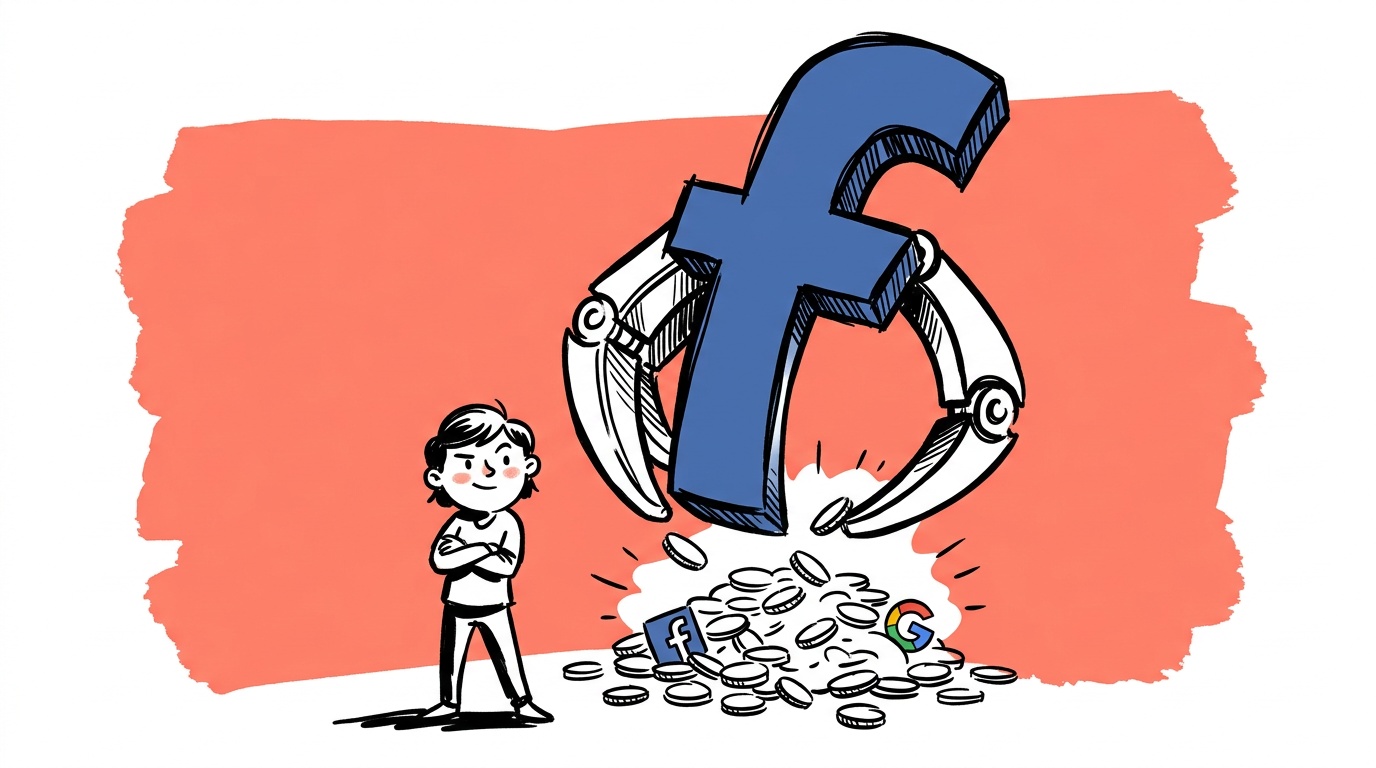
- Meta's delivery system will funnel close to 100% of campaign spend into a single ad, even inside multi-ad ad sets, when it perceives an early performance signal — a behavior multiple advertisers reported spiking after a recent Meta platform outage.
- Advantage+ creative features — AI translations, AI music, background generation — can activate on live ads without explicit per-campaign opt-in, altering creative you approved.
- Budget concentration accelerates creative fatigue: the "winner" exhausts its core audience fastest, then falls off a cliff with no backup spending elsewhere.
- The structural fix is isolation: one creative per ad set with its own budget cap, combined with explicit opt-out of every Advantage+ creative toggle.
- Scaling without creative depth is the core problem — Meta's AI will always concentrate spend; your job is to give it enough distinct assets that concentration doesn't matter.
What "Budget Concentration" Actually Means in Meta's Delivery System
Meta's ad auction is not a round-robin. It is a real-time predicted-value system: every impression slot is awarded to the ad with the highest estimated total value, which is a function of bid, estimated action rate, and ad quality. When one ad accumulates even a small early advantage in estimated action rate — a few more clicks, a slightly better CTR — the auction compounds that advantage on every subsequent impression.
The result is winner-take-all delivery inside your own ad set. Advertisers in the r/FacebookAds thread "Scaling campaign spending 99% of budget on one ad" described exactly this: multiple proven creatives, one ad capturing effectively all spend, no obvious quality difference visible to the human eye. Another thread documented "100% spend on 1 ad inside All Campaigns AFTER the Recent Outage", suggesting the outage reset delivery learning and the system re-converged aggressively on a single winner.
This is not a bug in the sense that the code is doing something unintended. It is the delivery system doing exactly what it was designed to do — optimizing hard for a single predicted winner. The problem, from your perspective, is that the system's confidence interval is far too narrow. It treats a 12-hour signal as a verdict.
When one ad captures most impressions, it saturates the same audience segments fastest. Frequency climbs on that one creative while your other ads sit idle. By the time CPA deteriorates, your backup creatives have zero warm delivery data and take days to ramp — if they ever do.
The Outage Effect: Why This Got Worse Recently
Multiple advertisers reported the concentration behavior intensifying after a Meta platform outage in mid-2025. The mechanism is straightforward: Meta's delivery system maintains learned signals about each ad — predicted CTR, conversion rate by audience segment, placement performance. An outage can partially reset that learned state.
When learning resets, the system runs a compressed re-exploration phase. In that phase, any early signal — even statistical noise — gets amplified into delivery decisions faster than under normal steady-state operation. Ads that happened to catch a conversion in the first hour of re-exploration get flagged as winners. Everything else gets starved.
The thread "Weird delivery glitch on my campaign (100% spend on 1 ad)" captured this in real time. If you ran campaigns through that window and saw a single ad take over, you weren't imagining it. The short-term fix is a hard reset: duplicate the ad set and re-enter learning intentionally rather than letting a corrupted delivery state persist and compound.
Advantage+ Creative Is Editing Your Ads Without Asking
Budget concentration is a delivery problem. The Advantage+ creative issue is a consent problem.
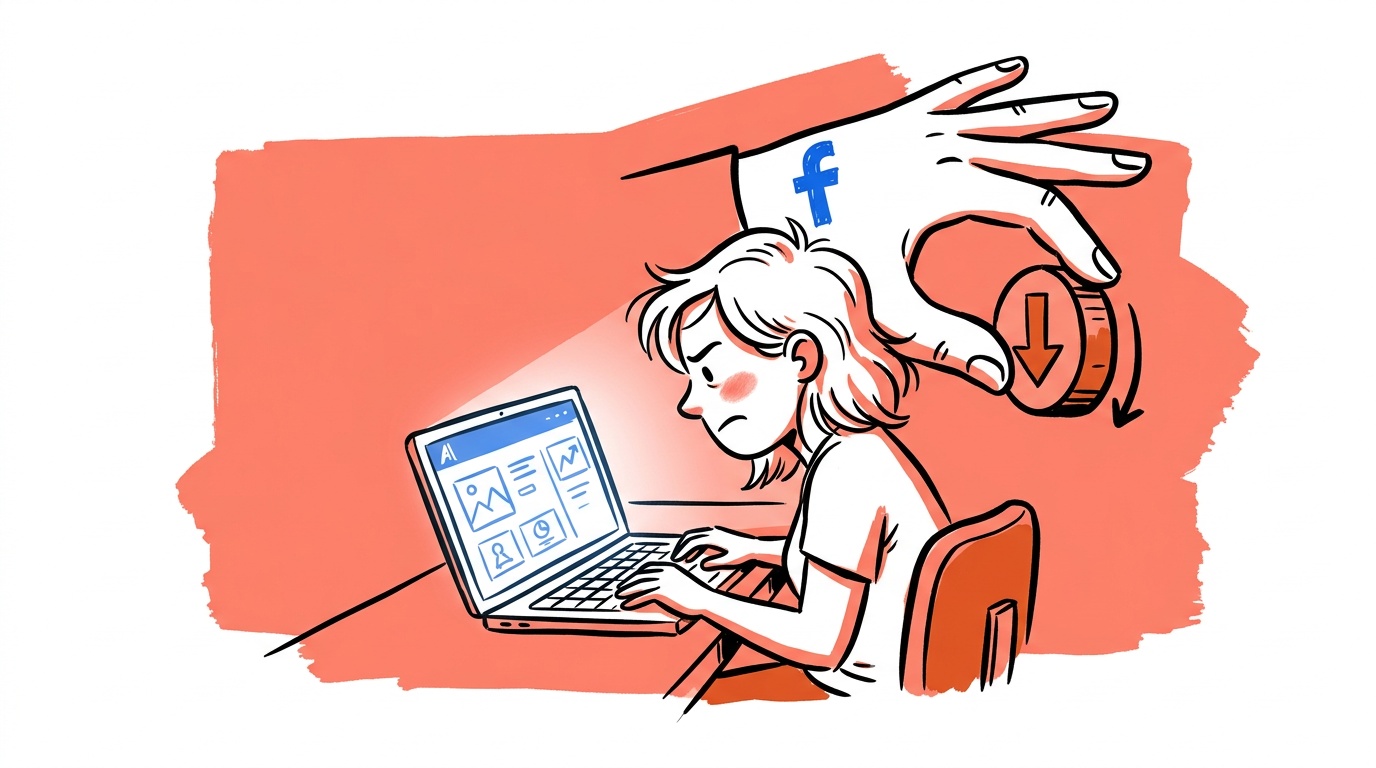
Advertisers reported AI translations activating on live ads with no explicit per-campaign opt-in. One thread title says it directly: "AI translation turned on!!!" — the exclamation marks are not enthusiasm. The advertiser discovered their ad was running in languages they hadn't approved, with copy they hadn't reviewed, to audiences in markets they may not be equipped to serve.
The AI music feature carries a different risk. The thread "Never turn on the AI music feature in Meta ads" documents the practical problem: generated music can shift the tone of a creative entirely, and you cannot A/B test it against silence because Meta controls which variant delivers.
The broader Advantage+ creative suite — text variations, image enhancements, background generation — operates on the same principle. Meta tests AI-generated variants of your creative against your original. If the AI variant wins by any margin, it absorbs spend. You may never know your original stopped running.
The thread "Las buenas prácticas de andrómeda son pura basura" — roughly "Andromeda best practices are pure garbage" — captures the sentiment from advertisers who followed Meta's recommended settings and lost control of their campaigns. Meta's "best practices" documentation optimizes for Meta's auction efficiency, not for your ability to understand what's running.

Live today.
The full campaign — copy, images, targeting — generated for your site and deployed paused for your approval.
The Structural Fix: Isolation Over Consolidation
Meta's official guidance pushes toward consolidation: fewer campaigns, broader ad sets, more budget for the algorithm to optimize. (When consolidation is the right call — and how to size it — is covered in our CBO vs ABO structure guide.) That guidance is correct if your goal is to minimize Meta's operational overhead and maximize its auction efficiency. It is wrong if your goal is to maintain visibility into what's working and protect yourself from single-point creative failure.
The fix is structural isolation:
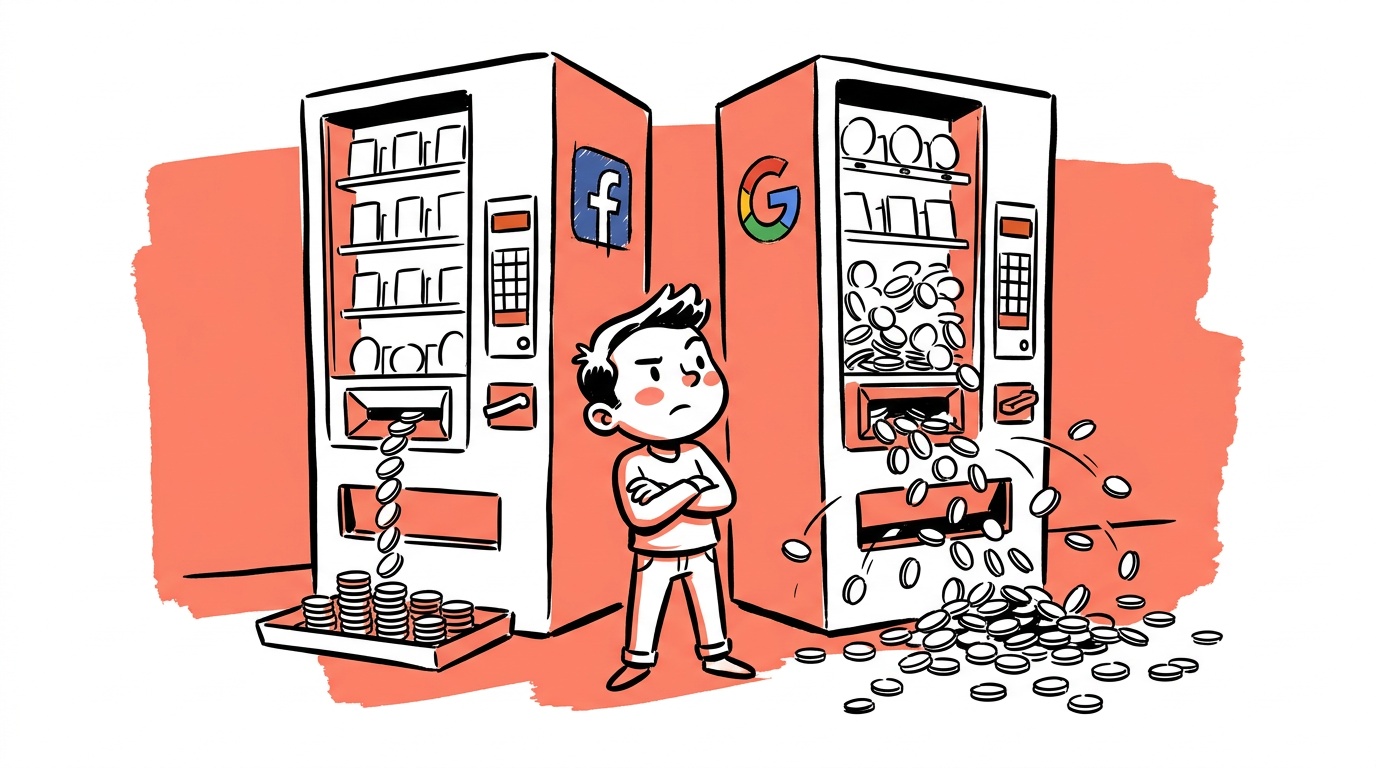
One creative per ad set, each with its own budget. This is the opposite of what Meta recommends. It is slower to set up, generates more line items to monitor, and costs you some auction efficiency. It gives you something Meta's consolidation model doesn't: per-creative spend data that is clean, and a natural cap on how much any single creative can consume before you've made that decision yourself.
When you run three ads in one ad set with a shared $300/day budget, Meta decides allocation. When you run three ad sets at $100/day each, you decide allocation. The algorithm still optimizes within each ad set. You just removed its ability to defund two of your three creatives unilaterally.
The efficiency trade-off is real but smaller than it looks. You give up some cross-creative auction optimization. You get clean per-creative CPA data, predictable spend distribution, and the ability to pause or scale individual creatives without restructuring the campaign. For most accounts running fewer than 20 active creatives, that trade is worth taking.
What to do with Advantage+ campaigns specifically
If you're using Advantage+ Shopping Campaigns (ASC), the isolation model doesn't directly apply — ASC is designed to operate across your entire catalog with full automation. For ASC, the lever is creative depth, not structural isolation. The principle holds regardless of exact asset counts: the more genuinely distinct creative directions you give the system, the less any single asset can monopolize delivery. "Distinct" means different hooks, formats, and visual concepts — not five versions of the same static with different text overlays.
Why "Winning Creatives" Burn Out Fast Under Concentration
The thread "Meta Ads only spend on top winning creatives for 1 day and stop spending on it before they become less efficient" describes what happens downstream of concentration: the winner runs hard, frequency climbs on its core audience, CPA deteriorates, Meta's system detects the deterioration and pulls back — but by then the other ads in the set have been starved so long they have no delivery momentum.
This is the expensive loop: concentration → fast fatigue → CPA spike → algorithm pulls back → cold backup ads can't ramp → you restart the test.
The way out is not to find a better creative. It is to refuse to let any single creative monopolize spend long enough to exhaust its audience. Isolation budgets enforce this mechanically. Rotating new creative into rotation on a fixed calendar — not waiting for performance to drop — breaks the dependence on a single winner before burnout forces your hand.
What to Turn Off Right Now
Here is a specific checklist based on what's actively causing problems across the advertiser community:
Advantage+ creative — translation. Off by default should be your policy. If you want to run translated copy, create the translated ad yourself so you can review it before it goes live.
Advantage+ creative — music. Multiple advertisers report this generating tonally inappropriate music on direct-response creatives. The risk of brand damage outweighs the marginal engagement lift, and you can't isolate the test to measure it cleanly.
Advantage+ creative — image enhancements and background generation. These modify the visual creative Meta approved. Turn them off unless you have a dedicated testing structure to measure their impact in isolation.
Dynamic Creative / Flexible Ads with broad asset mixes. If you are uploading 10 headlines and 6 images into a single flexible ad, Meta is generating a large number of combinations and delivering whatever wins the auction. You have no clear picture of what's actually running. This is defensible for top-of-funnel awareness work. It is a reporting problem for anything you need to understand and iterate on.
The thread "Disadvantage+ I'm out" captures a real frustration: Meta renamed Advantage+ features multiple times, moved settings between campaign and ad set levels, and changed defaults without announcement. Advertisers who configured campaigns correctly six months ago may have had defaults changed under them. A quarterly audit of every Advantage+ toggle across active campaigns is not paranoid — it's basic maintenance. (Those same default toggles are the main culprit when Facebook blows past your daily budget.)
The Real Tension: Efficiency vs. Control
Meta's automation is genuinely good at some things. Broad audience targeting outperforms detailed interest stacking for many accounts. Automated placements often beat manual placement selection on CPM efficiency. These are areas where ceding control costs you little in exchange for real gains.
Creative delivery and AI content modification are different. When the algorithm decides which creative runs and then edits that creative autonomously, you've lost the ability to learn anything from the results. You can't iterate on a creative you didn't know was running. You can't diagnose a CPA spike when you don't know which version of your ad was shown to which audience segment.
The practical position: automate audience and placement. Retain control over creative identity and budget allocation. That's not a protest against automation — it's drawing the line at the layer where your judgment still outperforms a model trained on aggregate behavior that may not match your specific account, offer, or audience.
FAQ
Why is Meta spending all my budget on one ad? Meta's auction system awards impressions to the ad with the highest predicted value. Once one ad gains a small early lead in estimated action rates, the system keeps awarding it impressions, which generates more signal, which further increases its predicted value. The result is that one ad can capture close to 100% of spend within an ad set. This effect is more pronounced after platform disruptions that reset delivery learning.
How do I stop Meta from spending everything on one creative? The most direct fix is structural isolation: one ad per ad set, each with its own budget cap. This removes the algorithm's ability to reallocate across creatives within a shared budget. You set the allocation. The algorithm optimizes within the constraint you've set.
Did Meta's AI translation turn on automatically on my ads? Yes, for some advertisers. Meta's Advantage+ creative features, including AI translation, have been reported activating on live campaigns without explicit per-ad opt-in. Check every active ad under Edit → Advantage+ creative and disable any toggle you didn't intentionally activate.
What is the AI music feature in Meta ads and should I use it? It's an Advantage+ creative feature that adds AI-generated background music to video ads. Advertisers report it can change the tone of a direct-response creative significantly and cannot be properly A/B tested because Meta controls delivery. The consensus from the advertiser community is to leave it off unless you have a specific use case and a clean way to isolate its impact.
Why do my winning ads burn out so fast on Meta? Budget concentration is the direct cause. When one ad captures most impressions, it exhausts its core audience segments faster — frequency rises quickly on the same people. By the time CPA deteriorates, there are no other ads with warm delivery data to take over. The fix is preventing concentration in the first place through isolation budgets, not searching for a more durable creative.
Is Advantage+ Shopping Campaign (ASC) affected by the same concentration problem? ASC operates differently — it manages delivery across your catalog with less per-creative control by design. The equivalent problem in ASC is over-reliance on a small creative set. Give the system genuinely distinct creative directions; don't let one creative type dominate the asset mix.
Should I just turn off all Meta AI features? Not all of them. Broad audience targeting and automated placements have real efficiency benefits for many accounts. The specific features worth disabling are those that modify your creative without your review (AI translation, AI music, image enhancements, background generation) and those that obscure what's actually running (flexible ad asset combinations when you need clean per-creative data). Draw the line at creative integrity and budget allocation. Let the algorithm handle the rest.
If your campaigns ran through any Meta outage in the past few months, the first thing worth doing isn't optimizing your creative — it's auditing which Advantage+ toggles are currently active on your live ads. You may find features running that you never turned on.
Live today.
The full campaign — copy, images, targeting — generated for your site and deployed paused for your approval.

We build AdControlCenter — AI-powered ad management for small businesses, online stores, SaaS companies and service providers. We write what we'd want to read: real numbers, no fluff, the things we wish we'd known when we started.
More from the team →