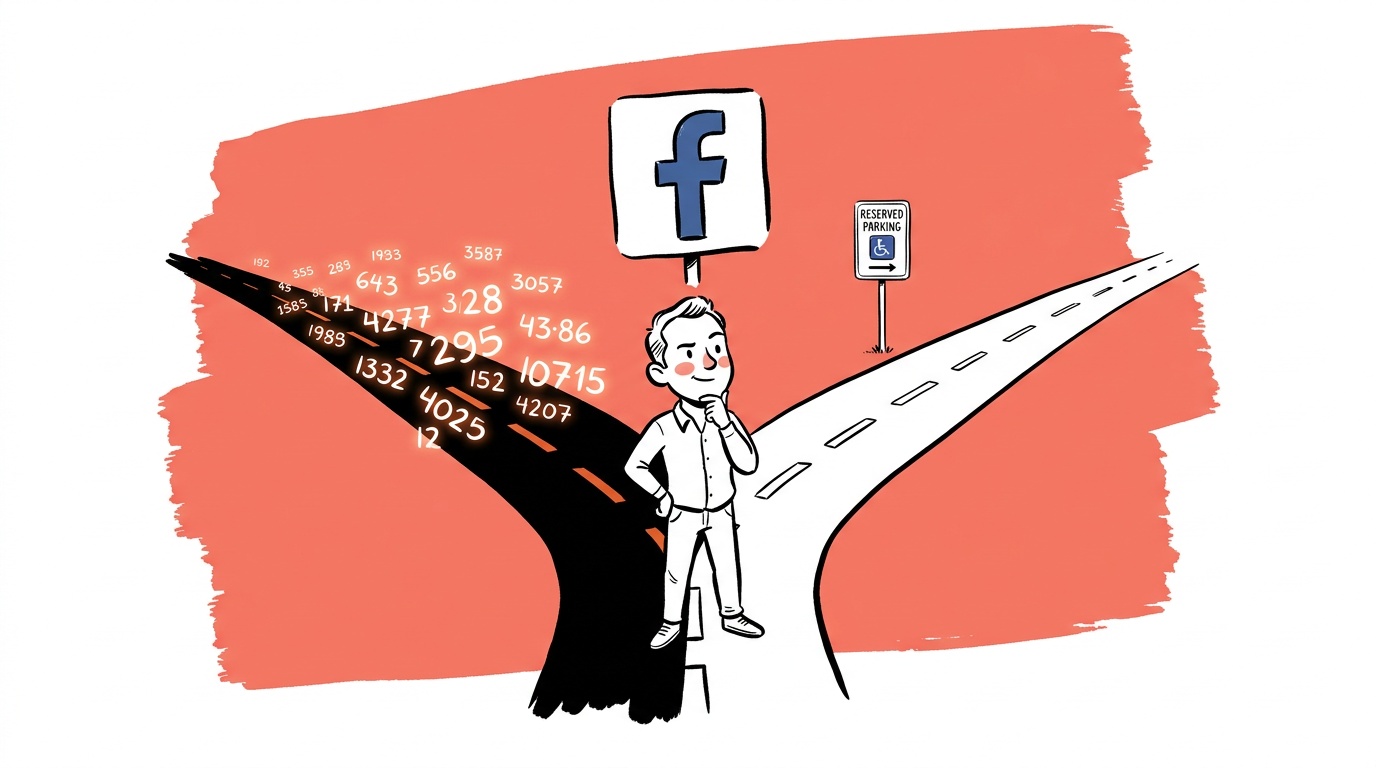


Most founders running Meta Ads have never seen the buying type selector. It sits one level above campaign objective, defaults silently to Auction, and unless you know to look for it, you will run every campaign you ever run on Meta without realizing a second system exists entirely.
That second system—Reservation—works nothing like the auction. It prices differently, delivers differently, and is designed for different goals. Conflating the two is how smart people end up comparing metrics that were never meant to be compared, and drawing conclusions that lead them in exactly the wrong direction.
TL;DR — Meta Ads: Auction vs. Reservation
- Meta has two buying types: Auction (the default, real-time bidding) and Reservation (formerly Reach and Frequency, fixed CPM committed in advance).
- Auction campaigns optimize dynamically and suit most direct-response goals; Reservation campaigns lock in delivery and cost before the campaign runs.
- Reservation is only available for Awareness and Engagement objectives, requires a minimum audience size, and is not accessible from all ad accounts.
- The two buying types produce fundamentally different delivery curves—Reservation is predictable and capped; Auction fluctuates with market demand.
- Choosing the wrong buying type for your goal doesn't just waste budget—it corrupts your performance data and makes apples-to-apples comparisons impossible.
What the Buying Type Selector Actually Does
When you create a new campaign in Meta Ads Manager, the very first structural choice is buying type. Many tutorials skip past it because it defaults to Auction and the vast majority of advertisers never change it. But the buying type determines the entire pricing and delivery mechanism underneath everything else you configure.
Auction means your ads compete in Meta's real-time auction every time there is an available impression. Your bid, your estimated action rate, and your ad quality score combine to determine whether you win that impression and what you pay. (Why stronger creative lowers that price is the core of Meta's interruption auction, explained.) Nothing about delivery is guaranteed. Meta's algorithm optimizes toward your chosen objective by finding people most likely to take that action—and it does this continuously, adjusting in real time based on what it learns.
Reservation means you are booking impressions in advance at a fixed CPM. You agree to a price before the campaign runs, Meta commits to delivering a specific number of impressions to a specific audience over a specific date range, and neither side can move the goalposts once the booking is confirmed. Think of it less like a stock market and more like buying a billboard for a month.
Reservation was called "Reach and Frequency" buying for years—and you will still see that name used in tutorials, documentation, and industry conversations. Meta rebranded it to "Reservation" but the underlying mechanic is identical. If you see "R&F campaigns" anywhere, that is what this post is talking about.
How Auction Delivery Actually Works
In an auction campaign, you are not buying a fixed block of impressions. You are entering a continuous competition. Meta runs billions of these auctions per day, and your ad's fate in each one depends on three inputs: your bid (explicit or algorithmic), the probability that a specific person takes the action you care about, and the estimated experience quality of your ad for that person.
The practical consequence is that your delivery is elastic. When you are in a hot auction—holiday season, a product category with many competing advertisers, a narrow audience that everyone wants—your CPMs rise and your delivery slows unless you increase your budget or broaden your targeting. When competition is low, the same budget buys more.
This is why auction CPMs are not a fixed cost. They are a market price, and they move. Founders who set a budget in January and assume the same budget will buy the same reach in November are consistently surprised to find their campaigns delivering less and costing more.
Auction campaigns support every campaign objective Meta offers: Awareness, Traffic, Engagement, Leads, App Promotion, and Sales. They are the right default for direct-response goals because the algorithm's dynamic optimization is genuinely powerful at finding converters when it has enough signal.
When Auction optimization breaks down
The auction system depends on signal volume. If your conversion event fires rarely—Meta's own guidance points to roughly 50 conversion events per week per ad set as the threshold for stable learning—the algorithm doesn't have enough data to learn who to find. It enters or stays in what Meta calls the learning phase indefinitely. In those cases, you are not getting the dynamic optimization you are paying for; you are getting a slow, expensive exploration that may never stabilize.
This is one of the most expensive mismatches in Meta advertising: a founder running an Auction/Sales campaign with a low-volume conversion event, waiting for optimization that the system cannot mathematically deliver. The way out—consolidating ad sets and stepping up the optimization event—is covered in how to escape the learning phase.
How Reservation Delivery Works
In a Reservation campaign, you build a forecast before committing. Meta shows you a projected reach, frequency, and CPM based on your audience, dates, and budget. You either accept those terms or adjust the parameters until the forecast works for you. Once you confirm the booking, Meta commits to delivering within those parameters.
The CPM is fixed. Delivery follows a predictable curve. Frequency is capped to whatever you set. You can sequence ads—running creative A to an audience, then serving creative B only to people who saw A—which is operationally difficult to control in an auction environment.
The tradeoffs are real. Reservation campaigns are only available for Awareness and Engagement objectives. They require a minimum audience size—Meta's documented threshold is meaningful, and very narrow audiences are not eligible. Because the price is locked in, you cannot benefit from low-competition windows the way an auction campaign can.

Live today.
The full campaign — copy, images, targeting — generated for your site and deployed paused for your approval.
Reservation Eligibility: What Meta Actually Requires
Reservation buying is not available to every account, and the eligibility requirements are worth knowing before you build a campaign strategy around it.
According to Meta's Ads Help Center documentation on Reservation buying, the following constraints apply:
- Audience size minimum. Meta requires a sufficiently large target audience to generate a delivery forecast. Tight geographic targeting, narrow interest stacks, or very small custom audiences will typically make a Reservation booking unavailable.
- Account access. Smaller accounts or newer accounts may not see the Reservation option at all in the buying type selector. Access has historically been tied to spend history and, in some cases, a managed relationship with a Meta sales representative.
- Supported placements and markets. Not all placements and not all countries support Reservation buying. Facebook Feed and Instagram Feed are generally supported; some placements are Auction-only.
- Objective restrictions. Only Awareness and Engagement objectives are available under Reservation. Selecting Reservation at the campaign level immediately removes all other objectives from the menu.
If you are building a brand launch plan that depends on Reservation, verify access in your actual account before committing to the strategy. The worst time to discover you cannot book a Reservation campaign is the week before the launch.
The Goal Mismatch Problem
Here is where most Meta Ads confusion actually originates. Founders see Reservation's predictable delivery and fixed CPM and assume it must be more efficient—or they see Auction's volatility and assume something is broken. Neither assumption is right. The two systems are optimized for different goals.
Auction is built for outcome optimization. You tell Meta what you want (a purchase, a lead, a video view), and the algorithm finds the people most likely to deliver that outcome at the lowest cost. The CPM varies because the system is buying the specific impressions most likely to convert, not just any impressions.
Reservation is built for reach and frequency control. You tell Meta how many people you want to reach, how often you want to reach them, and in what sequence. The system delivers against that plan predictably. It does not optimize for a downstream conversion event—because it cannot.
If you are running a product launch and want to ensure a specific number of people in a specific market see your ad exactly three times over two weeks, Reservation is the right tool. If you want the lowest cost per purchase, Auction with a conversion objective is the right tool. Using one for the other's job produces expensive, confusing results.
Practical Decision Framework
The choice between buying types is not complex once you know what each system actually does. Run through these questions in order:
1. What is the goal? If the goal is a measurable downstream action—a purchase, a form fill, an app install—use Auction with the matching conversion objective. If the goal is controlled brand exposure to a defined audience over a defined period, consider Reservation.
2. Do you have conversion volume? If your conversion event fires infrequently, Auction optimization will struggle. This is not a reason to use Reservation—it is a reason to choose a higher-funnel conversion event (add to cart instead of purchase, for example) that fires more frequently and gives the algorithm enough signal to learn.
3. Do you need frequency control? Auction campaigns have frequency controls, but they are softer guardrails. Reservation enforces frequency caps with more precision because delivery is planned rather than reactive.
4. Are you sequencing creative? Reservation makes sequential messaging substantially easier to execute. If you want to guarantee that a second ad only serves to people who saw the first ad, Reservation gives you tighter operational control.
5. Is your audience large enough? If your target audience is small and specific, Reservation may not be available. Auction handles small audiences; the tradeoff is you lose delivery predictability.
Many founders think of Reservation purely as a "big brand awareness tool" and ignore it. But the sequencing mechanic—showing creative B only to users who saw creative A—is genuinely useful for product launches, event marketing, and any campaign where the narrative order matters. You don't need a TV budget to use it. You need a large enough audience and access to Reservation in your account.
What This Means for Reporting
The buying type split has a direct consequence on how you should read your reports. Auction campaigns will show volatile CPMs that reflect real-time market conditions. Reservation campaigns will show stable CPMs that reflect your pre-negotiated rate. If you are pulling blended metrics across both buying types, you are averaging numbers that were generated by entirely different mechanisms.
The same caveat applies to frequency. Auction frequency numbers are averages that can mask significant skew—some users in your audience may see your ad many times while others see it once. Reservation frequency is a cap enforced at the delivery level. A "2.5 average frequency" means different things depending on which system generated it.
When we looked at campaign data across our own corpus, the accounts with the most distorted reporting were consistently those mixing Auction and Reservation campaigns in the same analysis without segmenting by buying type first. The confusion was not in the campaigns—it was in the spreadsheets.
The fix is mechanical: add buying type as a filter or segment in any report that spans multiple campaigns. Meta Ads Manager lets you filter by buying type at the campaign level. If you are exporting to a spreadsheet or a BI tool, make sure buying type travels with the data. Treating it as a throwaway field is how you end up debugging a performance drop that is actually just an audience overlap or a CPM comparison that was never valid.
FAQ
What is the difference between Auction and Reservation in Meta Ads? Auction is the default buying type where your ads compete in real-time bidding for each impression. Costs vary with market demand and Meta optimizes dynamically toward your chosen objective. Reservation (formerly Reach and Frequency) lets you pre-book a fixed volume of impressions at a locked CPM, with predictable delivery and frequency control. The two systems are built for different goals and should not be evaluated with the same metrics.
What is Reach and Frequency buying on Meta? Reach and Frequency is the old name for what Meta now calls Reservation buying. The mechanics are identical: you forecast and lock in your reach, frequency, and CPM before the campaign runs, and Meta commits to delivering against that plan. You will still see "R&F" used widely in tutorials and third-party documentation.
Why can't I find Reservation buying in my Meta Ads account? Reservation buying is not available to all accounts. Access has historically been tied to account spend history, account age, and in some cases a managed advertiser relationship with Meta. If you do not see a buying type selector when creating a campaign, your account may only have access to Auction buying. You can verify eligibility through Meta's Ads Help Center.
When should I use Reservation instead of Auction on Meta? Use Reservation when your goal is predictable reach and frequency control for a defined audience over a specific period—brand launches, event campaigns, sequential creative strategies. Use Auction when your goal is a measurable downstream action like purchases or leads, where Meta's dynamic optimization adds genuine value.
Can I run conversion campaigns with Reservation buying? No. Reservation campaigns are limited to Awareness and Engagement objectives. If you want to optimize for conversions, leads, or app installs, you must use Auction buying.
Why are my Meta Ads CPMs inconsistent? If you are running Auction campaigns, CPM inconsistency is expected—it reflects real-time changes in advertiser competition, audience availability, and seasonality. If you are seeing inconsistency in a Reservation campaign, check whether the campaign is actually running in Reservation buying (the CPM should be fixed after booking). Mixing both buying types in the same report without segmenting is the most common source of apparent CPM confusion.
Does Reservation buying work for small audiences? Generally no. Meta requires a minimum audience size for Reservation campaigns because the delivery planning model needs enough inventory to commit to. Very narrow audiences—tight geographic areas, highly specific interest stacks—are typically only eligible for Auction buying.
The specific takeaway here is mechanical: before you diagnose a Meta campaign as broken, check the buying type. An Auction campaign showing variable CPMs is working as designed. A Reservation campaign that you are evaluating on cost-per-conversion is being judged by a standard it was never built to meet. The confusion is almost never in Meta's system—it is in applying the wrong mental model to a campaign you did not fully configure.
Live today.
The full campaign — copy, images, targeting — generated for your site and deployed paused for your approval.

We build AdControlCenter — AI-powered ad management for small businesses, online stores, SaaS companies and service providers. We write what we'd want to read: real numbers, no fluff, the things we wish we'd known when we started.
More from the team →