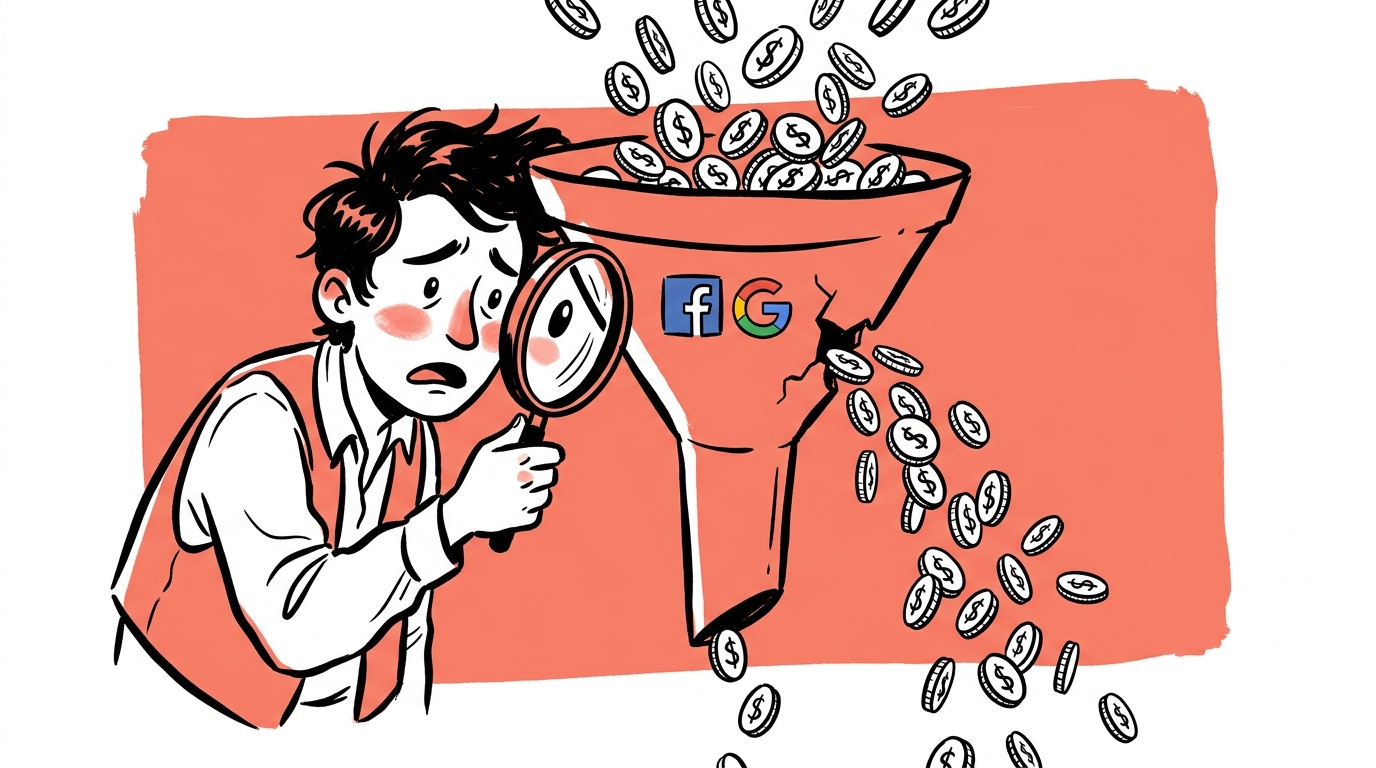
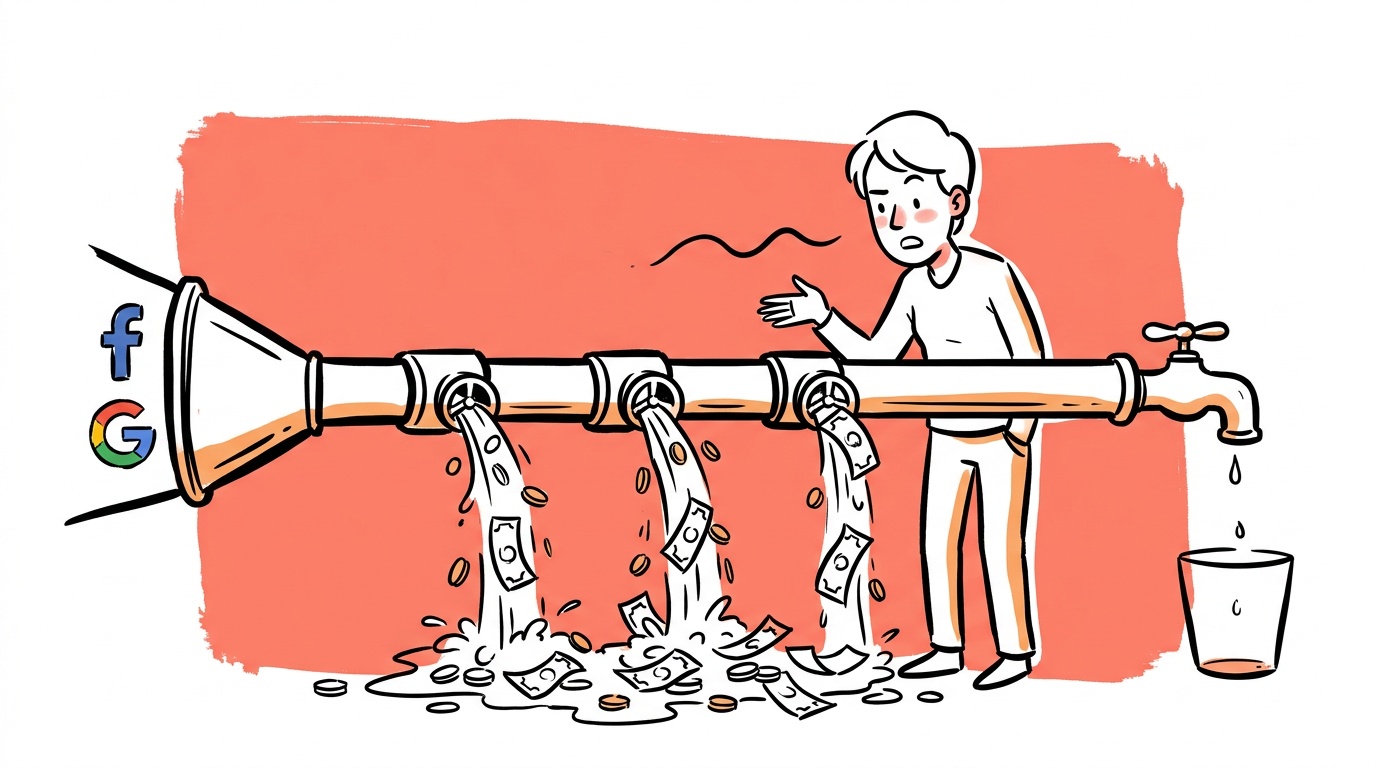
Most founders look at their ad spend when conversions drop. They tweak bids, refresh creatives, adjust audiences. Almost none of them look at what happens in the first few minutes after the click — and that oversight is expensive. Your onboarding flow is probably leaking more revenue than a bad CPM ever could. Because it happens after the click, it's invisible in your ad reporting. It goes unfixed longest.
The compounding problem: every dollar you spend on ads is being partially burned before the user ever sees your product. You're not running an acquisition problem. You're running an onboarding problem with an acquisition budget attached to it.
TL;DR — Onboarding Friction Costing Revenue
- Onboarding friction sits after the click and before value delivery — ad dashboards rarely surface it, so it goes unfixed longest.
- Manual, multi-step flows (long forms, email verification gates, forced integrations) drive drop-off at the exact moment intent is highest.
- The fix is rarely "remove steps" — it's reordering them so the user hits a value moment before being asked to do work.
- Automation inside onboarding (pre-filled data, smart defaults, skippable steps) removes throughput caps that ad spend will otherwise outpace.
- Every hour of delay between signup and first value delivered is a window your competitor's retargeting ad can use to win that user back.
The Drop-Off Nobody Is Watching
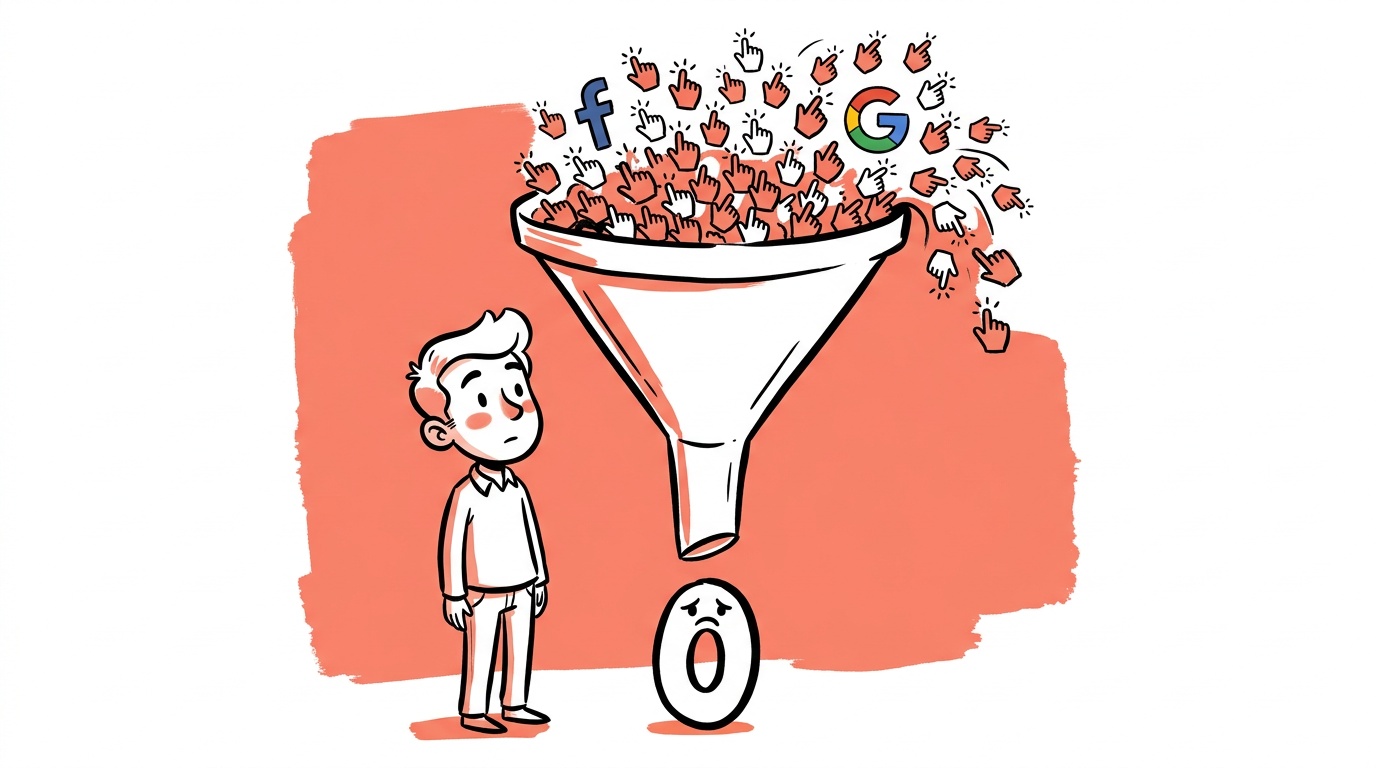
When we look at ad accounts, the funnel reporting almost always stops at "lead" or "trial start." That's a measurement choice that costs money. The user who clicks your ad, lands on your page, starts your signup, and then abandons halfway through an email-verification screen — that person is counted as a non-converter in your ad platform. But they expressed intent. They clicked. You paid for that click.
The real conversion rate for your paid traffic isn't "clicked to trial." It's "clicked to first meaningful action inside the product." When you measure it that way, most accounts look significantly worse than their dashboards suggest. The gap lives almost entirely inside onboarding.
This isn't a new problem. Product-led growth research from OpenView Partners has tracked for years that time-to-value is among the strongest predictors of whether a trial converts to paid. What's changed is the cost of ignoring it. With paid CPCs elevated across Google and Meta, every wasted click is more expensive than it was a few years ago.
Why Manual Steps Are the Worst Offenders
There's a specific class of onboarding friction that does the most damage: steps that require the user to do work that you could have done for them, or that could have waited until later.
Classic examples:
- Forcing credit card entry before the user has seen any value
- Requiring a company size or industry field that you'll never actually use to personalize anything
- Sending a "confirm your email" gate before letting the user into even a preview of the product
- Mandatory integration setup — connect your ad account, connect your CRM — before showing what the product does
Every one of these has a reasonable-sounding justification. "We need the card to prevent spam." "We use industry for segmentation." "We need the integration to do anything useful." Sometimes those justifications are real. Often they're organizational habits that nobody has re-examined since the product launched.
When a user clicks your ad, their intent peaks and then decays. They have other tabs open. They have a Slack notification. They have a meeting in twelve minutes. Every minute your onboarding flow burns before delivering something real is a minute that intent is draining away. Manual steps don't just slow users down — they burn the window.
The Automation Gap Is a Revenue Gap
A separate but related failure mode: founders who are still managing parts of their onboarding flow manually. Not because they haven't heard of automation, but because they haven't felt the revenue cost clearly enough to prioritize fixing it.
The arithmetic is straightforward. If your onboarding requires human intervention at any point — a sales rep to "approve" the account, a support ticket to provision access, a manual email to send credentials — then your throughput is capped by human hours. Your ad spend can scale. Your manual steps cannot. The gap between those two curves is dropped users.
Automation in onboarding isn't about replacing human relationships. It's about removing the steps that never needed a human in the first place. Pre-filling known data from the signup email. Defaulting to reasonable settings instead of presenting a blank-slate configuration screen. Sending a triggered walkthrough email based on what the user did (or didn't do) in their first session, not a generic "get started" drip.
Where to Find the Manual Bottlenecks
The fastest audit: walk through your own onboarding as a new user with a fresh email address, and time every step. Write down every moment where you're doing work that the product could have done for you, or where you're waiting for something external. That list is your automation backlog, roughly ranked by the order in which users encounter the steps.
If you can instrument it — most product analytics tools support this — look at where users stop in the flow. Not where they pause: where they actually abandon. It's often not the hardest step. It's a step that feels trivially easy to you because you've seen it a thousand times, but is genuinely confusing or friction-heavy to someone encountering it cold.

Live today.
The full campaign — copy, images, targeting — generated for your site and deployed paused for your approval.
Reordering Is More Powerful Than Removing
The counterintuitive finding when we've worked through onboarding audits: you often don't need to remove steps. You need to move them.
Asking for a credit card after the user has done something real in your product converts better than asking on day zero — even if the price and terms are identical. Asking for a company size after showing a personalized dashboard converts better than asking for it on the initial form. The information requirement hasn't changed. The user's willingness to provide it has, because now they have a reason to.
The same logic applies to integration requirements. If your product genuinely requires a connected ad account to function, show a demo mode or a sample dataset first. Let the user see what the connected experience looks like before you ask them to do the work of connecting. Then the integration step feels like enabling something they already want, not paying a toll before they're allowed to see anything.
What Good Onboarding Looks Like for Ad-Tech Products
Ad-tech tools have a specific onboarding challenge that generic SaaS advice doesn't fully address: the product often can't show anything useful until it has real data. You need the ad account connected, the pixel firing, the campaigns imported. Without that, the dashboard is empty and the product looks broken.
The solutions that work:
Sample data environments. Show the product with a realistic fake dataset — an account with campaigns, spend, performance curves. Let the user click around and understand what they're buying before asking them to connect anything real. This is not deceptive. It is demonstrating capability.
Guided connection flows. Instead of a raw OAuth screen, walk the user through exactly what you're asking for and why. "We're requesting read access to your campaign performance data. We use this to [specific thing]. We don't make changes without your approval." Specificity converts better than generic permission dialogs.
Progressive commitment. Ask for view-only access first. Once the user has seen value from their real data, ask for write access to enable automation. Users who've seen a good result from read-only are far more willing to grant broader permissions than users who are asked for everything upfront.
Appcues has published solid research on progressive onboarding patterns that applies directly here, even if their examples skew toward general SaaS.
Connecting Onboarding Back to Ad Spend
Your onboarding conversion rate is a multiplier on every ad dollar you spend.
If your flow converts at a low rate, your effective CPA is high — even if your ad platform CPC looks reasonable. Improving that conversion rate doesn't require spending more. It requires fixing what happens after the click. A meaningful improvement in trial-to-activation rate has the same revenue impact as a meaningful reduction in CPC, but the onboarding fix costs engineering time, not ongoing budget.
Stripe's documentation on reducing checkout abandonment uses the same principle for payment flows — every unnecessary field, every extra confirmation screen, every moment of uncertainty is a place users leave. Onboarding is a checkout for your product's value. The same rules apply.
The cheapest way to improve your paid acquisition efficiency is to stop wasting the users you've already acquired.
FAQ
What is onboarding friction and why does it cost revenue? Onboarding friction is any step, delay, or moment of confusion between a user signing up and that user experiencing your product's core value. It costs revenue because users who encounter friction before seeing value leave — and in a paid acquisition model, you already paid for those users to arrive.
How do I know if my onboarding flow has a friction problem? Walk through your own flow timed, with a fresh account. Then look at your product analytics for step-level drop-off data. If users are abandoning before completing setup, there is a friction problem. If you don't have step-level analytics, that's the first thing to instrument.
Should I remove steps from my onboarding or reorder them? Start with reordering. Most onboarding flows have all the right steps in the wrong sequence. Move value delivery earlier and work requirements later. Only cut steps that are genuinely unused or unjustified after that audit.
Does a mandatory email verification gate hurt conversions? In most cases, yes. Gating the product entirely behind email verification before the user has seen any value is a high-friction pattern. A common alternative: let the user into a limited product experience immediately, then prompt verification to unlock full functionality or persistence.
What's the connection between onboarding and paid ad efficiency? Your onboarding conversion rate functions as a multiplier on ad spend. If you're paying for traffic that drops off in the onboarding flow, your real cost per acquired user is higher than your ad dashboard shows. Fixing onboarding improves that ratio without increasing budget.
How does manual onboarding hurt scale? Manual steps — human approval, support-mediated provisioning, manual email sends — create throughput caps that ad spend can easily outpace. As you scale acquisition, manual bottlenecks cause increasing drop-off because the wait time between signup and access grows. Automation removes the cap.
What's the fastest onboarding improvement for an ad-tech product specifically? Add a sample data environment or demo mode. It lets users understand what they're buying before the friction of connecting real accounts. Users who see value in a demo convert to full connection at a higher rate than users who see an empty dashboard and are asked to connect immediately.
The question worth sitting with: if you ran your onboarding flow as a paid ad — where every step costs you money and every abandonment is a direct loss — which step would you cut first? That answer is probably where you should start.
Live today.
The full campaign — copy, images, targeting — generated for your site and deployed paused for your approval.

We build AdControlCenter — AI-powered ad management for small businesses, online stores, SaaS companies and service providers. We write what we'd want to read: real numbers, no fluff, the things we wish we'd known when we started.
More from the team →