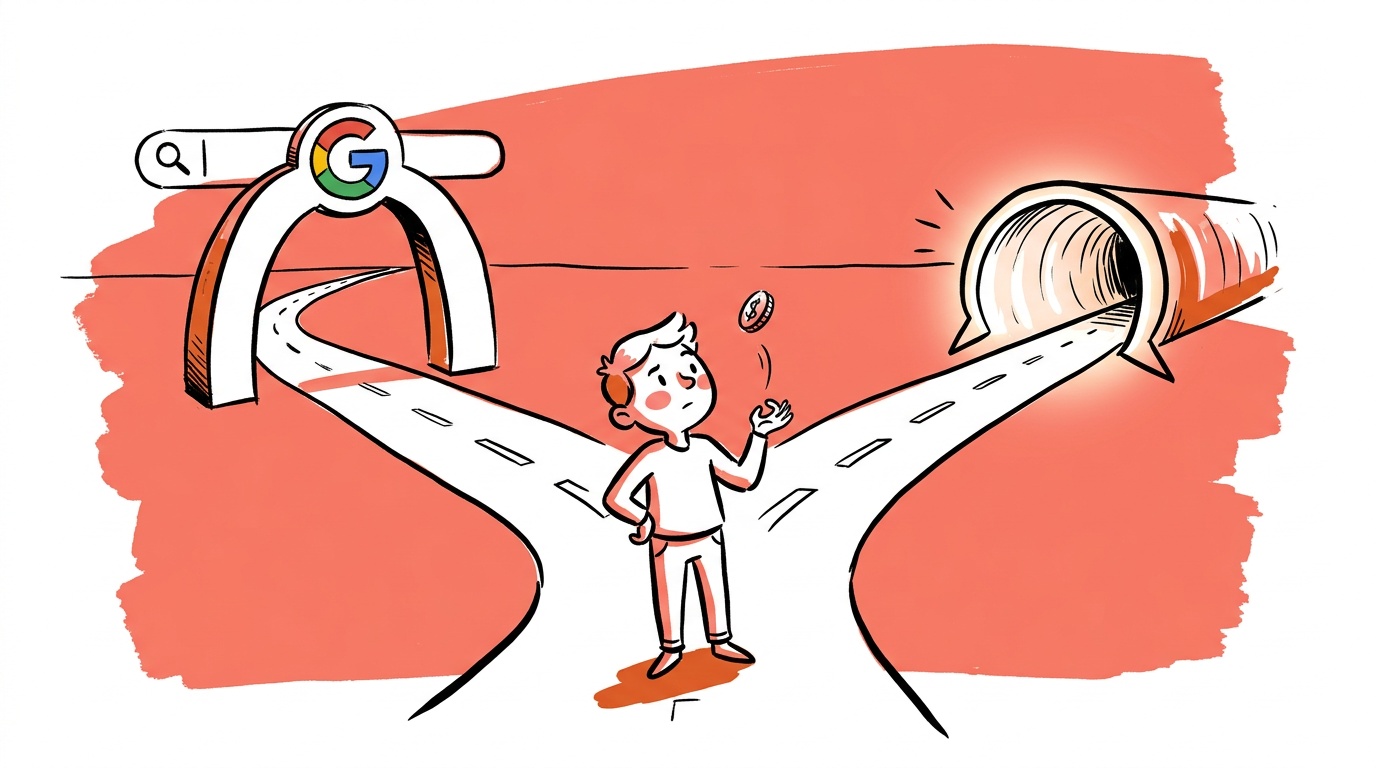
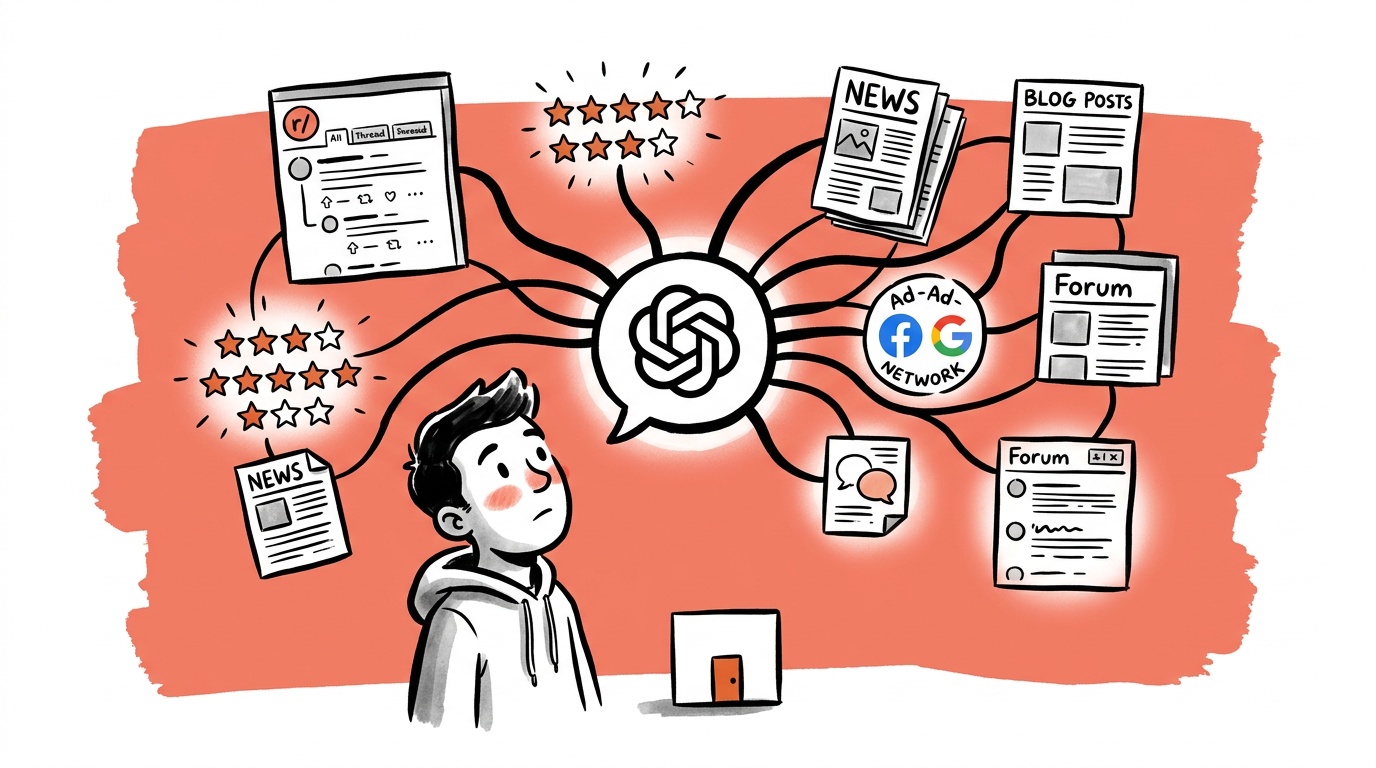

The person typing a query into Google and the person asking ChatGPT for a recommendation are in meaningfully different mental states. Running the same creative and bidding logic against both will quietly drain a tight budget before you figure out why.
If you're working with somewhere between $500 and $2,000 a month in paid budget, the allocation question isn't academic. Every dollar you put in the wrong place is a dollar that can't prove your model works. Here's how to think about it clearly.
TL;DR — ChatGPT Ads vs Google Ads for Small Budgets
- Google Ads wins on bottom-funnel, local, and shopping intent—people arrive already in decision mode.
- ChatGPT placements intercept conversational, exploratory queries where the user wants a recommendation, not a list of results.
- The measurement infrastructure for ChatGPT ad placements is still early; attribution is harder and requires more patience than Google's mature conversion tracking.
- Small budgets (under $1,000/month) should anchor on Google for proven ROI, then use a small experimental slice for ChatGPT placements.
- Managing both from one dashboard eliminates the context-switching cost that causes founders to under-optimize one channel or abandon it too early.
The Intent Gap Is Real and It Matters More Than the Platform Name
When someone searches "best CRM for freelancers" on Google, they've already decided they want a CRM. They're comparing. They're close to a decision. The keyword is a signal of purchase proximity.
When someone asks ChatGPT "what CRM should I use if I'm a freelancer who hates admin work?", they're having a conversation. They're describing their life and asking for a judgment call. That's a fundamentally different mental posture—more like asking a knowledgeable friend than querying a database.
This distinction matters for ad creative, landing page design, and bid strategy. Google rewards relevance to a keyword. ChatGPT's ad placements reward relevance to a context—the full conversational thread, not just the final phrase. If your ad copy is written around a head keyword rather than a problem scenario, it will feel jarring in a conversational interface and will likely underperform. Our guide to advertising on ChatGPT covers how to write for that context.
ChatGPT users often don't know the exact category name for what they need. They describe symptoms, not solutions. Your ad has to meet them at the symptom level, not the solution level.
Funnel Position: Where Each Platform Dominates
Google Ads has a well-understood funnel map. Broad match and Discovery campaigns capture early awareness. Phrase and exact match capture mid-to-bottom intent. Shopping campaigns are almost exclusively bottom-funnel—someone searching for a specific product with a price expectation already formed. Local Service Ads are bottom-funnel by design; the user wants a plumber in their zip code right now.
ChatGPT placements currently sit higher in the funnel for most categories. Users are in research and recommendation mode. They haven't committed to a category yet, let alone a vendor. That creates an opportunity—first-mover brand exposure in a channel where most competitors haven't shown up yet—but it also means the path from impression to conversion is longer and harder to measure with standard last-click attribution.
For a founder spending $800/month total, spending most of it on Google's bottom-funnel keywords and using a smaller slice to test ChatGPT placements is a rational structure. You need the Google spend to produce attributable conversions that prove your unit economics. You use the ChatGPT slice to learn whether the channel can generate qualified top-of-funnel volume before your competitors arrive.
The Measurement Maturity Gap
This is where a lot of founders get burned. Google Ads has had conversion tracking, view-through attribution, and offline conversion imports for years. The tooling is mature, the documentation is thorough, and your analytics platform almost certainly has a native integration.
ChatGPT ad attribution is earlier-stage. Pricing is also still negotiated rather than auctioned — see ChatGPT ads costs, formats and eligibility. The signals you're used to—keyword-level conversion data, Quality Score, impression share by match type—don't exist in the same form. You're working with coarser data, which means your optimization loops are slower.
That's not a reason to avoid the channel. It's a reason to set expectations correctly. When we work with accounts that are testing ChatGPT placements alongside Google, we tell them the same thing: budget for a longer learning window, track engagement metrics as proxy signals while conversion data accumulates, and don't make kill decisions on a small sample.
When Google Still Wins Outright
There are three scenarios where Google is the unambiguous answer for a small budget:
Local intent. If your business serves a geographic area—a clinic, a law firm, a home services company—Google's local inventory (Local Service Ads, Maps placements, local pack) is purpose-built for the "near me" query that drives foot traffic and phone calls. Someone looking for an emergency plumber on a Sunday night opens Google, not a conversational AI.
Shopping and e-commerce. Google Shopping campaigns intercept purchase-ready queries with product images, prices, and reviews in the result. The visual comparison format is native to how people shop online. ChatGPT's interface isn't optimized for this yet.
High-volume exact-match categories. If there are keywords in your category that have been running profitably for years—keywords with a clear commercial modifier, consistent search volume, and documented conversion rates in your account—don't abandon them for an experimental channel. Let those keywords keep working while you test new ones.

Live today.
The full campaign — copy, images, targeting — generated for your site and deployed paused for your approval.
When ChatGPT Placement Is a First-Mover Advantage
In categories where competitors have driven Google CPCs to painful levels, ChatGPT placements offer lower advertiser density right now. That will change as more advertisers show up, which is exactly why early movers have a real window.
The categories where ChatGPT placements fit best tend to share a few traits: considered purchases with a longer research phase, categories where trust and recommendation credibility matter more than price comparison, and B2B products where the buyer is trying to understand a solution space before talking to sales.
Software, professional services, financial products, health and wellness products with a strong education component—these fit the conversational discovery model well. A user asking ChatGPT "how do small teams usually handle expense reporting?" is a better early-funnel signal for an expense management SaaS than most broad-match Google queries in the same category.
In a channel with low advertiser density, even a modest budget can achieve meaningful reach. That ratio will compress as the channel matures. The window is real, but it's not permanent.
How to Actually Test ChatGPT Placements Without Wasting the Budget
The missing piece in most early-channel tests is a clear definition of what a passing result looks like before you spend the first dollar. Without that, you'll either kill the test too early or keep funding it out of hope.
Here's the test design we recommend for accounts in the $500–$2,000/month range:
Set a fixed test window. Four to six weeks minimum. ChatGPT ad attribution is slower than Google's, and a two-week sample will produce noise, not signal.
Pick two or three proxy metrics. Since conversion volume will be thin at small budgets, define the engagement signals that would indicate qualified traffic: landing page session duration above a threshold you've already seen correlate with conversion on Google, email capture rate, or scroll depth on an educational page. These won't replace conversion data, but they'll tell you whether the traffic is engaged before you have enough conversions to be statistically meaningful.
Run a clean holdout on Google. Keep your Google campaigns unchanged during the test period. If you adjust both channels simultaneously, you won't know which change caused any performance shift.
Define a clear kill criterion. For example: if after five weeks the proxy metrics are all below what you'd accept from a new Google ad group, pause and reassess. The point is to have a number in mind before you start, not after you're emotionally invested in the result.
Compare incremental cost per qualified visit, not raw CPC. A higher CPC on ChatGPT placements can still be efficient if the downstream engagement is meaningfully stronger than your Google broad-match traffic.
This isn't a perfect methodology—incrementality testing at small budgets is genuinely hard—but having the structure in place forces cleaner decisions and prevents the most common failure mode: abandoning a channel after three weeks because it "didn't work."
A Practical Split for a $500–$2,000/Month Budget
Here's a decision structure for allocation between the two channels. Not a formula—the data in your account overrides any fixed ratio.
Under $1,000/month: Anchor on Google. Focus on your highest-intent keywords first—exact and phrase match, tightly themed ad groups, conversion tracking verified and working. If budget remains after covering that, run a small ChatGPT placement test. Keep it small enough that a null result doesn't hurt your monthly economics.
$1,000–$1,500/month: Google should still carry the majority. At this level you can usually cover core search terms with room for remarketing. Allocate a meaningful but bounded slice to ChatGPT—enough to generate real impressions and early engagement data over several weeks.
$1,500–$2,000/month: Running both channels in parallel starts to make sense as a real strategy rather than a side experiment. Google covers bottom-funnel and drives primary conversion volume. ChatGPT placements work the higher funnel, building brand recognition in a conversational context that may shorten later sales cycles.
In all cases, the split should follow what your data tells you, not a fixed ratio. If your Google campaigns are hitting diminishing returns on incremental spend, that's a signal to move more budget toward exploration. If they still have headroom, feed that first.
Managing Both Without Losing Your Mind
The practical problem with running two ad platforms simultaneously on a small budget is that you're already time-poor. Switching between dashboards, reconciling metrics that use different attribution models, and trying to understand cross-channel effects without a unified view is genuinely expensive in attention and time.
This is the exact problem we built AdControlCenter to solve. You can manage Google campaigns and ChatGPT placements from a single interface, with a shared reporting layer that normalizes the attribution differences between platforms rather than leaving you to reconcile them manually. When you pause a creative on one channel, you can see whether the same message is running elsewhere. When you want to test whether a keyword theme is working in conversational format on ChatGPT, you don't need to rebuild the campaign logic from scratch.
The goal isn't to make both channels feel identical—they're not, and pretending they are causes bad decisions. The goal is to reduce the overhead of managing both so you can actually optimize, rather than just monitor.
FAQ
What are ChatGPT ads and how do they differ from Google Ads?
ChatGPT ads are placements that appear within OpenAI's ChatGPT interface, shown in response to conversational queries. Google Ads are placements that appear on Google's search results page, Maps, YouTube, and the Display Network. The core difference is intent format: Google users type short queries and expect a list of results; ChatGPT users ask open-ended questions and expect a recommendation or explanation.
Is ChatGPT advertising worth it for a small business?
It depends on your category and your goals. For local businesses or e-commerce with purchase-ready buyers, Google is almost always the better use of a small budget. For B2B software, professional services, or any category where buyers need education before they convert, ChatGPT placements can reach high-quality prospects earlier in their research process, often with less advertiser competition than Google.
How do I measure the ROI of ChatGPT ads?
ChatGPT ad measurement is less mature than Google's. Expect coarser conversion data and longer attribution windows. Use engagement metrics—click-through rate, landing page dwell time, downstream email signups—as proxy signals while you accumulate enough conversion data to make optimization decisions. Don't apply the same weekly optimization cadence you'd use on Google.
Can I run ChatGPT ads and Google Ads at the same time on a small budget?
Yes, but be intentional about the split. Under $1,000/month, let Google carry most of the budget and run a small ChatGPT test on the side. At higher budget levels, running both in parallel as complementary funnel stages starts to make more sense. The key is having a unified view of performance so you're not making decisions in isolation.
What kind of ad creative works on ChatGPT placements?
Creative that speaks to problems and scenarios rather than keywords. ChatGPT users describe their situation in natural language, so ads that mirror that language—acknowledging the specific problem before presenting the solution—tend to feel less jarring than keyword-optimized copy. Think of it as writing for a reader who wants a recommendation, not a reader scanning a comparison table.
Will ChatGPT ads become more competitive over time?
Almost certainly. Early-stage ad channels typically see lower CPCs and less advertiser density before mainstream adoption catches up. If ChatGPT placements are relevant to your category, the cost of waiting is likely higher than the cost of an early test, even if that test produces inconclusive results.
Does AdControlCenter support both Google Ads and ChatGPT placements?
Yes. AdControlCenter lets you manage campaigns across both platforms from a single dashboard, with reporting that accounts for the different attribution models each platform uses. The goal is a unified view that respects the real differences between how each channel works—not one that flattens them into a single misleading number.
The honest question worth sitting with: if a competitor in your category starts running ChatGPT placements today and you wait six months to test it, how much of your top-of-funnel research phase will they have claimed by the time you show up? That's the actual cost of treating this as a future consideration rather than a current one.
Live today.
The full campaign — copy, images, targeting — generated for your site and deployed paused for your approval.
We build AdControlCenter — AI-powered ad management for small businesses, online stores, SaaS companies and service providers. We write what we'd want to read: real numbers, no fluff, the things we wish we'd known when we started.
More from the team →