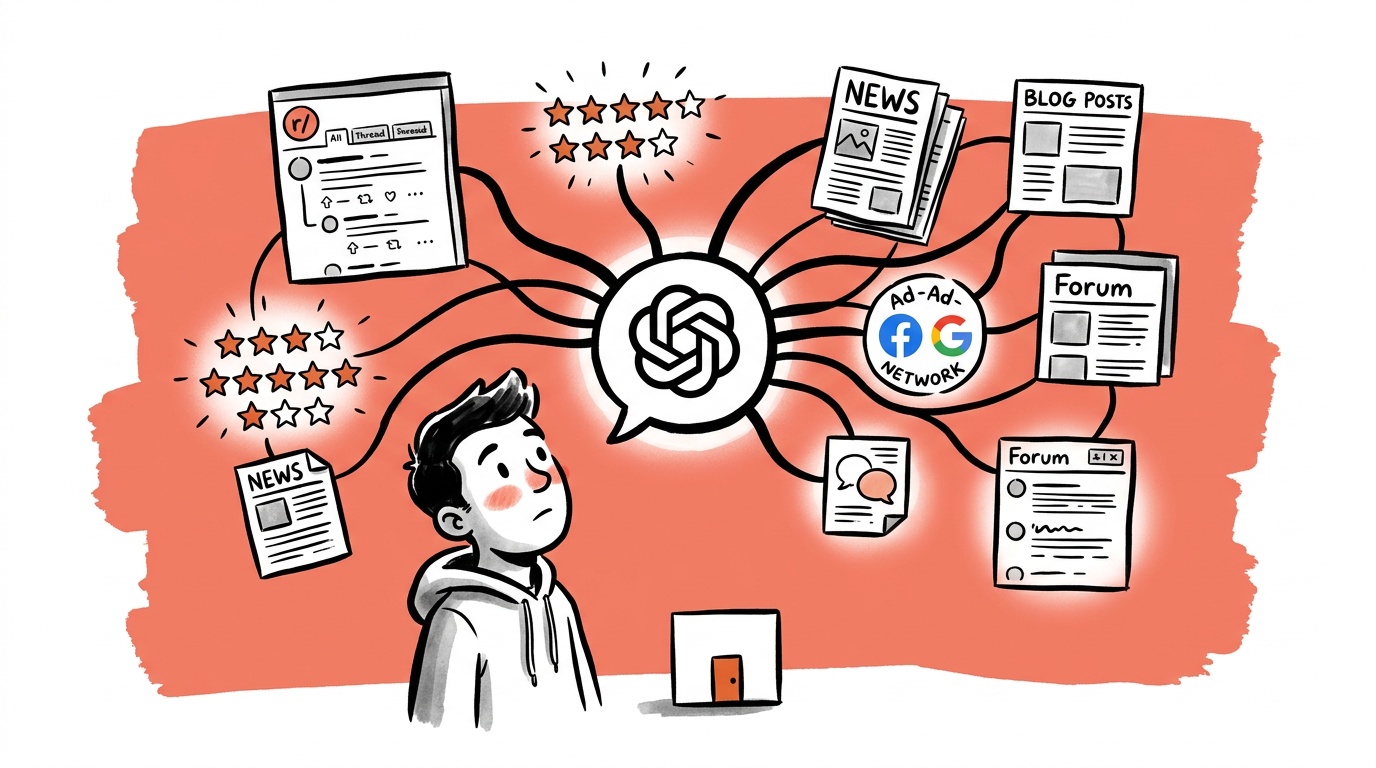
Most founders approach ChatGPT visibility the same way they approached Google SEO in 2004: by optimizing their own website. That is the wrong surface. ChatGPT doesn't read your homepage and decide you're trustworthy. It synthesizes what everyone else has written about you — review sites, trade publications, Reddit threads, comparison articles — and if that third-party corpus is thin, your homepage can be immaculate and you'll still be invisible.
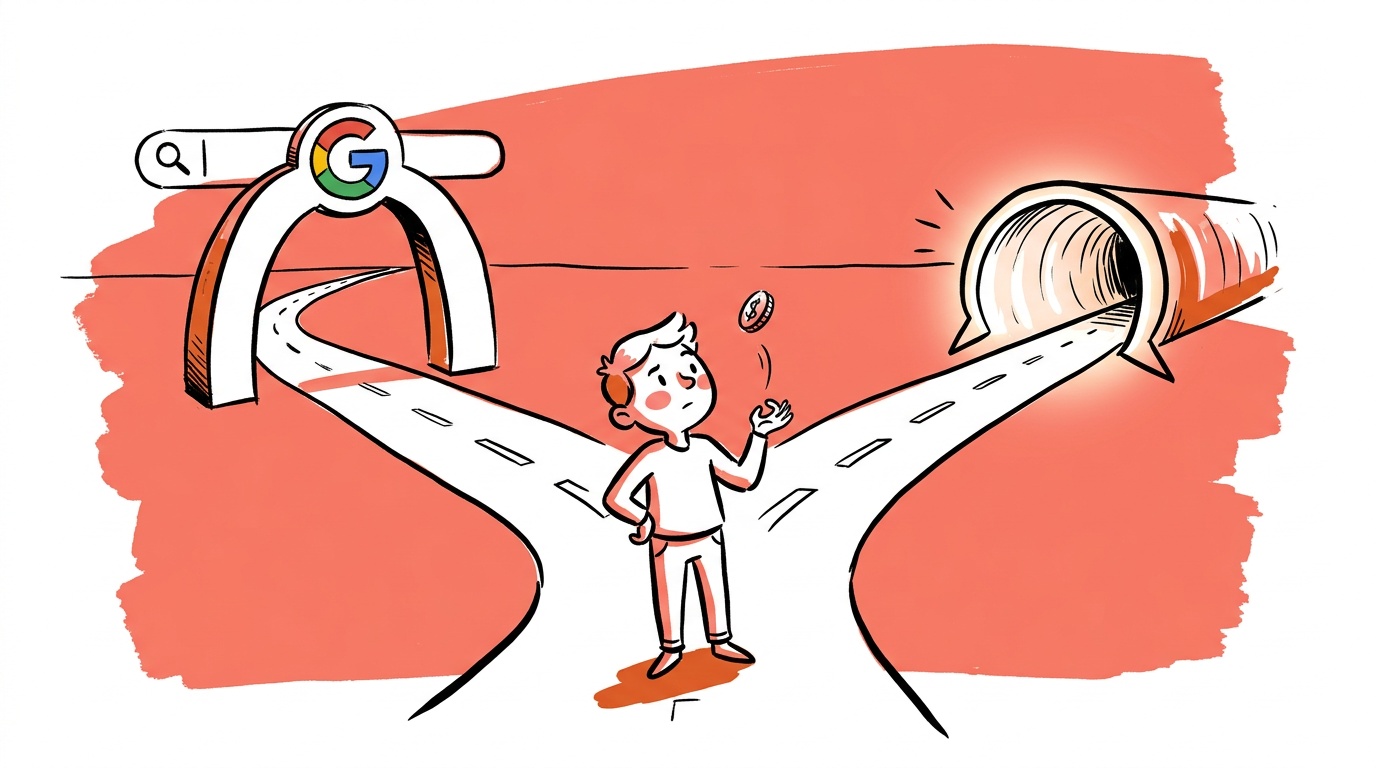
That asymmetry is the thing most guides miss. Your AI visibility is almost entirely determined by your reputation's footprint across sources you don't control. Which means getting ChatGPT to recommend your business is a two-front operation: building the organic citation surface that earns you a mention, and using paid placements to stay visible while that surface matures.
TL;DR — How to Get ChatGPT to Recommend Your Business
- ChatGPT recommendations draw on third-party sources (reviews, press, citations) more than your own site — your owned content is table stakes, not the differentiator.
- OpenAI offers paid placements inside ChatGPT; they create guaranteed impressions but don't substitute for organic AI credibility.
- Generative Engine Optimization (GEO) is the discipline of making your business citable: structured data, authoritative mentions, and answer-shaped content.
- Ads accelerate short-term visibility; GEO compounds over months as citations propagate through the web.
- The fastest path to a ChatGPT recommendation is running both in parallel — ads drive traffic while you build the citation foundation that earns organic mentions.
Why ChatGPT Cites What Others Say About You
Large language models are trained on a snapshot of the web, then continuously updated via retrieval (browsing, Bing integration, real-time search). When someone asks ChatGPT to recommend a project management tool, an accountant, or a dog food brand, the model surfaces entities that appear confidently and consistently across high-authority sources.
Three signals matter most:
Mention frequency across independent sources. If your business appears in ten different review roundups, two Reddit threads, and a trade publication feature, that pattern of independent agreement raises your entity's signal strength. One perfectly written case study on your own domain does almost nothing by comparison.
Specificity of claims made about you. Vague praise ("great service") is hard for a model to act on. Specific, factual claims — the exact problem you solve, the category you operate in, the type of customer you serve — are what get retrieved and quoted. This is why FAQ-style content and structured comparison articles get cited at a disproportionate rate: they're already answer-shaped.
Source authority. A mention in a publication that itself gets cited frequently carries more weight than a mention in an obscure directory. The web's existing authority graph shapes the model's confidence, which is why a single piece of coverage in a genuinely authoritative outlet can outperform dozens of low-signal mentions.
When ChatGPT cites a source, that source gets traffic. When it gets traffic, it often earns more links. When it earns more links, its future mentions of your business carry more authority in the model's retrieval layer. Your GEO strategy isn't just about today's AI responses — it's about positioning your citations inside sources that will compound in authority over time.
What ChatGPT Ads Actually Do (and Don't Do)
OpenAI offers paid placements inside ChatGPT (we cover access, formats and targeting in how to advertise on ChatGPT). The mechanics continue to evolve, but the basic premise is that advertisers can bid to appear in relevant conversations — surfaced as sponsored results, product cards, or contextually recommended links depending on the query type.
What paid placements do well:
- Guaranteed impressions for high-intent queries. If someone asks ChatGPT to recommend accounting software and you're bidding on that category, you can appear even if your organic citation footprint is thin.
- Speed. GEO takes months. An ad account can be live this week.
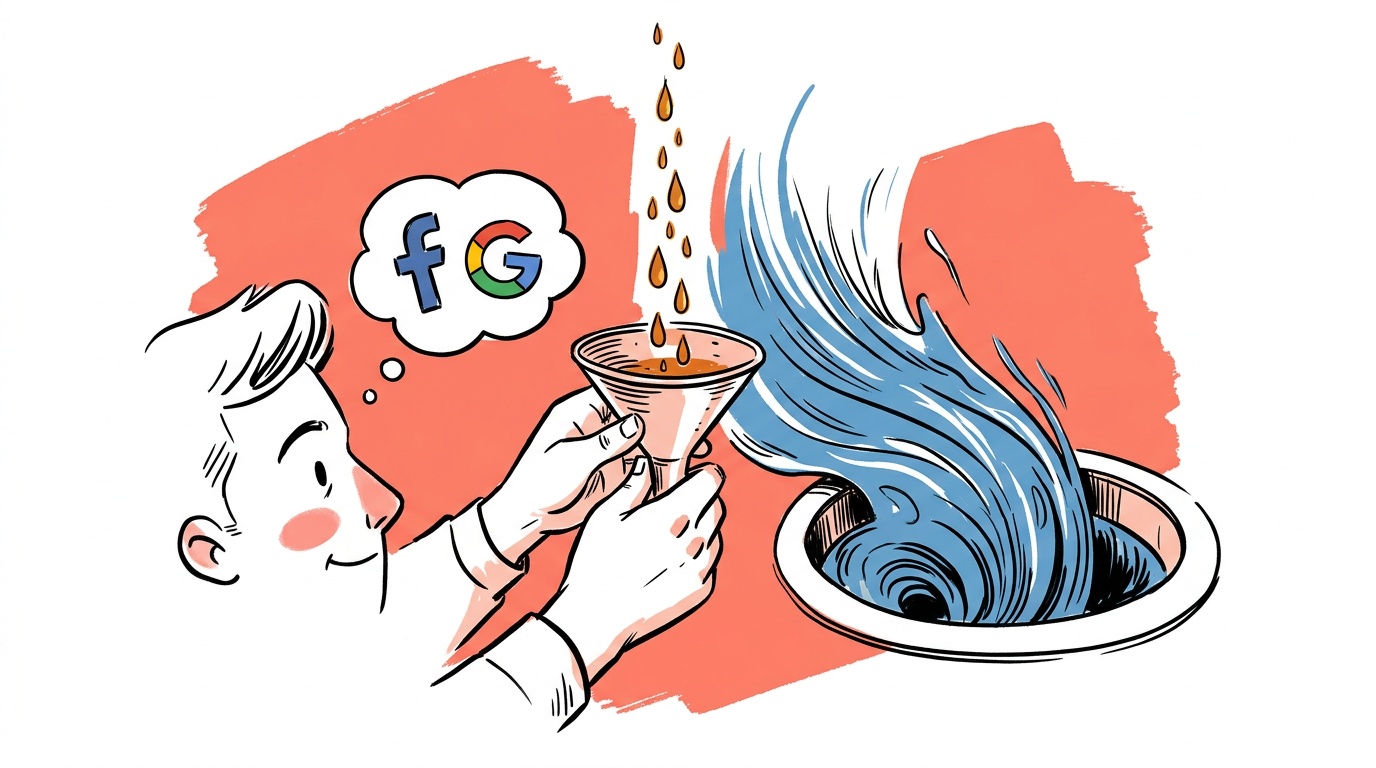
- Traffic for retargeting. ChatGPT referral traffic that converts becomes an audience you can retarget across Meta, Google, and other platforms.
What paid placements don't do:
- Build trust. ChatGPT users skew technically sophisticated. Many will note a sponsored tag and make an independent judgment. The ad gets the click; your product, reviews, and third-party reputation close the deal.
- Substitute for organic mentions. If someone asks a follow-up question — "Is [your business] actually any good?" — the model's answer draws on organic sources, not your ad spend. A thin citation surface will undercut your paid placement at exactly the wrong moment.
The honest framing: ads are a volume lever. GEO is a trust lever. You need both, and they operate on different timelines.
The GEO Citation Playbook: What Makes a Business Recommendable
GEO (Generative Engine Optimization) is the practice of structuring your presence so AI systems can confidently retrieve and cite you. The work splits into two layers: owned content that's answer-shaped, and third-party citations that the model can independently verify.
Target source types — and what to do with each
Here are the source categories that consistently appear in AI-generated recommendations, ranked roughly by authority signal:
Wikipedia / Wikidata. The single highest-authority mention most businesses can earn. If your company meets Wikipedia's notability guidelines, a well-sourced article there will likely become your most-cited entity definition. Even without a full article, adding your business to Wikidata with correct category, founding date, and product type helps models parse your entity cleanly. Check the Wikidata property documentation for the right fields.
Tier-1 trade publications. A feature or roundup inclusion in a publication your customers already read outperforms a dozen directory listings. Pitch with a specific angle tied to a question your customers actually ask — editors at trade outlets increasingly write "best tools for X" content that models cite heavily. Identify the three or four publications dominant in your category and treat placement there as a primary goal.
G2, Capterra, Trustpilot, and vertical equivalents. Aggregate review platforms are a primary signal for commercial queries. Getting listed isn't enough — you need enough reviews with specific, factual language (not just star ratings) to give the model something to retrieve. Ask customers explicitly to describe the problem you solved and how, not just to leave a rating.
Reddit. Models treat Reddit as a source of authentic, community-validated opinion. Honest mentions of your product in relevant subreddits — from real users or from your team being transparently helpful — create citation surface in a high-weight source. Spam or obviously promotional posts tend to generate negative sentiment that also gets retrieved, so the bar here is genuine participation, not broadcast.
Comparison and "best of" articles on independent blogs. These are often the exact format models quote most directly. If a respected blogger in your space writes "the five best tools for X" and you're on the list with a specific description, that one article can drive AI mentions for a long time. Identify who writes these in your category and build a relationship before you need the coverage.
Google Business Profile, Yelp, and data aggregators. Low-glamour but foundational. These define how models parse your entity's basic facts — address, category, hours, founding information. Inconsistencies here create ambiguity that suppresses citation confidence. Get them right and keep them consistent.
Your own site — FAQ pages, comparison content, structured data. Owned content contributes to your entity definition. Write FAQ sections with real questions and specific answers, not marketing paragraphs. Publish honest comparison content. Use Schema.org structured data markup on your product and service pages so crawlers can parse your entity cleanly — the Schema.org documentation is the canonical reference. Write a clear, factual "what we do and who we serve" statement above the fold on your homepage. Models need a clean entity definition to cite you confidently.
Verify you're being retrieved — before assuming you're not
Every few weeks, ask ChatGPT, Perplexity, and similar tools the same queries your customers would type. Note three things: whether you're mentioned, which sources are cited alongside your name, and what specific language is used to describe you. That language is what the model has retrieved and trusts — it tells you exactly which sources are working and which descriptions are sticking.
If you're not appearing, look at what sources are cited for competitors. Those are your target publications. If you are appearing but the description is wrong, find where that wrong description lives in the wild and correct it at the source.
Consistent entity definition across all surfaces
Models get confused when your business name, category, and value proposition are inconsistent across sources. "We help teams ship faster" on your homepage, "AI-powered DevOps platform" on G2, and "project management for startups" on Product Hunt creates ambiguity. Ambiguous entities get cited less confidently. Pick a canonical description and propagate it everywhere.

Live today.
The full campaign — copy, images, targeting — generated for your site and deployed paused for your approval.
How to Use Ads While GEO Compounds
The practical sequencing looks like this:
Weeks 1–4: Run paid placements to drive traffic while your GEO foundation is being built. Use this traffic to identify which queries convert. Feed that query data back into your content plan — if a particular question type drives sign-ups, write dedicated answer content for it and pursue citations in that specific context.
Months 2–4: Pursue earned coverage aggressively. One feature in a relevant trade outlet can do more for your AI citation surface than months of on-site content work. Press and PR aren't dead — they're more important than they've been in years, because the publications you get cited in are both training data and active retrieval sources.
Month 4 onward: Your citation surface starts to compound. New mentions cite old mentions. Authority propagates. At this point, you may find organic AI mentions start driving meaningful traffic even on queries where you're not running paid placements.
The ads don't stop mattering — but their role shifts. Early on, they're your primary visibility mechanism. Later, they're a supplement that covers high-value queries while organic handles the long tail.
Users who arrive via a ChatGPT recommendation and don't convert immediately are a high-intent audience — they were actively seeking a recommendation, not passively scrolling. Retargeting them on Meta or Google at a higher bid multiplier often outperforms cold audience campaigns. Tag the traffic source and create a dedicated retargeting segment.
Measurement: How to Know If It's Working
AI-driven visibility is genuinely hard to measure right now. A few approaches that actually work:
Track referral traffic from ChatGPT directly. OpenAI sends referral traffic with a recognizable source; segment it in GA4 or your analytics platform. Watch for growth in this channel independent of your paid spend.
Run brand query monitoring. Set up Google Search Console tracking for branded queries and watch for acceleration. AI mentions frequently produce downstream branded search as users verify recommendations on Google after receiving them from ChatGPT.
Ask your customers. In your post-sign-up survey or onboarding call, ask where they first heard about you. "ChatGPT / an AI tool" is now a real answer category that many businesses aren't capturing yet.
Manual AI audits. Use the verification approach described above — same queries, recurring cadence, logged results. This is qualitative, but it's the ground truth for whether your citation playbook is working.
For a deeper look at structuring your content for AI retrieval, our GEO checklist for 2026 covers the technical layer in detail. And if you're building the third-party mention strategy, our guide on why AI isn't citing your brand covers the mention-building side.
The One Thing Founders Get Wrong
They treat GEO as a website project. They hire an SEO agency, rewrite their meta descriptions, add schema markup, and then wonder why ChatGPT still isn't recommending them six months later.
GEO is fundamentally a reputation project with a technical layer on top. The schema markup matters. The structured content matters. But none of it moves the needle if the third-party citation surface is empty.
The businesses that appear most often in AI recommendations aren't always the best products. They're the products with the most confident, consistent, specific presence across sources the models trust. That's an achievable position — but it requires treating your business's external reputation as a managed asset, not a byproduct of doing good work.
FAQ
How long does it take to get ChatGPT to recommend my business?
It varies significantly by category and competitive density. If your industry already has thin AI coverage, you might appear in recommendations within a few months of focused GEO work. In saturated categories, it can take longer. Paid placements can produce visibility immediately; organic AI mentions typically take several months to establish and several more to compound.
Does having a good website help ChatGPT recommend me?
Partially. Your website contributes to your entity definition — structured data, clear descriptions, and FAQ content are all retrievable. But the majority of the signal that drives AI recommendations comes from third-party sources: reviews, press, comparison sites, and community mentions. A great website with no third-party presence will still produce weak AI visibility.
What's the difference between SEO and GEO?
Traditional SEO optimizes your content to rank in Google's blue links. GEO optimizes your entire presence — owned and third-party — to be cited in AI-generated answers. GEO cares more about entity clarity, citation patterns, and third-party source authority. Many SEO tactics still apply (structured data, clear content, page authority), but GEO adds a layer of reputation management and earned coverage that traditional SEO largely ignored.
Can I pay to appear in ChatGPT recommendations?
Yes, through OpenAI's paid placement products. Sponsored placements can appear in relevant conversations. However, paid visibility and organic AI credibility are separate things — an ad can get you a click, but if the follow-up question is "is this company trustworthy?", the model answers from organic sources. You need both.
How does Reddit affect whether ChatGPT recommends my business?
More than most founders expect. Reddit functions as a source of authentic, community-validated opinion in model training and retrieval. Honest mentions of your product in relevant subreddits — from real users or from your team being transparently helpful — create citation surface in a high-weight source. Spam or obviously promotional posts tend to generate negative sentiment that also gets retrieved.
What's the fastest single action I can take to improve AI visibility?
Get a single, authoritative, third-party source to publish a specific, factual description of your business in the context of a relevant question. A feature in a trade publication, a "best tools for X" roundup inclusion, or a detailed third-party review on a major platform will move the needle faster than any amount of on-site optimization.
Do ChatGPT ads work the same way as Google Ads?
The targeting and bidding mechanics differ, and the user context is distinct — ChatGPT users are mid-conversation with a specific intent, not scanning a search results page. The principles of match-to-intent are similar, but the creative requirements are different: concise, specific, and clearly relevant to the conversational context. This ad format will keep evolving as OpenAI iterates on the product.
Live today.
The full campaign — copy, images, targeting — generated for your site and deployed paused for your approval.
We build AdControlCenter — AI-powered ad management for small businesses, online stores, SaaS companies and service providers. We write what we'd want to read: real numbers, no fluff, the things we wish we'd known when we started.
More from the team →