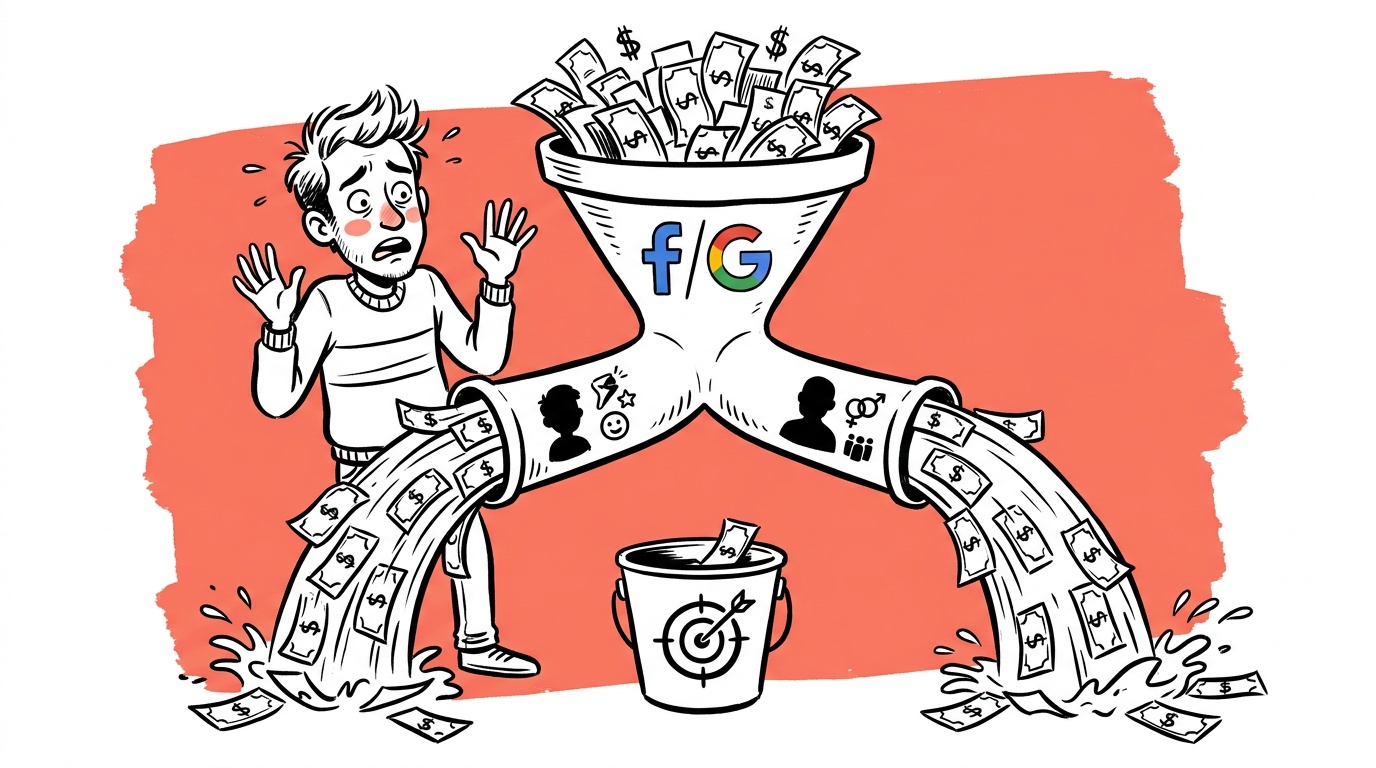


When you break campaign performance down by age band, a pattern shows up repeatedly: a product clearly built for one generation running its highest spend against a completely different one. The account looks fine at the top level. ROAS is acceptable. But the demographics report tells a different story — budget drifting toward cheap clicks rather than real buyers, because the algorithm was given too much room to decide who matters.
The generational targeting conversation usually gets buried under lifestyle stereotypes. The real problem is structural: Gen Z and Boomers make purchase decisions through different channels, respond to different creative signals, and have fundamentally different relationships with trust. Collapsing them into one "adults 18–65" bucket doesn't just underperform — it actively suppresses the segments that would have converted.
TL;DR — What this post answers
- Gen Z and Boomers require different channel mixes, not just different copy
- Platform algorithm defaults push spend toward cheap clicks, not high-intent demographics
- Age-band segmentation in your campaign structure is the fastest diagnostic tool available
- Creative format mismatches — video length, social proof type — account for a large share of cross-generational waste
- A/B testing by age cohort, not just by creative, surfaces the real cost of audience mismatch
The Algorithm Doesn't Know Who Should Buy Your Product
Platforms optimize for the objective you set. If you set "link clicks," you get cheap clickers. If you set "purchases," you get whoever in your audience has historically converted on similar products — which sounds good, until you realize that historical signal is built from the entire ad ecosystem, not your specific product category.
What this means in practice: a broad age target of 18-to-65 on Meta will almost always skew spend toward the cohort that clicks cheapest or converts fastest on superficially similar offers. For many product categories, that's a demographic mismatch from day one. The algorithm isn't malicious. It's optimizing for a proxy metric that doesn't perfectly represent your buyer.
A campaign optimized for "purchases" on a broad demographic doesn't mean you're reaching your best customers — it means you're reaching whoever bought something vaguely similar most recently. That cohort may be the wrong generation entirely.
The fix isn't to turn off algorithmic optimization. It's to scope the audience tightly enough that the algorithm operates within the right demographic pool before it starts optimizing. The same logic applies to spending-state signals — see targeting budget-conscious buyers. You give it less room to be wrong.
What Actually Differs Between Gen Z and Boomer Buyers
Forget the cultural shorthand. The differences that matter for ad spend are mechanical.
Trust signals are structurally different. Boomers were raised on brand authority — a well-known logo, a professional voiceover, television-style production signals legitimacy. Gen Z is suspicious of exactly that aesthetic. Polished production reads as "ad," and "ad" reads as "skip." What builds trust for Gen Z is peer validation: real user reactions, unedited testimonials, creators who seem like genuine customers rather than paid spokespeople.
Channel behavior is different, not just preference. Boomers are heavy Facebook users. Gen Z's time on Facebook is minimal compared to TikTok, YouTube Shorts, and Instagram Reels. This isn't a preference — it's where attention physically lives. Running your Gen Z acquisition campaign heavy on Facebook Feed placements is spending money in a room most of your target audience isn't in.
Purchase cycle length differs. A large share of Boomer purchasing behavior involves a longer consideration phase — research, comparison, return visits before converting. Gen Z conversion patterns, particularly for lower-ticket items, can be faster but require the initial creative to do more heavy lifting. The implication: retargeting strategy, window length, and message sequencing need to be different for each cohort.
Video consumption patterns diverge sharply. Traditional-format ads — 30-second pre-rolls with a slow build — perform differently across generations. Shorter, faster-cut creative with the value proposition front-loaded tends to perform better with younger audiences. Longer-form content that builds context and credibility often works better with older demographics. This is a consistent pattern in how platforms report engagement by age band, and it shows up clearly when you split creative tests by cohort.
What About Millennials and Gen X?
Worth naming: Millennials and Gen X often sit between these poles and respond to hybrid signals. Millennial buyers, depending on category, can skew toward either peer-validation creative or authority-signal creative depending on price point and category familiarity. Gen X often mirrors Boomer patterns in channel behavior but tolerates faster creative pacing. If your product has genuine cross-generational appeal, these middle cohorts are worth testing as a bridge — but they still need their own age-banded campaigns to measure cleanly, not a default slot in a broad campaign.
How to Diagnose Whether You Have a Generational Targeting Problem
Before you restructure anything, you need to know whether this is actually your problem. Here's the exact diagnostic we run on new accounts.
Step 1: Pull age-band breakdowns on your last 90 days of spend. Most platforms surface this in the demographics report. Look at cost-per-result by age band, not just impressions. Impressions tell you where the algorithm went. Cost-per-result tells you where it worked.
Step 2: Compare your age-band spend distribution against your actual customer data. Pull your real buyers from your CRM or Shopify — what age range do they cluster in? Now compare that to where your ad spend went. A gap between those two distributions is money that left with no return.
Step 3: Check your creative-to-audience match. If your best-performing creative is a fast-cut UGC video and your highest-spend age band is 55-to-64, you have a structural mismatch. The creative is right for one audience; the spend is going to a different one.

Live today.
The full campaign — copy, images, targeting — generated for your site and deployed paused for your approval.
Structuring Campaigns to Actually Segment by Generation
The structural solution is simple but requires discipline: separate campaigns or separate ad sets with age targeting locked, not layered on as an afterthought.
Don't rely on exclusions inside a broad campaign. Excluding 55+ from a broad campaign still gives the algorithm room to drift. Create discrete ad sets with hard age floors and ceilings instead.
Match creative to segment at the campaign level. Gen Z ad sets should carry creative built for Gen Z consumption patterns: short-form, peer-voice, platform-native. Boomer ad sets should carry creative that signals authority and gives the detail-oriented buyer what they need to feel confident.
Set separate budgets per segment. If you blend budget across a multi-age campaign, the algorithm will shift spend wherever cost-per-click is lowest — which defeats the purpose of segmentation entirely. Fixed budgets per segment let you measure real performance before the algorithm cannibalizes one cohort's budget for another's short-term efficiency gains.
Use CBO carefully. Campaign Budget Optimization is designed to find efficiency across ad sets, which means it will pull budget from a Gen Z ad set that's still learning toward a Boomer ad set that's already optimized — even if the Gen Z segment has better long-term LTV for your product. In early-stage segmentation testing, Ad Set Budget Optimization gives you cleaner data and keeps each cohort honest. (CBO vs. ABO on Meta goes deeper on when each makes sense.)
Platform Choice Is a Targeting Decision
Where you run the campaign is as important as how you set the audience parameters. This is where many founders make an expensive mistake by treating platform selection as an afterthought.
If your buyer skews Boomer, Facebook remains one of the most cost-efficient channels. The user base is large, engagement is high, and the ad formats — longer text, link posts, video in the feed — match Boomer consumption patterns in a way that short-form native content doesn't.
If your buyer is Gen Z, TikTok and YouTube Shorts are where the attention is. The ad formats that work on those platforms are faster, more native-feeling, and punish anything that looks like a traditional ad within the first two seconds. Running your Facebook creative on TikTok isn't just inefficient — it actively damages brand perception with that audience.
Choosing Facebook over TikTok as your primary channel is a demographic choice, whether you intend it that way or not. The platform's user base skews your reach before you set a single targeting parameter. Match the platform to the generation first, then layer audience targeting on top.
YouTube proper — not Shorts — performs well across both demographics when the creative respects format. Longer pre-rolls with strong hooks work for Boomers doing research. Skippable formats with front-loaded value work for Gen Z. The same platform, used differently, can serve both segments, but it requires separate creative, not separate placements of the same asset.
The Creative Mistakes That Make Demographic Targeting Irrelevant
You can have perfect demographic targeting and still burn the budget if the creative signals the wrong thing to the right person.
Mistake 1: Using Boomer-coded production values in Gen Z placements. High production quality, professional voiceover, clean studio backgrounds — these signal "TV ad" to a Gen Z viewer. That's a trust killer. They expect content that looks like it could have come from a creator they follow.
Mistake 2: Using Gen Z format conventions in Boomer-targeted ads. Nothing kills credibility with an older buyer faster than creative that feels like it's trying too hard to seem young. Boomers want authority, specificity, and reassurance — not a trending audio track.
Mistake 3: Identical CTAs across segments. "Shop now" hits differently depending on where a buyer is in their consideration cycle. Gen Z — particularly for higher-ticket items — may need a softer CTA ("see how it works," "watch the full review") before they're ready to convert. Boomers, once trust is established, often respond well to direct, time-bound offers.
Mistake 4: Same video length for both audiences. Short-form video — under 30 seconds — with immediate value communication performs better with younger audiences at the awareness stage. Longer-form content, one to two minutes, works better for older audiences who want full context before clicking. Forcing one length across both segments means you're creating the wrong experience for at least one of them. Meta creative hooks, formats and testing covers how to structure those format tests.
A Practical Prioritization Framework
If you're resource-constrained — which most founders are — you can't run fully separate creative suites for every generation simultaneously. Here's how to sequence it.
First: Run the diagnostic. Pull your age-band cost-per-result data and compare it to your actual customer age distribution. Identify your biggest mismatch.
Second: Fix the structural problem before the creative problem. If you're spending heavily on an age band that doesn't convert, no amount of creative testing will fix it. Lock down your targeting first.
Third: Prioritize creative development for your highest-LTV segment. If your best buyers are 45-to-60 and you've been running Gen Z-style creative, that's your first production investment.
Fourth: Test generational-specific creative in isolation. Don't mix your new Boomer-focused creative into the same campaign as your Gen Z creative. Keep the experiments clean so you know what's actually working.
Fifth: Let the data tell you whether cross-generational campaigns make sense for your product. Some products genuinely perform across a wide age range — but confirm that with evidence, not assumption.
FAQ
What is an audience targeting strategy in paid ads? An audience targeting strategy is the set of decisions that determines who sees your ads — including demographic parameters like age, behavioral signals, interest categories, and platform selection. A good strategy aligns these parameters with your actual customer data rather than relying on platform defaults.
Should I target Gen Z and Boomers in the same campaign? Generally no, at least not until you have data showing they convert comparably on your product. Running them in the same campaign allows algorithm optimization to cannibalize budget from one cohort to serve the other. Separate campaigns with separate budgets give you cleaner signal.
Which platforms work best for targeting Boomers? Facebook remains one of the most effective platforms for reaching older demographics. Its user base skews older than TikTok or Instagram Reels, and the ad formats — longer text, link posts, video in the feed — match Boomer consumption patterns better than short-form native content.
Which platforms work best for targeting Gen Z? TikTok, YouTube Shorts, and Instagram Reels are where Gen Z attention is concentrated. The critical detail is that the creative must match platform conventions — fast-cut, creator-voiced, and front-loaded with value. Repurposing traditional ad creative onto these platforms typically underperforms.
How do I know if I'm wasting budget on the wrong demographic? Pull age-band cost-per-result from your platform's demographics report, then compare the spend distribution to your real buyer age data from your CRM or e-commerce backend. If the two distributions don't match, that gap is your targeting tax.
How does creative format affect demographic performance? Significantly. Short-form video with immediate value communication performs better with younger audiences. Longer-form content with a credibility-building arc tends to perform better with older audiences. Using the wrong format for the right demographic is almost as expensive as reaching the wrong demographic entirely.
What's the fastest fix if I suspect generational targeting waste? Segment your existing campaigns by age band using hard floors and ceilings — not just exclusions — assign fixed budgets to each segment, and run your current creative against each for two to three weeks. The cost-per-result data will tell you immediately which segments are working and which are burning money.
The fastest thing you can do this week is open your demographics report, sort by age band, and check whether the distribution of your spend matches the distribution of your actual buyers. If it doesn't, you have your answer — and the fix is structural, not creative.
Live today.
The full campaign — copy, images, targeting — generated for your site and deployed paused for your approval.

We build AdControlCenter — AI-powered ad management for small businesses, online stores, SaaS companies and service providers. We write what we'd want to read: real numbers, no fluff, the things we wish we'd known when we started.
More from the team →