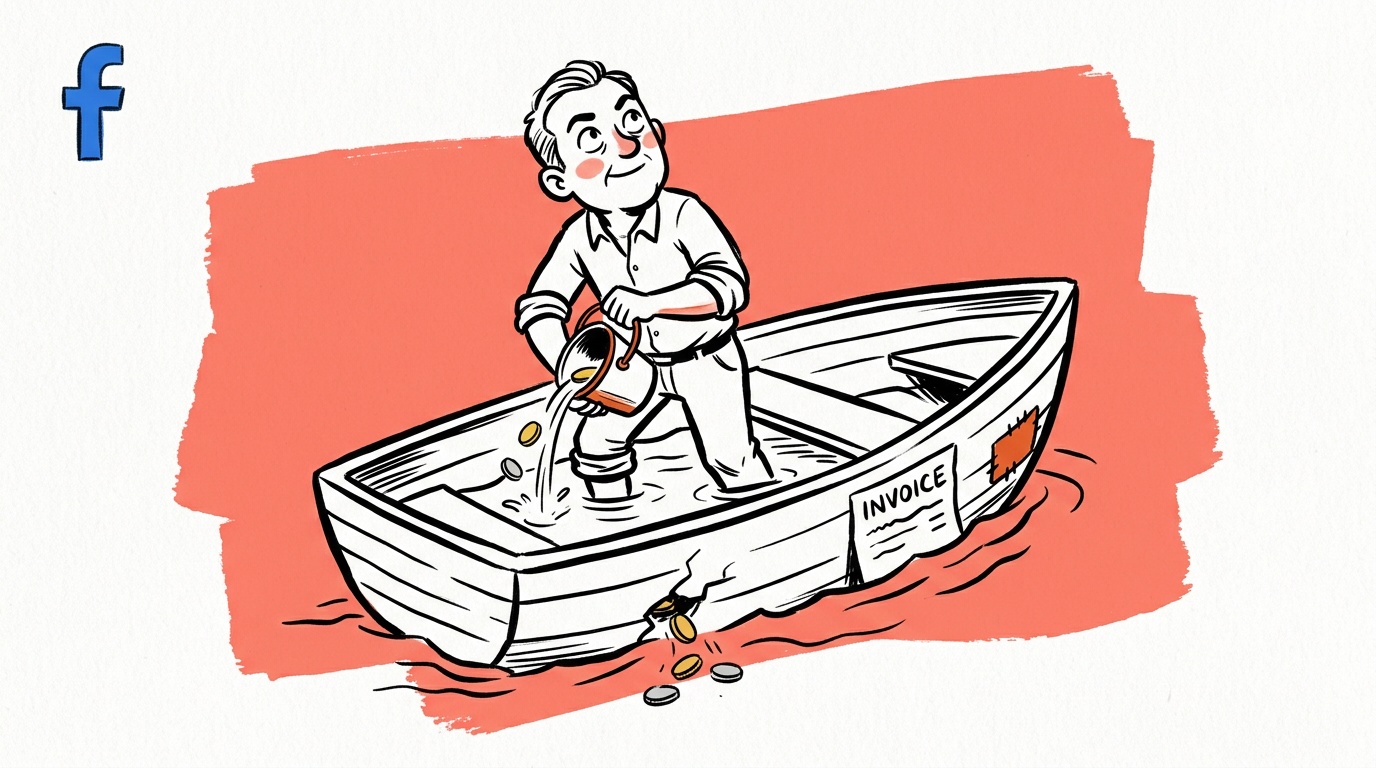


Monthly invoicing sounds like a gift. One clean bill at the end of the month instead of a dozen auto-charges scattered across your statement. Founders asked for it. Agencies lobbied for it. Meta shipped it. And then margins started disappearing.
That's the thread running through two separate pain points we've been tracking in the r/PPC community: a discussion about Meta's move to monthly invoicing destroying agency cash flow and a parallel thread about EU founders struggling to account for purchased Business Managers. These are not the same problem, but they share the same root: Meta's billing infrastructure was built for Meta's convenience, not yours.
TL;DR — Meta Ads Billing and Financial Ops
- Meta's monthly invoicing cycle shifts float risk entirely onto agencies and founders, especially when clients pay on net-30 or net-60 terms.
- EU businesses buying or managing Business Managers face a genuine accounting grey zone: Meta issues invoices from Ireland, VAT treatment varies by transaction type, and many accountants have never seen this scenario before.
- The threshold at which Meta switches an account to monthly invoicing is not publicly documented and appears to vary — which means you often don't know you're on monthly billing until the first large invoice lands.
- Prepaid billing (manual payments) is still available on Meta and restores cash-flow control at the cost of operational friction.
- The cleanest fix for EU accounting on purchased BMs is to treat them as intangible asset acquisitions and get a proper VAT invoice from the seller — Meta's own invoice won't cover you.
How Monthly Invoicing Breaks Agency Cash Flow
The mechanics are simple and brutal. Under threshold-based auto-charge billing, Meta charges your card every time spend crosses a payment threshold — sometimes daily for high-volume accounts. Under monthly invoicing, Meta consolidates all spend for the calendar month and issues a single invoice, typically due within a short window after month end.
For a founder running their own ads, that's fine. For an agency billing clients on net-30 terms, that's a float gap measured in tens of thousands of dollars per client. You've already spent the money on Meta. Your client hasn't paid you yet. You are, functionally, a short-term lender to your own clients.
The r/PPC thread on this is blunt: agencies report that after Meta moved their accounts to monthly invoicing, effective margin on media buying compressed immediately — not because fees changed, but because the cost of carrying that receivable increased.
To make that concrete: if you're running $100,000 per month in client spend across ten accounts, with clients on net-30 terms and your own cost of capital at 8% annually, the float cost of a single billing cycle is roughly $667. Across a year, that's over $8,000 in real financing cost that never shows up in your fee structure. At $200,000 per month in spend, double it. The number isn't dramatic until you add it up.
Billing Method Comparison
The three billing modes behave very differently in practice:
| Billing method | Who bears float | Typical payment timing | Key control required |
|---|---|---|---|
| Threshold (auto-charge) | Meta bears none; you pay at trigger | Immediately on threshold hit | Card with headroom; watch limits |
| Monthly invoicing | You bear full month's float | Invoice issued after month end, short due window | Receivables timed to billing cycle |
| Prepaid (manual) | You prepay; Meta bears none | Before spend occurs | Balance monitoring to prevent pauses |
The table makes the float direction obvious: threshold and prepaid put you in control of timing; monthly invoicing does not.
Meta doesn't publish the exact spend level at which accounts move from threshold billing to monthly invoicing. Community reports suggest it happens somewhere above a few thousand dollars per month in spend, but accounts have reportedly been moved without notice. If you're an agency, audit every account's billing settings now — not when the invoice lands.
The Prepaid Escape Hatch (And Why Most People Ignore It)
Meta still offers manual payments — you top up an account balance and ads run against that balance. It solves the float problem completely. You control exactly when money leaves your bank account, there are no surprise end-of-month invoices, and you can set the balance size to match your operational rhythm.
The reasons agencies avoid it are real but mostly surmountable:
Operational friction. Someone has to remember to top up the balance. If it hits zero, campaigns pause. That's a genuine risk for a busy team. (A zero balance is also one of the silent causes of ads that are live but not spending.)
No credit terms. You're paying before you spend, not after. For cash-constrained accounts, that's a problem.
Account-level management. You can't do a single top-up across all client accounts. Each one requires its own manual payment.
None of these are fatal. Automated balance monitoring catches low-balance situations before campaigns pause — it's something we've built directly into our product. A payment failure has a second, nastier cost: Meta's fraud systems can read a declined charge as a risk signal and restrict the account itself — the billing-flag scenario we cover in our Meta account recovery playbook. And if the alternative is carrying a large monthly receivable at zero interest, the operational friction of prepaid billing is cheap.
EU Accounting for Purchased Business Managers: A Genuine Grey Zone
This is the messier problem, and the one that's going to surprise the most EU-based founders reading this.
When you buy a Business Manager — whether from a marketplace, a broker, or another business — you are acquiring an intangible asset. You're not buying ad spend. You're not paying a service fee. You're buying an entity that has history, trust signals, and potentially higher spend limits with Meta. That transaction has accounting and tax implications that most bookkeepers and even many accountants haven't dealt with before.
The r/PPC thread on this surfaces the core issue: EU businesses purchasing BMs are often receiving informal invoices (or no invoice at all) from sellers, and then trying to expense the purchase as an operational cost when it should likely be capitalized as an intangible asset. The VAT treatment is also unclear — if the seller is in a different EU member state, reverse-charge rules may apply. If the seller is outside the EU, different rules again.
What a Clean Transaction Looks Like
If you're buying a BM in the EU, here's what you should insist on:
-
A proper VAT invoice from the seller, with their VAT registration number, your VAT registration number, a clear description of what's being sold (rights to a Meta Business Manager account, not "consulting services"), and the correct VAT treatment applied.
-
A written transfer agreement that establishes the date of transfer, the price, and any conditions. This is your evidence if your tax authority asks why you capitalized this asset.
-
Capitalization as an intangible asset, not an immediate expense, unless the amount is below your country's materiality threshold. Your accountant should confirm the threshold and the amortization schedule —, but this varies.
What you will not get from Meta is any documentation of the transfer. Meta's Terms of Service formally prohibit the sale of Business Managers, which means Meta will not issue a document acknowledging that a transfer occurred. That's the accountant's core problem: you've paid real money for a real asset, and the platform that hosts it won't acknowledge the transaction.
Meta prohibiting BM sales doesn't make the accounting go away. Your tax authority doesn't operate under Meta's Terms of Service — it cares whether you paid money, received something of value, and reported it correctly. Get the documentation from the seller, not from Meta.

Live today.
The full campaign — copy, images, targeting — generated for your site and deployed paused for your approval.
VAT on Meta Ad Spend Itself: Ireland, Reverse Charge, and the Invoice You Actually Need
Separate from the BM purchase issue, EU businesses regularly get confused about the VAT treatment on Meta ad spend. Meta's European operations bill through Meta Platforms Ireland Limited. For B2B transactions (a business buying ads), this is a cross-border service supply and reverse charge should apply — meaning you report and recover the VAT yourself rather than Meta charging it to you.
Meta does issue VAT invoices for ad spend, but they're only useful if you've correctly set up your billing account with your VAT number. If you haven't done that, Meta may issue invoices without your VAT number, which can complicate recovery. The fix is straightforward: go to your Meta Business account billing settings, find the business information section, and enter your VAT registration number. Meta will then apply it to future invoices.
The invoices you've already received without your VAT number are harder. In some EU jurisdictions, you can request corrected invoices from Meta; in others, your accountant may be able to document the reverse-charge treatment without a corrected invoice. The European Commission's VAT rules for digital services are the authoritative starting point.
Reconciling Meta's Invoices Against Actual Spend
Monthly invoices create a second operational problem beyond cash flow: reconciliation. When Meta was charging your card at threshold intervals, each charge corresponded roughly to a discrete period of spend. With a monthly invoice, you're reconciling 28–31 days of spend across potentially dozens of campaigns, ad accounts, and clients against a single line item.
Meta's billing reports (downloadable from the billing section of Business Manager) are the tool here. You can export transaction-level detail that shows spend by campaign, date, and ad account. The problem is that this report is not the invoice — it's supporting detail. Your accounting system needs both: the invoice as the payable record, and the transaction report as the backup.
For agencies managing multiple client accounts under a single billing account, this creates a cost-allocation problem. You need to slice the transaction report by client, verify it against the invoice total, and then allocate the cost. This is exactly the kind of work that should be automated, and currently isn't, by Meta's native tools.
The Meta Business Help Center documentation on billing covers the basics of downloading billing reports, but it doesn't address multi-client reconciliation at all. That gap is real and it's where a lot of agency hours disappear every month.
What We're Doing About It
We built AdControlCenter partly because we were running into these problems ourselves. The reconciliation issue is one we've addressed directly: our platform pulls transaction-level Meta billing data, maps it to client accounts, and produces per-client cost reports that match the Meta invoice total. It's not a complete accounting solution — you still need your bookkeeping system — but it eliminates the manual spreadsheet work.
The cash-flow and prepaid monitoring problem is also something we've built for: account balance alerts before campaigns pause, and a unified view of which accounts are on threshold billing versus monthly invoicing versus manual payments. If you're managing more than five Meta ad accounts, that visibility alone saves hours a month.
We don't solve the EU BM accounting problem, and we won't pretend to. That one requires a tax professional who understands both intangible asset accounting and cross-border digital asset transactions. What we can do is make sure the spend documentation you hand to that professional is clean and complete.
FAQ
Why did Meta switch my account to monthly invoicing? Meta moves accounts to monthly invoicing based on spend history and account standing, but the exact threshold isn't publicly documented. It's presented as a feature (fewer charges, cleaner invoices) but it shifts float risk to the advertiser. Check your billing settings under Meta Business Manager — the current billing method is listed there.
Can I switch back from monthly invoicing to threshold-based billing or manual payments? In most cases, yes. Go to your Meta Business Manager billing settings, find the payment method section, and look for the option to add or switch to a manual payment method (prepaid balance). Meta may not make this obvious, but the option exists. Note that switching may require you to settle any outstanding invoice balance first.
How do I get a proper VAT invoice from Meta for EU tax purposes? Add your VAT registration number to your Meta billing account settings before your next billing cycle. Go to Business Settings → Billing → Business Info and enter your VAT number. Meta will apply it to future invoices. For past invoices without your VAT number, contact Meta Support to request corrected invoices — success varies by market.
Is buying a Meta Business Manager legal and how should I account for it? Meta's Terms of Service prohibit the transfer or sale of Business Managers, so Meta will not acknowledge or document a transfer. From a tax perspective in the EU, if you paid money for an intangible asset, you still need to account for it correctly: get a VAT invoice from the seller, record it as an intangible asset acquisition, and discuss amortization treatment with your accountant. Your tax obligations run between you and your tax authority, not between you and Meta's ToS.
What's the reverse-charge mechanism for Meta ad spend in the EU? Meta's EU entity (Meta Platforms Ireland Limited) supplies advertising services to EU businesses as a cross-border B2B digital service. Under EU VAT rules, the reverse-charge mechanism applies: Meta does not charge you VAT, and you self-report the VAT liability in your own country's VAT return — and simultaneously recover it as input VAT if you're VAT-registered and the spend relates to taxable activities. This only works cleanly if your VAT number is on your Meta billing account.
How do I reconcile a Meta monthly invoice against individual campaign spend? Download the transaction-level billing report from Meta Business Manager (Billing → Transaction History → Export). This gives you spend broken down by campaign, ad set, and date. Cross-reference the total against the invoice amount — they should match. Discrepancies sometimes arise from credits or adjustments applied mid-month. Keep both the invoice and the transaction export as supporting documentation.
My agency carries Meta spend for clients on net-30 terms. What's the right way to handle this financially? You have three options: switch affected accounts to prepaid billing to eliminate the float gap; build a financing cost into your fee structure to cover the carry; or tighten client payment terms to match Meta's billing cycle. Most experienced agencies use a combination of the first and third. Carrying net-30 receivables against monthly Meta invoices is not a billing problem — it's a working capital problem, and it needs a structural fix, not a workaround.
Where do I download my Meta ads invoices? In Meta Business Manager, go to Billing → Payment activity (accounts on monthly invoicing will also see an Invoices section). Each transaction row has a downloadable receipt, and monthly invoices appear as PDFs once the cycle closes. For reconciliation, also export the transaction-level report (Billing → Transaction History → Export) — the invoice is the payable record, the export is the supporting detail.
Why is Meta charging me before the end of the month? You're on threshold (auto-charge) billing: Meta charges your card every time accumulated spend crosses your payment threshold, which can mean several charges per month — sometimes daily on high-spend accounts. It has nothing to do with the calendar month, and as your account builds payment history the threshold rises automatically. If the surprise is the amount rather than the timing — Meta spending past your daily budget — that's a delivery-side mechanism, explained in why Facebook spends more than your daily budget.
The specific action here is one most people skip: audit your Meta billing method settings across every account this week, before the next billing cycle closes. Monthly invoicing you didn't notice going in is a cost you're already carrying. The billing comparison table above tells you exactly what to look for and what to do about it when you find it.
Live today.
The full campaign — copy, images, targeting — generated for your site and deployed paused for your approval.

We build AdControlCenter — AI-powered ad management for small businesses, online stores, SaaS companies and service providers. We write what we'd want to read: real numbers, no fluff, the things we wish we'd known when we started.
More from the team →