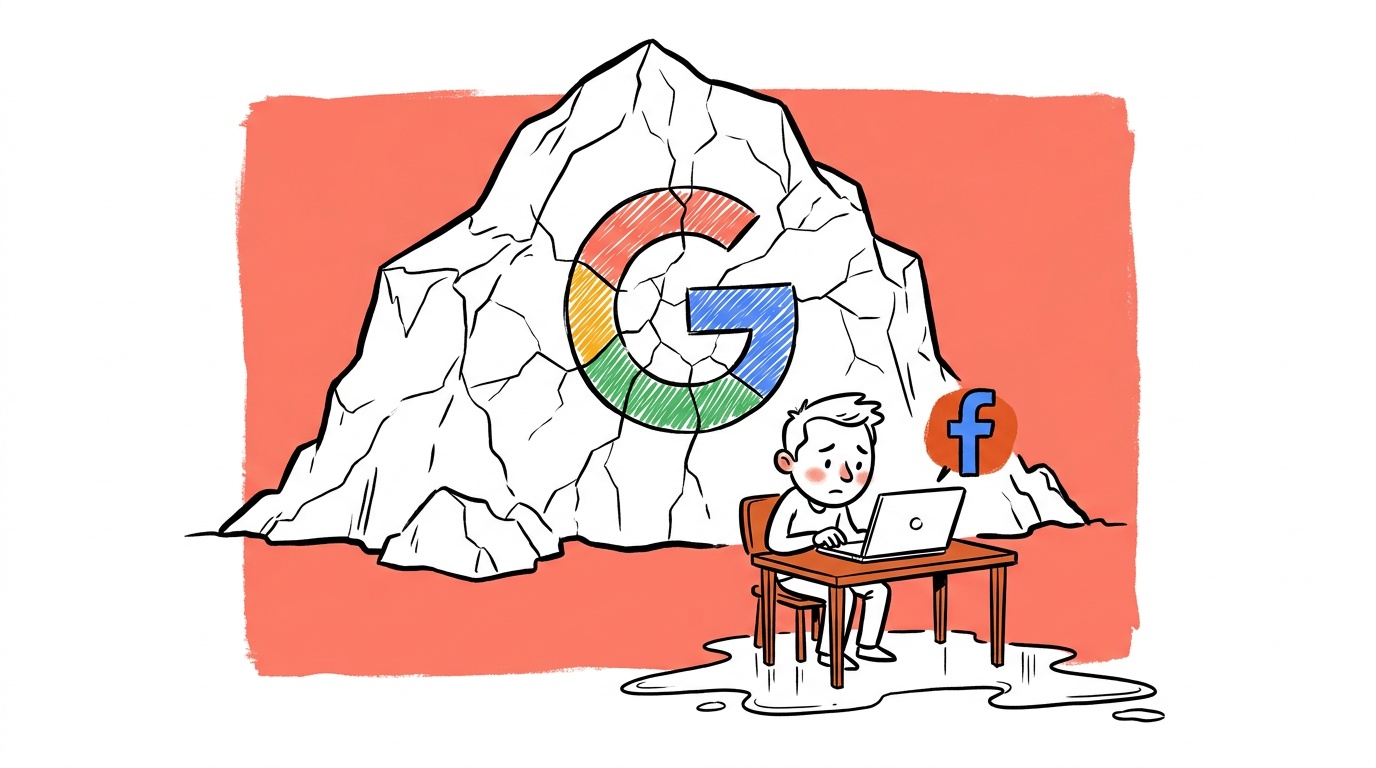
A founder came to us after burning through $4,200 in 11 days with a campaign structure ChatGPT recommended. The bot had told him to use broad match on his core keywords "because Smart Bidding handles the rest." By the time he paused the campaign, 68% of his spend had gone to irrelevant queries — competitors' brand names, how-to searches, and navigational queries for products he didn't sell. The account had fewer than 10 conversions in its history. Smart Bidding had almost nothing to learn from. ChatGPT wasn't hallucinating — every word of its advice had been correct at some point. The problem is Google Ads changes fast and LLMs are frozen.
This post documents the four categories where we consistently see ChatGPT give wrong or dangerously outdated Google Ads guidance, plus a fifth category — Performance Max — where the stakes are even higher. We built this list from our own campaign audits and from the decision-rule engine we use internally at AdControlCenter, which encodes what we actually do for accounts, not what was true in 2022.
- ChatGPT's Smart Bidding advice defaults to Target CPA before you have enough conversion data — Google itself requires at least 30–50 conversions per month before tCPA is reliable.
- It still recommends broad match and Smart Bidding as a universal pairing, which is actively dangerous for small budgets and new accounts.
- Its keyword match type explanations reflect pre-2021 behavior; phrase match and broad match no longer work the way most ChatGPT answers describe.
- Its account structure advice — SKAGs, tightly themed ad groups — was deprecated by Google's own guidance years ago, yet ChatGPT still presents it as best practice.
- There is a narrow set of tasks where ChatGPT is genuinely useful for Google Ads, and those tasks have nothing to do with strategy.
Mistake 1: Smart Bidding advice that ignores your data volume
Ask ChatGPT "how should I bid in Google Ads?" and you'll almost always get a recommendation to use Target CPA or Target ROAS. The advice sounds reasonable. The problem is the threshold that makes these strategies actually work.
Google's own Smart Bidding documentation states that tCPA campaigns need a minimum of 30–50 conversions in a 30-day window to exit the learning period reliably. Target ROAS campaigns carry a higher bar — Google recommends at least 50 conversions with sufficient value variance before tROAS produces stable results. Below those thresholds, Smart Bidding is optimizing against a statistically thin signal. In practice, it guesses, and it guesses expensively.
When we audited campaigns for early-stage founders, the most common pattern was: account has 8–12 conversions per month, Smart Bidding is set to tCPA, CPA is 3–4x what it should be, and CPCs are volatile day to day. ChatGPT's advice got them into this state.
Our decision-rule engine treats conversion volume as a hard gate. If the primary conversion action averages fewer than 30 per month, we do not propose tCPA or tROAS. We propose Maximize Conversions as a transitional strategy and flag the account for review until it accumulates enough signal. The bidding progression we actually use is in how to pick a Google Ads bidding strategy. ChatGPT applies no such gate. It answers for a generic advertiser with an implied mature account — and most founders asking the question don't have that.
Mistake 2: Keyword match types explained with 2020 behavior
This is the most dangerous category because the misinformation is delivered with complete confidence and sounds entirely plausible if you haven't run ads recently.
ChatGPT commonly tells users that phrase match requires the exact phrase in the user's query, in order, with possible words before or after — and that broad match modifier is a useful middle-ground option. Both are wrong. Google retired broad match modifier in July 2021, folding its behavior into phrase match. Phrase match itself was simultaneously expanded to cover queries where the meaning is similar, not just the literal phrase. If you build a campaign on what ChatGPT says phrase match does, you will get more traffic than you expect, from queries you didn't expect, at CPCs you can't predict.
We tested this directly. We asked ChatGPT-4 to explain phrase match in March 2025, without mentioning the year in the prompt. It described pre-2021 behavior — the old literal-phrase-with-words-before-or-after definition — and made no mention of the 2021 expansion. We then ran a phrase match campaign for a B2B SaaS client using that guidance. The keywords ChatGPT suggested "would stay tightly controlled under phrase match" surfaced a wide range of adjacent queries within the first 10 days: job-seeker searches, competitor navigational queries, and informational how-to searches that shared the same root meaning but had no purchase intent. None of those query types would have matched under the pre-2021 phrase match definition.
The real-world rule is simpler than most LLM explanations suggest: broad match is a prospecting tool that requires Smart Bidding and a mature conversion history to stay controlled. Phrase match is your workhorse for mid-funnel. Exact match is for protecting branded terms and your most profitable queries. If you're a small account, start with exact and phrase. Do not use broad until you have 90 days of clean conversion data. The beginner structure that gets from zero clicks to results shows what that looks like in practice.
Mistake 3: Account structure advice from a deprecated era
Ask ChatGPT about Google Ads account structure and there is a reasonable chance it recommends Single Keyword Ad Groups (SKAGs). This was a legitimate strategy — roughly 2016 to 2019 — that gave advertisers granular control over ad copy and Quality Score by isolating one keyword per ad group.
Google killed the conditions that made SKAGs work. Expanded Text Ads were deprecated in June 2022. Responsive Search Ads replaced them and use machine learning to assemble headlines and descriptions dynamically. RSAs perform worse, not better, in ultra-narrow ad groups — they need variation and signal diversity to function. Quality Score calculation also changed; the per-keyword score is less directly tied to ad group structure than it was five years ago.
Our internal rules never produce SKAG structures. For a new Search campaign, we target thematically grouped ad groups with 5–15 keywords each, at least 8–10 RSA assets with genuine copy variation, and assets pinned only where legally or brand-safety required. That threshold reflects RSA quality score mechanics that require asset diversity to give the ML enough to work with.
ChatGPT will sometimes get this right if you prompt it carefully and include the current year in your question. But the default answer — the one most founders get — is still SKAGs or SKAG-adjacent structures. That advice will actively hurt your Quality Scores on RSA-era accounts.
An RSA with 15 headlines and 4 descriptions has over 43,000 possible combinations Google can test. Pinning all headlines and running one keyword per ad group negates this entirely. You've paid for a machine and switched it off.

Live today.
The full campaign — copy, images, targeting — generated for your site and deployed paused for your approval.
Mistake 4: Negative keyword discovery treated as a one-time task
When we ask ChatGPT "how do I build a negative keyword list for Google Ads?", the standard answer describes generating a seed list from brainstorming and competitor research, adding it before launch, and periodically reviewing search term reports. That workflow is directionally correct but misses the most expensive failure mode: negatives that need to be added in the first 72 hours of a new campaign, before the budget has been consumed.
New campaigns with any broad or phrase match keywords will surface irrelevant queries immediately. The search term report lags — it doesn't show 100% of queries, and the data takes time to populate. By the time a founder "periodically reviews" their search terms, they've often spent 40–60% of their first-week budget on garbage traffic.
What actually works: set a daily budget you can afford to lose entirely on day one, check the search term report every morning for the first two weeks, and add negatives aggressively. For categories with obvious pollution — software tools, for example, constantly attract "free," "torrent," and "crack" queries — front-load a negative list from industry-standard exclusions before the campaign goes live.
Our decision-rule engine flags specific patterns when it detects signals like India traffic bleed on broad match or brand-term cannibalization — real failure modes we've seen repeatedly in client accounts. Those flags change how conservatively we initialize match types on a new campaign. ChatGPT has no such memory. Every conversation starts fresh, with no account history, no search term data, and no adjustment for what's already gone wrong.
Mistake 5: Performance Max treated like a regular Search campaign
This is the category where ChatGPT's generic advice causes the most silent damage, because the mistakes don't surface quickly.
When founders ask ChatGPT about Performance Max, the answers typically describe asset groups in terms similar to ad groups — implying you can control targeting by structuring assets carefully. That's not how PMax works. Performance Max campaigns give Google near-total control over where and how ads appear across Search, Display, YouTube, Gmail, and Maps. The levers advertisers actually have are audience signals, asset quality, and conversion goals — not keyword lists or placement targeting in any traditional sense.
The specific failures we see from ChatGPT-guided PMax setups:
- Asset groups built around keyword themes rather than audience intent, which wastes the audience signal input entirely
- Conversion goals left at the account default, which often includes low-value micro-conversions (page views, time on site) that teach the algorithm to optimize for the wrong thing
- No brand exclusions added, so PMax cannibalizes branded Search traffic and inflates reported conversion numbers without generating incremental revenue
- Search themes used as a substitute for proper audience signals, which misunderstands their function
If you're running PMax alongside Search campaigns, the brand exclusion issue alone can make your Search data uninterpretable. ChatGPT's advice on this is usually either absent or wrong.
Before your PMax campaign goes live, add your brand terms as campaign-level negative keywords. Without this, PMax will absorb branded queries that would have converted anyway on Search, report them as PMax conversions, and make the campaign look better than it is.
When ChatGPT is actually right
We want to be honest here, not just critical. ChatGPT is genuinely useful for Google Ads in a specific, narrow category: copywriting scaffolding and ideation.
RSA headline generation, description variants, ad copy for A/B testing, rewriting a headline to fit Google's 30-character limit — all of this works well. ChatGPT doesn't need to know how Google's auction works in 2025 to suggest that "Cut your CAC by 40%" is a stronger headline than "Affordable marketing software."
It's also useful for writing keyword expansion lists from a seed list, as long as you treat the output as a brainstorming draft and validate match types yourself. And it can explain Google Ads concepts accurately at the introductory level — what a Quality Score is, what an impression share means — where the definitions haven't changed much.
The failure mode is when founders treat it as a strategist. It's a fast, articulate research assistant with a knowledge cutoff. Use it accordingly.
ChatGPT: headlines, descriptions, keyword brainstorming, explaining what a metric means. Not ChatGPT: bid strategy, account structure, match type selection, negative keyword workflow, Performance Max setup.
A verification checklist before you act on any ChatGPT Ads recommendation
| ChatGPT recommendation | What to verify | Where to check |
|---|---|---|
| Use Target CPA / Target ROAS | Conversion volume in past 30 days | Google Ads conversion report |
| Phrase match will "stay controlled" | Current match type behavior post-2021 | Google match types documentation |
| Use SKAGs for tighter control | Whether ETAs are still available | RSA migration guide |
| Review negatives monthly | Date of last search term report review | Search terms report, filtered by last 7 days |
| Structure PMax like ad groups | Actual PMax control levers | PMax overview documentation |
FAQ
Does ChatGPT know about the latest Google Ads updates? No. ChatGPT's training has a cutoff date, and Google Ads changes frequently — major updates to match types, bidding strategies, and ad formats ship multiple times per year. For anything structural or strategic, verify against Google's own documentation or a dated practitioner source, not an LLM answer alone.
Is it safe to use ChatGPT to write Google Ads copy? Yes, with review. ChatGPT is useful for generating RSA headline and description variants, rewriting for character limits, and A/B testing ideas. It doesn't need current platform knowledge to write good ad copy. Always review output against Google's editorial policies before uploading.
What bid strategy should a new Google Ads account use? For accounts averaging fewer than 30 conversions per month on their primary conversion action, Maximize Conversions is safer than Target CPA. It doesn't require a CPA target and won't over-constrain delivery while the account learns. Switch to tCPA after you've hit 30 or more conversions per month consistently.
Are SKAGs still a good Google Ads structure? No. SKAGs made sense when Expanded Text Ads were the standard format. Responsive Search Ads replaced ETAs and perform better with asset variety and thematically grouped keywords. A modern ad group should have 5–15 related keywords and at least 8–10 distinct RSA assets.
How often should I review the search terms report? Daily for the first two weeks of any new campaign, especially with broad or phrase match. The search term report doesn't show every query, but it shows enough to catch expensive mismatches early. After the first month, weekly reviews are usually sufficient for established campaigns with stable performance.
What is the minimum conversion volume for Target ROAS campaigns? Google recommends at least 50 conversions in the past 30 days as a baseline for tROAS, with sufficient value variance so the algorithm has a real distribution to optimize against. Below this, results are erratic. Start with Maximize Conversion Value without a ROAS target and layer the target in once performance stabilizes.
Can I trust ChatGPT's advice on Performance Max campaigns? Only for copy and asset ideas. ChatGPT consistently misframes PMax as a keyword-targetable campaign type and underemphasizes the importance of conversion goal setup, brand exclusions, and audience signals. These are the exact settings that determine whether PMax helps or cannibalizes your other campaigns. Verify any structural PMax advice against Google's current documentation before acting on it.
Before you act on any ChatGPT Google Ads recommendation, ask one question: does this require current platform knowledge? If yes — bid strategies, match types, account structure, ad formats, PMax setup — verify it against a dated source. If no — copy, naming conventions, brainstorming — use it freely. The problem isn't that ChatGPT is wrong. The problem is that it doesn't know which category it's answering in, and it won't tell you when it doesn't know.
Live today.
The full campaign — copy, images, targeting — generated for your site and deployed paused for your approval.
We build AdControlCenter — AI-powered ad management for small businesses, online stores, SaaS companies and service providers. We write what we'd want to read: real numbers, no fluff, the things we wish we'd known when we started.
More from the team →